Managing Fleet Costs in an Era of Permanent Volatility
Fleet operating costs have risen more than 20% since 2020, raising a key question: When does extending a vehicle's service life stop making financial sense?
From fuel and maintenance to vehicle acquisition and replacement cycles, rising costs are forcing fleet managers to balance immediate budget pressures against the long-term expense of keeping vehicles in service.
Credit:
Automotive Fleet | Edited with OpenAI
8 min to read
Fleet operating costs have surged by over 20% since the year 2020, prompting concerns for fleet managers.
Analyzing when to extend a vehicle's service life is crucial for cost-effective fleet management.
The concept of permanent volatility impacts decision-making in managing fleet operations.
*Summarized by AI
“Judging from today’s ongoing supply chain disruptions, the unexpected may be the new norm, and fleets need to prepare for that.”
That was the final line from a 2021 Automotive Fleet article that detailed how supply-chain disruptions upended vehicle production and fleet replacement schedules.
Ad Loading...
Five years later, the prediction is still valid. Wars in Eastern Europe and the Middle East, along with widespread tariffs, have introduced new uncertainty even as vehicle availability has improved.
The semiconductor shortages and reduced fleet allocations of 2021 may be behind us, but the challenge remains: building budgets and replacement plans around costs that may never be predictable again.
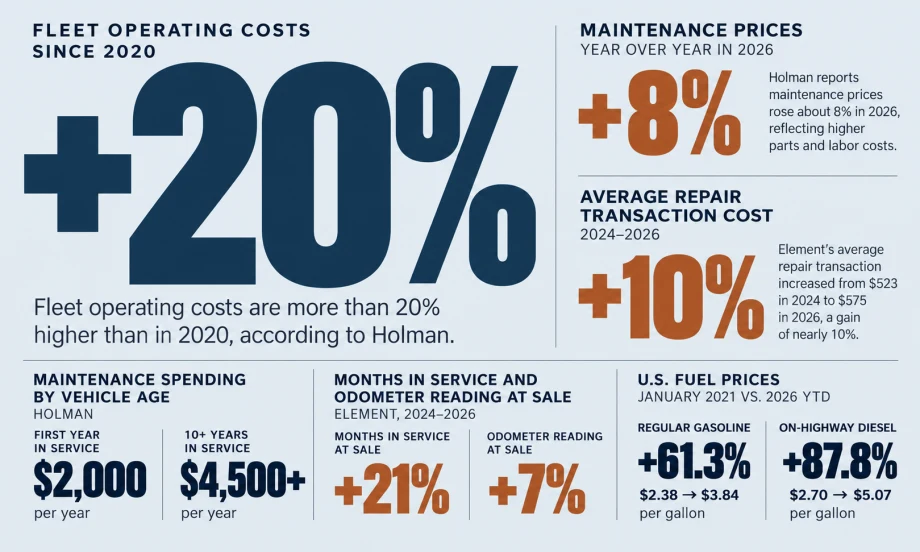
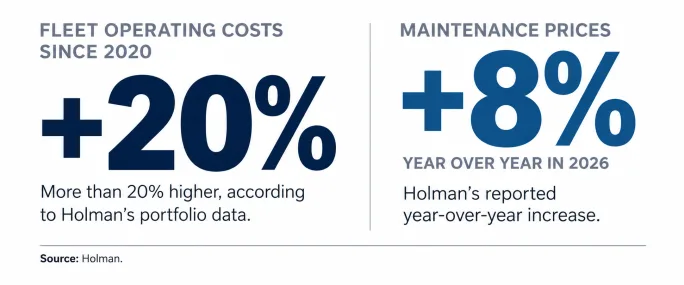
According to Ed Powell, director of consulting services at Holman, fleet operating costs remain more than 20% above 2020 levels, with maintenance, vehicle acquisition, and fuel as the most significant pressures.
Element Fleet Management's Strategic Advisory Team reports a similar convergence of expenses. Fuel, maintenance, financing, and aging assets are all affecting budgets simultaneously, leaving less room for inefficient vehicle specifications, underutilized assets, or poorly timed replacements.
Persistent cost increases are forcing fleets to rethink vehicle specifications and replacement cycles.
Credit:
Holman and Automotive Fleet | Edited with OpenAI
The Fuel Cost Yo-Yo
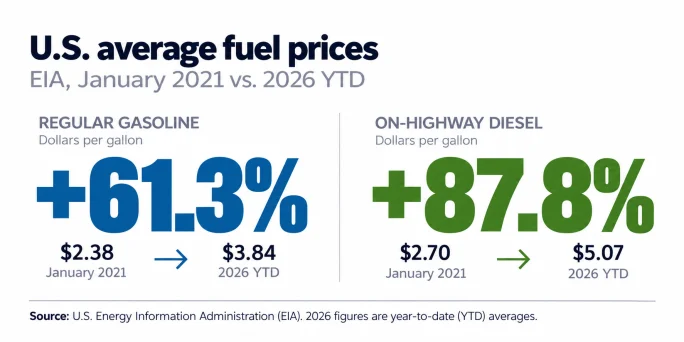
According to the U.S. Energy Information Administration (EIA), average U.S. retail gasoline prices rose from about $2.38 per gallon in January 2021 to $3.84 in 2026 year-to-date (Oct. 16), a 61.3% increase.
Diesel prices climbed even more sharply over the same period, from about $2.70 to $5.07 per gallon, an 87.8% increase.
Element's U.S. portfolio data show average fuel prices rising from $2.80 in the first quarter of 2026 to $4.22 in the third quarter, a rise of almost 51% over three quarters.
The company projects its fuel spending will exceed budget by approximately 25% by year-end. Stevenson said the increase was unexpected, with diesel purchases at record highs.
Essential Utilities has responded partly through vehicle selection, adding more four-cylinder pickups to improve fuel economy.
Hilti, manufacturer of equipment for the construction and building industries, has faced similar pressure. "Fuel is our biggest bucket increase so far in 2026," said Taylor Murphy, Hilti's fleet vehicle manager.
The company has offset some of the increase through improved fuel efficiency and continues to replace older, fuel-intensive internal combustion engine vehicles with hybrids and battery-electric vehicles where appropriate.
Fuel remains one of the least predictable fleet expenses in 2026, complicating budgets and reinforcing the importance of vehicle efficiency.
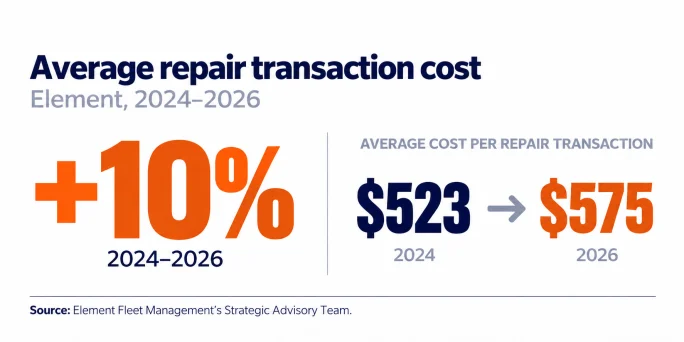
Holman reports maintenance prices rose about 8% year over year in 2026, reflecting higher parts prices and labor costs. Element's portfolio data show average repair transactions increasing from $523 in 2024 to $549 in 2025 and $575 in 2026.
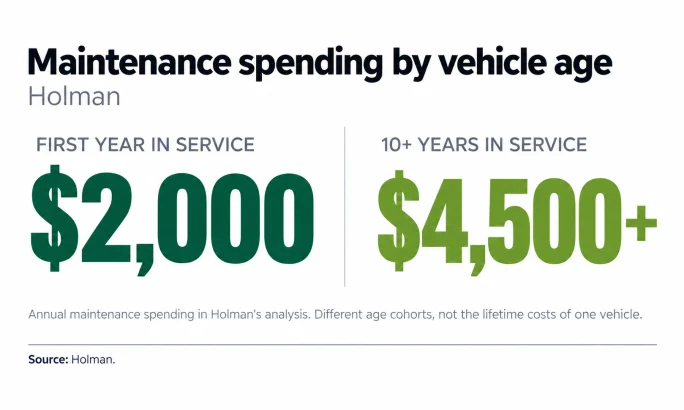
Vehicle age compounds the problem: Holman's analysis puts annual maintenance spending at approximately $2,000 per vehicle in its first year of service, compared with more than $4,500 for vehicles 10 years or older.
That is particularly consequential for fleets that extended vehicle lifecycles during the supply shortages and have not yet returned to their previous replacement schedules.
Repair Environment — A Mixed Bag
The repair environment has improved in some respects.
Justin Lisonbee, assistant vice president of fleet operations at Enterprise Fleet Management, said parts availability is considerably better than it was several years ago, and widespread supply-chain disruptions have become less common.
However, Mike Albert Fleet Solutions points out continuing pressure from specialized parts, labor, and vehicle technology.
Jenny Baker, manager of fleet maintenance at Mike Albert, expects these pressures to persist into 2027, even if the pace of year-over-year cost increases moderates.
Some encouraging news: TechForce reports that automotive training completions increased in the latest academic year, and collision-repair graduates rose 14.2%. That suggests the training pipeline is improving, though it still falls short of projected demand.
Higher repair costs are changing the economics of keeping older vehicles in service, particularly when downtime is factored in.
Credit:
Element and Automotive Fleet | Edited with OpenAI
Vehicle Availability Improves, but Replacement Costs Remain High
One of the clearest changes since the supply-chain crisis is improved vehicle availability.
According to Jess Cramer, vice president of fleet strategy and vehicle acquisition at Enterprise Fleet Management, ordering has become more predictable, though certain commercial configurations and high-demand vehicles can still be difficult to source.
Acquisition costs remain elevated. Most vehicle segments are experiencing low-single-digit price increases, Cramer said.
Jason Kraus, vice president of operations at Mike Albert Fleet Solutions, said factory-order availability has generally improved, but vehicle prices keep rising as manufacturers add equipment and safety technology.
Kraus said fleets buying from dealer stock may face a shortage of lower-cost base trims, with available inventory weighted more toward mid-level and higher trim packages.
That can force a fleet to pay for equipment it doesn't need, especially when it needs a replacement vehicle immediately.
Element's sales-fleet data illustrates the longer-term acquisition-cost trend. Average factory-order capitalized costs increased from approximately $40,800 for model-year 2023 vehicles to $44,500 for model-year 2026 vehicles, an increase of about 9%.
Resale values offer some relief. Holman reports favorable conditions for certain fleet assets, although Cox Automotive's Manheim Used Vehicle Value Index declined 0.6% year over year in September. How much a fleet recovers at resale remains an important variable in the replacement calculation.
5 Ways to Control Fleet Operating Costs in 2027
Based on interviews with fleet managers and fleet management companies, these five strategies offer practical opportunities to contain costs in the year ahead.
1. Prioritize high-cost vehicles for replacement: Rather than extending replacement cycles across the board, identify vehicles with rising maintenance costs, frequent repairs, and excessive downtime. Compare the cost of keeping them against replacement.
2. Reevaluate vehicle specifications: Could a midsize pickup replace a half-ton, or a 4x2 handle work currently assigned to a 4x4? Match vehicle capabilities to actual job requirements and eliminate unnecessary equipment.
3. Review fleet utilization and eligibility: Identify underused vehicles that could be reassigned or eliminated. Revisit employee vehicle eligibility policies to ensure assignments reflect current business needs.
4. Plan replacement orders earlier: Factory ordering can reduce acquisition costs and provide greater control over specifications. Account for upfit lead times to avoid costly last-minute purchases.
5. Target avoidable fuel and maintenance expenses: Use telematics and fuel-card data to identify excessive idling, unnecessary mileage, and inefficient routing. Monitor preventive maintenance compliance to help prevent costly breakdowns.
Aging Fleet Meets Remarketing Timing
Holman reports that replacement orders from 2023 through 2025 ran more than 40% below the levels it recommended for the fleets analyzed. The company estimates that average fleet vehicle age is approximately six years, with a concentration of older assets in their 10th and 11th years of service.
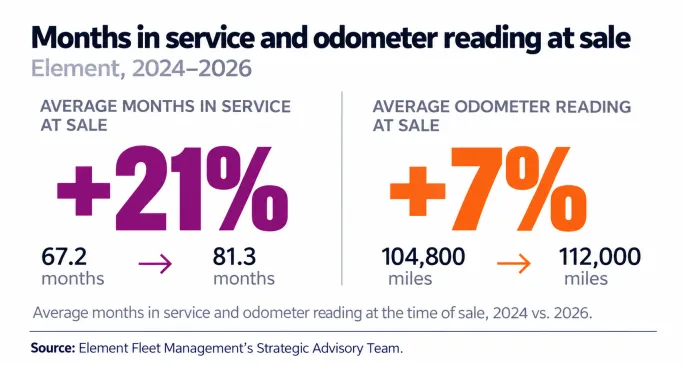
Element's service-fleet remarketing data shows a similar trend. Average months in service rose from 67.2 in 2024 to 81.3 in 2026, an increase of about 21%.
Yet average odometer readings at sale increased only about 7% over the same period, from approximately 104,800 to 112,000 miles.
Why would fleets keep vehicles longer without accumulating substantially more mileage?
One explanation is that fleets are retaining older vehicles as spares to cover extended repair downtime, collision repairs, or replacement delays. An older vehicle has already absorbed much of its depreciation, so keeping it as a backup may cost less than buying a replacement.
The widening gap between vehicle age and mileage suggests some fleets may be retaining older vehicles for backup capacity rather than daily use.
Credit:
Element and Automotive Fleet | Edited with OpenAI
Hold, or Replace?
Hilti has kept some older, lower-mileage vehicles, but Murphy said rising transmission, engine, and electrical repair costs make continued operation less attractive.
Replacing those vehicles, however, could increase lease costs by a mid-teens percentage, creating another challenge for the company's operating-expense forecast.
Essential Utilities faces a similar problem. Stevenson said the company cannot increase its 2027 replacement budget despite rising vehicle and equipment prices. Instead, it must identify the existing vehicles with the highest operating costs and determine which replacements will deliver the greatest benefit.
Fleetio's 2026 benchmarking data shows that vehicles 10 years and older accounted for 12% of miles driven but 34% of service spending. Still, age alone shouldn't dictate replacement.
“There’s no set age or mileage when an asset becomes cheaper to replace,” said Dan Simpson, manager of product marketing at Fleetio. “It comes down to what you expect to spend keeping it running compared with what a replacement would cost to do the same job over the same period.”
The question is not whether older vehicles cost more to maintain. Generally, they do. It is whether those additional costs exceed the expense of replacing them under current market conditions.
Collision Repairs Add Cost and Complexity
Collision repair presents another challenge, especially as vehicle technology changes what it takes to return damaged vehicles to service.
Robert Martines, CEO of Corporate Claims Management, said replacement parts, specialized materials, labor, and vehicle electronics continue to increase repair expenses.
He cited a door skin that previously cost $250 can now cost $400 or more.
Modern vehicles also require additional procedures when cameras, radar sensors, and other safety systems are affected. Repairs that once involved replacing a bumper, mirror, windshield, or headlamp may now require diagnostic scans and recalibration of ADAS components.
Martines estimates that associated diagnostic and calibration procedures can add hundreds of dollars, and in some cases $500 to $1,500, to a repair.
Repair complexity can also affect downtime. Vehicles may require specialized facilities, additional technician hours, or multiple steps before they can return to service.
For fleet managers, collision costs extend beyond parts and labor to replacement transportation, employee productivity, and potential insurance implications.
Extending replacement cycles can preserve capital, but the maintenance burden becomes harder to justify as vehicles age.
Credit:
Holman and Automotive Fleet | Edited with OpenAI
Finding Savings in What Fleets Can Control
Although fleets have little influence over fuel markets, vehicle manufacturers' pricing, or broader labor conditions, they still control vehicle selection, utilization, and operating practices.
One strategy gaining renewed attention is right-sizing.
Rather than replacing each vehicle with a newer version of the same model, fleets are reassessing the actual work the vehicle performs.
Alexa Rubin, manager of truck upfit at Mike Albert Fleet Solutions, said some work truck fleets are designing specifications around the jobs vehicles perform most frequently rather than the most demanding task they might occasionally encounter.
Kraus said fleets are reconsidering whether every application needs a half-ton pickup or whether midsize models could do the job. They are also evaluating which duty cycles need four-wheel drive, particularly in regions where road conditions and operating requirements do not justify it.
For suitable duty cycles, hybrids can reduce fuel consumption without the charging infrastructure and operational adjustments required by battery-electric vehicles.
Planning for 2027 Without Assuming Stability
Some cost pressures may moderate in 2027, helped by better vehicle availability and fewer supply-chain disruptions. But lower inflation doesn't necessarily mean lower operating costs.
Fuel remains unpredictable, while aging vehicles and increasingly complex repairs continue to strain maintenance budgets. Higher acquisition costs also make replacement decisions more consequential.
With little certainty about where costs are headed, fleet managers will need to concentrate on the expenses they can influence. One thing remains true in the fleet environment of 50 years ago, today, and the future: There are always opportunities to improve operating efficiency without compromising the fleet's ability to support the business.
Fleet operating costs have risen due to a combination of factors, including increased labor expenses, fuel price volatility, supply chain disruptions, and rising maintenance and repair costs. These combined conditions have resulted in higher operational expenses for fleet managers.
Key factors include the vehicle's current mileage, maintenance history, the cost of repairs, depreciation rates, and how these compare to the cost of acquiring a new vehicle. Fleet managers must evaluate whether maintaining the current vehicle is more cost-effective than investing in new assets.
Vehicle depreciation affects the resale value of a fleet vehicle. As a vehicle ages and accumulates mileage, its value decreases, which can impact the total cost of ownership. Extending the service life might reduce depreciation costs temporarily but can also lead to higher maintenance expenses.
Fleet managers can utilize strategies such as implementing preventive maintenance schedules, optimizing routes to reduce fuel consumption, negotiating better supplier contracts, and investing in telematics for better vehicle tracking and efficiency.
It no longer makes financial sense to extend a vehicle's service life when the cost of maintenance and repairs surpasses the cost-benefit of acquiring a new vehicle. This includes considering factors such as reduced vehicle performance, increased downtime, and potential safety concerns.
Fleet operating costs have risen more than 20% since 2020, raising a key question: When does extending a vehicle's service life stop making financial sense?
Nearly eight in 10 surveyed fleets allow personal use of company vehicles, while just over half of respondents report charging employees for the privilege.
Insights from a commercial insurance carrier and a broker show how fleets can turn video telematic data, driver coaching, and improved claims results into a stronger case at insurance renewal.
Five fleet professionals — none with programming skills — discuss how they’re using AI to build fleet solutions in-house and in a fraction of the time.
Vincentric’s three-year, 60,000-mile projections reveal wide differences for both scheduled and unscheduled maintenance among selected vehicle categories. Projected maintenance visits also play a factor.
A vehicle health score could improve the value of fleet vehicles at remarketing. The path to a universal standard is forming, and fleets that understand the process early will be better positioned when it arrives.
AI is no longer a luxury but the baseline for profitability in 2026. Auto haulers that adopt these tools now will quickly outpace those that use manual workflows or take a wait-and-see approach.
The repair crisis gets blamed on technician shortages and parts delays. But a big part of the problem is what's happening before the vehicle even reaches the shop, and that's within your control.