




Operations
Fleet Personal-Use Charges Edge Higher in 2026
Nearly eight in 10 surveyed fleets allow personal use of company vehicles, while just over half of respondents report charging employees for the privilege.
 MENU
MENU SEARCH
A vehicle health score could improve the value of fleet vehicles at remarketing. The path to a universal standard is forming, and fleets that understand the process early will be better positioned when it arrives.
Connected-vehicle data is giving fleets a new way to document vehicle health and potentially improve resale performance at remarketing.
Automotive Fleet
You can spend years doing everything right with your fleet vehicles: Meet the PM schedules, address every diagnostic code, and counsel your drivers to ease up on the lead foot.
However, even with your self-built maintenance Code of Excellence, that value doesn’t necessarily translate to secondary buyers, who rely on long-standing visible metrics such as mileage, interior and exterior appearance, tire tread depth, and whether the vehicle sounds normal when started.
Yes, Carfax and Experian AutoCheck do a good job identifying the 2-4% of vehicles with serious historical issues such as accidents, flood damage, or total losses, but the rest fall into an average, leaving fleets that maintain their vehicles carefully paying the price.
That paradigm is beginning to change. The data is there; the question is how to get it from the vehicle to the buyer at the moment of sale.
Connected-vehicle data is giving fleets a new way to document vehicle health and potentially improve resale performance at remarketing.
Motorq
As of today, 96% of new vehicles sold in the U.S. have factory-installed, embedded modems that can transmit up to 200 data points, such as vehicle health information, driver behavior, electrical system status, fuel-efficiency patterns, oil-life management, and powertrain diagnostics in near-real time.
About 85% of lease returns are now connected, while fleets that cycle through vehicles more slowly have a connected share of 65%.
While those percentages are increasing every year, telematics-enabled fleets can connect the rest via aftermarket modems.
Both connections generate rich vehicle data. The challenge is that they generate it in different formats and store it in different systems without a reliable, standardized path to the remarketing transaction.
Motorq, a software company that normalizes and interprets OEM-sourced vehicle data from major manufacturers and provides vehicle insights, has been working on making that connection.
The company was approached by JD Power and a major auction house to understand if vehicle data could be used to produce a health score based on the data the vehicle was generating.
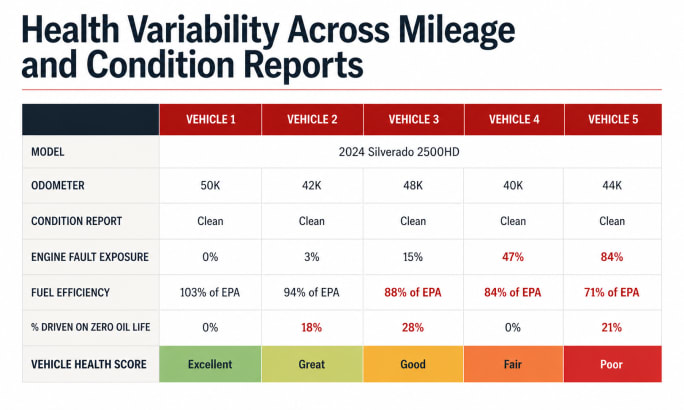
Working with a large fleet customer operating tens of thousands of vehicles, Motorq examined health data from about 14,000 pickups from model years 2018 through 2025, focusing on the last 2,000 miles of driving history.
Within this set, Motorq then compared five 2024 Chevrolet Silverado 2500s with odometers in the 40,000-to-50,000-mile range and carrying condition reports of 4-plus.
What made the comparison striking was that all five trucks appeared virtually identical through the lens of a traditional auction condition report. Each carried a “clean” condition assessment, yet once connected-vehicle data was layered in, the differences became substantial.
One truck showed no engine-fault exposure at all and achieved fuel economy slightly above EPA estimates, earning an “Excellent” health score. Another recorded engine fault exposure of 84%, fuel efficiency at only 71% of EPA expectations, and more than 20% of its miles driven after the oil life monitor had reached zero, resulting in a “Poor” health score.
Between those extremes were vehicles that looked nearly identical on paper but displayed varying levels of mechanical stress and maintenance discipline. One truck had driven 28% of its miles with zero oil life remaining. Another showed a sharp decline in fuel efficiency despite no visible issues in the condition report.
The data suggested that traditional remarketing metrics alone may miss meaningful differences in how vehicles were operated and maintained during their service life. In effect, connected vehicle data introduced a second layer of evaluation — one capable of identifying hidden operational patterns that are otherwise invisible at auction.
Motorq’s analysis also found that fuel efficiency trends frequently correlated with broader powertrain health indicators. Trucks with elevated engine fault exposure often showed lower real-world fuel economy, suggesting that operational inefficiencies can surface in the data long before they become visible during a physical inspection.
"If you relied on the condition report, all these looked the same," said Arun Rajagopalan, CEO and co-founder of Motorq. "If you add data, it looks a lot different. When you talk to the car, it can tell you a lot."
Regarding the discrepancies, Rajagopalan drew a medical analogy: A standard condition report at auction is equivalent to the basic vitals — blood pressure, oxygen saturation, and temperature.
Connected vehicle data, however, is like a blood test, which gives a much more comprehensive view of the patient, the layer that doesn’t transfer to the secondary buyer.
For vehicles with internal combustion engines, the case for connected vehicle health data is compelling, but even more so for electric vehicles.
A fleet vehicle with an ICE powertrain can at least be visually inspected for some indicators of condition. An EV battery — the vehicle’s most meaningful value contributor — cannot be inspected using traditional methods.
There is a growing market of diagnostic platforms that measure EV battery health, but again, it's all about communicating that health at resale.
"You may not have to worry about it right now," Rajagopalan said of EV battery health data, "but you will at some point, and the next buyer will want this data.”
So, how does connected vehicle health information get from the car to the next buyer?
Motorq's answer is a certificate that communicates the vehicle's mechanical and electrical health in a standardized, readable format. The certificate appears as a separate document, displayed alongside existing reports such as CarFax or Experian AutoCheck, and is being deployed through auction partners.
JD Power’s tests compared identical vehicles sold with and without a health certificate and showed a value gain of 2 to 5% on vehicles carrying the cert. At fleet scale, that is a meaningful number.
Carfax gained acceptance as it grew incrementally. Could the idea of a health certification follow similarly? "Just like a clean Carfax report today is table stakes," Rajagopalan says, "at some point, a vehicle health report, we believe, will become table stakes too."
The consent framework for accessing vehicle data is being established. OEM partnerships are consent-based, and for fleets that have been working with Motorq throughout a vehicle's life, that consent is already in place.
What remains to be built, Rajagopalan acknowledges, is awareness, from the dealers and auctions to the consignors, secondary buyers, transport providers, FMCs, upfitters, and industry as a whole.
There may be no direct path yet — no single action a fleet operator can take today that will reliably translate their vehicle data into better auction outcomes tomorrow. But there are things worth doing now to prepare.
Know what data you have. Many fleet operators have been running telematics platforms that have been capturing vehicle health and operational data for years, without considering it from a resale value perspective.
Record and analyze fault code histories, fuel efficiency trends, maintenance records, and driver behavior data. Understand what your telematics provider captures, how long it is retained, and whether it can be exported in a useful format.
Nearly every new vehicle you add to your fleet today is factory-connectable. Make data access a condition of acquisition. OEM-supported programs, such as Motorq, allow fleets to secure that data stream as part of the vehicle purchase price.
Start asking your OEM, fleet management company, FMIS providers, and telematics partners how they can process and use the data. The immediate response might be, “We can’t, yet.” But just understanding what this picture looks like is a start.
These suppliers are developing reporting tools that can surface vehicle health summaries alongside operational data. Engage with them on data portability and remarketing documentation.
Fleets with EVs or EV plans need to treat battery health data as an asset, as those able to demonstrate this data at remarketing will have an advantage as the EV market matures.
The fleets that understand what their data says and start thinking now about how that data could travel to a secondary buyer will be ready when the path opens up.
In the retail environment today, sellers get better returns on vehicles with a history report, and buyers are more receptive. In the future, fleets may operate in an environment where buyers expect not only a record of accidents and title events but also proof of how the vehicle performed mechanically throughout its life.
The fleets that begin organizing and understanding that data will be in the strongest position when health certificates and standardized scoring systems become more widely adopted.
In a connected era, resale value may increasingly depend not only on how a vehicle looks but also on what its data reveals.
Loading data...

Operations
Nearly eight in 10 surveyed fleets allow personal use of company vehicles, while just over half of respondents report charging employees for the privilege.




Safety
Insights from a commercial insurance carrier and a broker show how fleets can turn video telematic data, driver coaching, and improved claims results into a stronger case at insurance renewal.
Fleet Forward
Five fleet professionals — none with programming skills — discuss how they’re using AI to build fleet solutions in-house and in a fraction of the time.
Maintenance
Vincentric’s three-year, 60,000-mile projections reveal wide differences for both scheduled and unscheduled maintenance among selected vehicle categories. Projected maintenance visits also play a factor.
State of the Fleet Industry
Most organizations misunderstand fleet. The best managers make sure that doesn’t happen.
Remarketing
A vehicle health score could improve the value of fleet vehicles at remarketing. The path to a universal standard is forming, and fleets that understand the process early will be better positioned when it arrives.
Technology
AI is no longer a luxury but the baseline for profitability in 2026. Auto haulers that adopt these tools now will quickly outpace those that use manual workflows or take a wait-and-see approach.
Fleet Forward
The job hasn’t changed, but the expectations have. Do you have a plan on how to use AI to thrive?
Maintenance
The repair crisis gets blamed on technician shortages and parts delays. But a big part of the problem is what's happening before the vehicle even reaches the shop, and that's within your control.
Remarketing
Smart remarketing begins before vehicles enter the fleet, and is built on strong data and stronger FMC partnerships.
State of the Fleet Industry
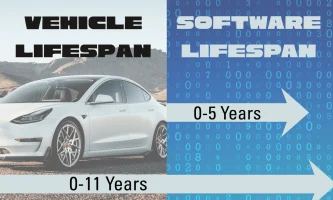
When the US’s largest EV manufacturer discontinues a model, it gives me pause to consider the software that drives it.
Operations
Here’s what is keeping fleet managers up at night this year, and what they're doing about it.
Leasing
As costs rise and scrutiny increases, fleets are refining criteria that govern eligibility for company-owned vehicles.