
February 1, 2026
11 Fleet Managers Describe Challenges, Opportunities for 2026
Here’s what is keeping fleet managers up at night this year, and what they're doing about it.
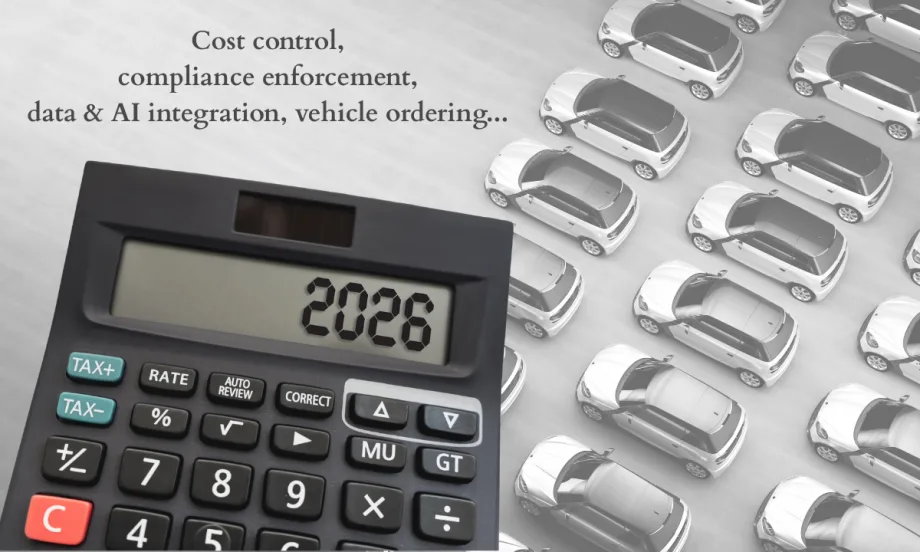
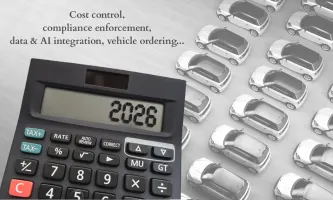
Budget constraints top the list of operational headaches for fleet managers entering 2026, compounded by challenges involving insurance, vehicle procurement, and technology integration.
Image: Automotive Fleet
8 min to read
How are fleet managers approaching the year ahead? What do they see as their challenges and opportunities?
Automotive Fleet asked 11 fleet managers to weigh in on three questions:
- What's your biggest operational headache going into 2026?
- What's one thing you're planning to do differently in 2026 compared to 2025?
- What's one trend or technology you're watching closely (whether you’re ready to adopt or not)?
Their responses reveal that the challenges aren't any single issue, but rather multiple pressures surrounding budget constraints, OEM unpredictability, technology adoption, compliance management, and data integration.
And how close are we to using robots in fleets?
Biggest Headaches for 2026
While budget constraints remain the most immediate pressure, fleet managers also cite workforce compliance, vehicle order unpredictability, and data integration as significant operational hurdles.
1. Cost Containment with a Tighter Budget
For many fleet managers, 2026 begins with the same issue as recent years: doing more with less.
Bob Adamsky, fleet manager at AWP Safety, points to the challenge of meeting lifecycle targets under financial pressure. His biggest operational headache is “completing the replacement lifecycle targets on a reduced budget,” while still being asked to deliver the same outcomes.
Cost escalation is also concerning for Jen VrMeer, fleet manager for BD, a global medical device company. She cites “the continuous rise of costs in all aspects of fleet (except fuel so far),” compounded by “the ongoing unpredictable nature of various OEMs’ model capacity, build-out dates, start-up dates, etc.”
Jeb Lopez, owner and CEO of Wheelz Up, a delivery and courier service, is worried about rising insurance premiums (a recent 6% increase), even with drivers’ clean safety records.
“Mid-sized operators like us can't access the captive insurance options available to national fleets, yet we're competing against 1099 networks that sidestep these costs entirely,” he said, noting the cost disadvantage of running W-2 employees because dealership customers need that reliability.
2. Training, Compliance, Vehicle Ordering, and Data
Other fleet managers report policy coordination, training and compliance, vehicle order timing, and data integration as their biggest headaches.
Ernie Garcia, director of fleet management and business systems at Gothic Landscape, describes a tie between “equipment operators needing training to reduce misuse” and “driver onboarding compliance,” particularly when trying to standardize workflows across three states in a way that is both auditable and practical.
Lisa Kneggs, fleet manager for Farmer Brothers, sums up her challenge as timing. “Using a crystal ball to predict and plan,” she said. From factory to upfit to shipping and final delivery, “there is no surety in any answer.”
Operational coordination also remains a challenge in smaller or specialized fleets. Al Saunders, fleet manager for the San Diego Humane Society, points to the complexity of aligning with Humane Law Enforcement on vehicle retirements, replacements, upfit requirements, and public-facing markings — noting that “they are not willing to see anything retired.”
Tim Lovett, fleet manager at Cameron Enterprises, cites ongoing delivery delays and inconsistent order bank timelines, which have forced vehicles to stay in service longer, increasing maintenance costs and affecting residual values.
Linda Ellis, global fleet lead at UCB, points to inefficiency driven by manual processes and fragmented data. Without a trusted, aggregated data source, resolving driver complaints and maintaining accuracy becomes “time-consuming tasks that should be more automated and readily available.”
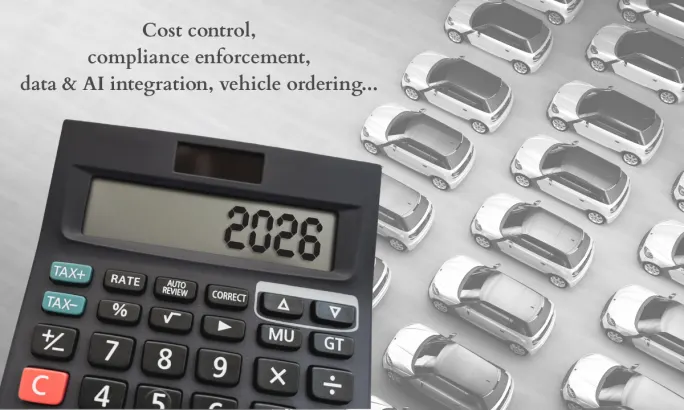
Budget constraints top the list of operational headaches for fleet managers entering 2026, compounded by challenges involving insurance, vehicle procurement, and technology integration.
Image: Automotive Fleet
3. Managing the Basics and Multiple Problems
David Hayward, director of fleet management at ABM Industries, sees the issue more broadly. “Fleet problems rarely arrive one at a time. They stack,” he explains. Tariffs, OEM volatility, and pricing pressure are all occurring simultaneously, “against a backdrop of flat budgets and lean teams.” The result is fleet being asked to “deliver certainty in a world that no longer offers it.”
Amy McAdams, CAFM, fleet manager for Diebold Nixdorf, highlights disruption to core programs. “Sometimes it’s the basics that cause the most pain,” she said. Even small policy changes can throw fuel or maintenance programs off its axis,” which can compound issues if communication and expectations are not well managed.
SuYvonne Bell, associate director, sales operations at Gilead Sciences, highlights industry-wide uncertainty as her biggest headache, naming tariffs, affordability pressures, and what she describes as “the first truly massive shift in modern fleet management,” which is challenging FMCs to adapt their operating models and service delivery.
“Together, these factors are making long-term planning and cost predictability more challenging than ever,” she said.
What's the common thread? While cost containment is a perennial problem, fleet managers are facing many pressures that are compounding all at once.
Fleet Managers Are Employing These Strategies for 2026
Fleet managers are responding with strategies such as elevating compliance metrics and pursuing standardization, adjusting vehicle ordering timelines, improving data visibility, and rethinking decision-making to build greater resilience.
1. Compliance as a Core Metric
Like Garcia, Adamsky is managing compliance issues. He plans to make compliance a core performance metric in 2026. “Include fleet compliance status in core fleet reporting metrics,” he said. He is also pushing his FMC to “provide real metrics for our business, not what the FMC wants to publish.”
VrMeer is rethinking interim rentals, which have become significantly more expensive. With high driver turnover, BD has relied on rentals to bridge gaps, but in 2026 she plans to explore alternatives such as out-of-stock dealer ordering and building more surplus inventory. She will also scrutinize the replacement schedule “unit by unit.”
2. Standardization That Is Scalable
McAdams is prioritizing standardization. In 2026, she plans to ensure changes and decisions are made “with standardization in mind,” while keeping operations engaged when vehicle specifications or program elements need to change.
Garcia is focused on scalability, pushing “a standardized, scalable structure in the shops” to better support growth.
3. Vehicle Order Adjustments to Improve Efficiencies
For Kneggs, 2026 marks a return to ship-thru ordering. By routing vehicles through dealers closer to final destinations, she hopes to reduce transportation costs compared to shipping units from upfitters to end locations.
Lovett plans to adjust order timing, moving up order parameters to 60,000 miles instead of 70,000 to better accommodate delivery challenges.
4. Planning for On-Time Maintenance Intervals
Saunders is taking a more hands-on approach to maintenance scheduling, shifting responsibility away from primary users (the drivers) which resulted in missed maintenance intervals. He has begun proactively scheduling preventive maintenance and tracking follow-ups.
In addition to using his FMC's database to record all maintenance, Saunders is working with Outlook Task Manager to track actions that are pending, in progress, or complete.
5. New Data Tools for Measurable ROI
Ellis is piloting a supplier-agnostic, single data solution to provide global visibility across UCB’s fleet footprint. “If I can trust the data, I can run a successful program,” she said, emphasizing visibility as a foundational requirement in an uncertain environment.
Lopez is investing heavily in AI-powered dashcams, driver training, and telematics to demonstrate to insurers that his drivers are safer than industry averages. “Insurers are increasingly using real-time risk scoring based on driver behavior data, so we need hard evidence of our performance,” he said.
He’s also getting selective about customers, prioritizing dealerships that value on-time delivery over the lowest bid.
6. Setting Up Protocols for Better Fleet Decisions
Bell said she plans to “lead more creatively” in 2026 by expanding her internal stakeholder base “to gain deeper feedback on things such as vehicle selection, policy, and program initiatives, ensuring fleet decisions are more informed, inclusive, and resilient.”
Hayward describes 2026 as a chance to “shift from reaction to intentional design.” That means deciding in advance where flexibility is appropriate and where consistency matters more, to reduce one-off approvals and debates. “Good fleet management isn’t about faster answers,” he said. “It’s about fewer surprises.”
Why are fleets focusing on standardization? Because it provides a way to harness unpredictability in a myriad of external factors that affect every cost in fleet.
Technology Opportunities: AI, Data Integration, and Robotics
While artificial intelligence leads, fleet managers are equally focused on integrating existing systems, reassessing electrification strategies, and considering the long-term potential of autonomous vehicles.
1. AI to Manage Workloads, Processes
VrMeer sees AI and automation as necessary to handle growing workloads with limited resources, calling it “the path we’ll need to focus on for sure.”
McAdams is cautiously optimistic that AI can reduce the “noise” that disrupts fleet programs and make fleet managers more effective.
Hayward contends that the value of AI and automation lies not in more data, but in “earlier signal detection, reduced manual effort, and clearer prioritization.” Technology, he said, “doesn’t replace judgment. It reveals where judgment is needed.”
Lovett is monitoring AI for predictive maintenance and safety, while exploring better use of OEM tools in lieu of telematics for now.
Bell sees AI as a powerful enabler, from streamlining processes to potentially creating an AI-powered resource that helps drivers get answers faster and more consistently.
2. Using Data from Existing Systems
Ellis is monitoring connected vehicle and AI developments to perform cost analyses and integrate with UCB's existing tools. Rather than pursuing new technology for its own sake, she's asking “What do we already have in the kitchen to create the best fleet recipe?”
The goal is what Ellis describes as “one-degree improvement each quarter across teams.”
Adamsky is focused on combining fuel and telematics data to reduce wasteful spending. This includes ranking each of his locations on idling, fuel card misuse, and underuse of vehicles.
3. Smart Electric and Hybrid Reassessment
Saunders remains focused on electrification planning, even as CARB mandates evolve. SDHS is evaluating which roles can realistically be electrified while laying groundwork for charging infrastructure and doing it cost-effectively.
Garcia is closely watching hybrid technology. As OEMs pull back on EVs, he believes “the focus will shift to more efficient hybrids.”
4. Planning for Our Robotic Future
Lopez admits the technology he really thinks about is robotics. With advances like NVIDIA's autonomous vehicle chips, fleets are moving toward a future without human drivers. But he's realistic: “We're years, maybe decades, away from autonomous delivery vans navigating tight dealership lots and loading docks.”
For now, “we're living in the early stages of the 'Terminator' timeline, just with better dashcams and slightly smarter routing software,” he said.
What's the real opportunity in AI and automation? Not generating more data, but being able to interpret, demonstrate, and act on it.
Loading data...