





Related: Supply Chain Strain: Fleets Manage in the New Normal
Supply, Chained: Parts Shortages, Price Hikes, and Incentive Cuts
As disruptions continue to rock vehicle and parts production, fleets should plan for limited fleet supply and cost increases in the near term. But there are things they can do now to mitigate the situation.
September 7, 2021
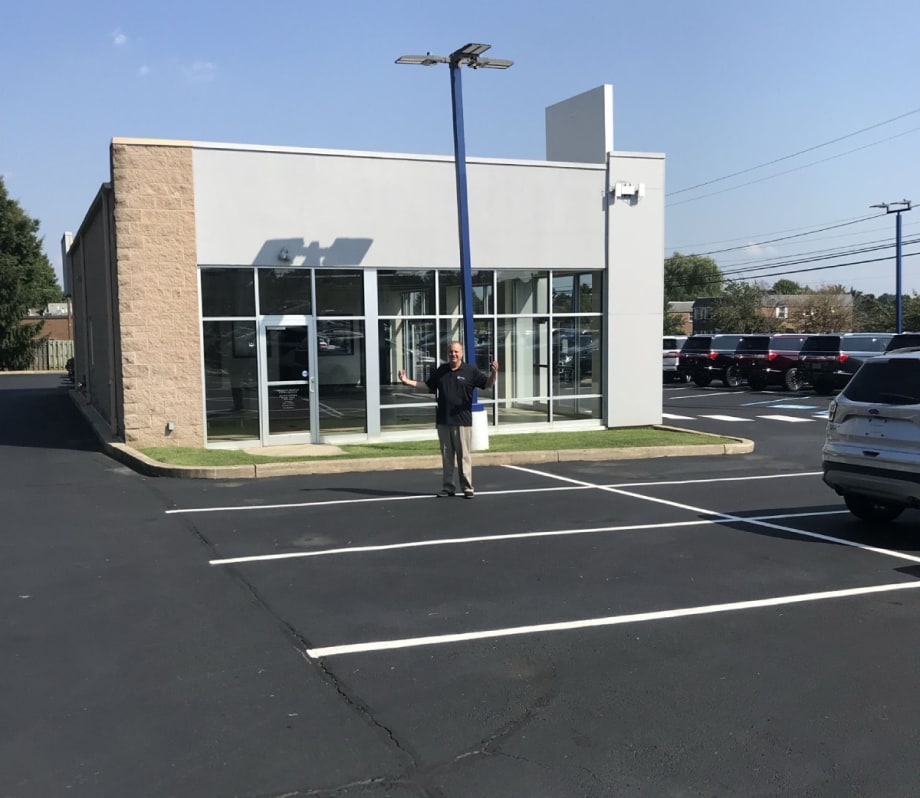
“What happened to all my vehicles?” asks Joe David Pacifico of Pacifico Marple Ford in Broomall, Pa. Pacifico’s sales to fleet customers have been severely curtailed for the 2021 and 2022 model years.
Photo: Joe Lyons
9 min to read
This is the second in a two-article series on how the fleet industry is managing the disruption to the automotive supply chain and resulting shortage of vehicles.
When the going gets tough, the tough get creative.
One of Perry Ressler’s larger fleet clients regularly has incomplete vehicles shipped from the factory to a parts supplier that finishes them with a necessary build component. But that parts supplier had a labor shortage, which interrupted the completion of those units. Ressler’s client sent up to a dozen workers for several weeks to work on the out-of-state supplier’s assembly line to help get those vehicles finished.
“That's what they had to do to build the vehicles,” says Ressler of Pritchard Commercial Sales, a national fleet dealer headquartered in Clear Lake, Iowa. “The industry is dealing with supply chain shortages and it’s not just microprocessor chips, but workforce related too. That’s extreme, but it’s happening.”
In less than a year, the imbalances and inequities in the automotive and parts supply chains are being exposed. The tangible consequence is the loss of as many as 7 million units of auto production in the U.S. for the 2020 and 2021 calendar years. The spill-off effects for automakers, dealers, retail buyers, and fleets are only beginning to be felt.
We’re learning more than we ever cared to know about semiconductor chips:
A fire in a chip maker’s factory amplified the production issues of one automaker that had all its chips in that one basket, so to speak.
Sales to the automotive industry constitute only 5% of the overall semiconductor chip market, which makes it easier for chip makers to divert production to higher margin sales to smartphone, computer, and electronics.
Some vehicle models use obsolete chip technology that is long overdue to be phased out.
Prices on chips are set to increase by up to 20%.
Though chip manufacturers are investing billions to expand production capacity, the new facilities could take years to become fully operational.
How acute has the vehicle supply crunch gotten on the ground?
The major rental companies are expecting only 50% fleet allocation for the 2022 calendar year. Those companies, the largest fleet buyers in the world, are paying hundreds — sometimes thousands — of dollars over their usual acquisition prices.
With no place to put them, incomplete vehicles are being shipped to dealers’ lots or empty fields to wait for semiconductor chips.
Manufacturers are shifting chip allocation to models with higher profit margins. They’re also trying to replenish retail dealer networks’ historically low inventory levels, so many of the produced vehicles aren’t necessarily destined for fleets.
At the same time, they’re drastically lowering incentives to capture better margins and improve bottom line numbers from lost production output.
While some 2021-MY production has ended, automakers have extended 2021 production schedules for certain makes and models to try and accommodate existing orders.
While most order banks for 2021-MY vehicles have closed or are closing soon, total fleet orders exceed plant capacities. Automakers will ultimately fail to produce thousands of fleet orders this year due to supply chain shortages and disruptions.
Instead of the traditional allocation to dealers based on yearly retail sales and fleet orders, some manufacturers are requiring dealers to show confirmed fleet orders to authorize dealer order placements for fleet units.
Light-duty pickups for both retail and fleet are being offered with an option to remove auto start/stop capabilities, which saves some chips. Other automakers are building vehicles without non-critical components such as power mirrors and heated steering wheels. Some vehicles are even being shipped with a single key fob to save on chip allotments.
A Moving Target
The timeline to normalcy is a moving target. Chip production is ramping up but will take time to get into vehicles. Other supply chain disruptions, from natural disasters and Covid factory shutdowns to imposed social distancing guidelines amplify an already delicate situation.
“The rate at which the supply chain normalizes will vary significantly for each OEM,” says Ted Davis, vice president, North American supply chain for ARI. “Some OEMs are better positioned to rebound from the ongoing disruptions more successfully than others.”
As a result, the manufacturers that bounce back quicker will face increased demand pressures, Davis says, which will extend the industrywide challenges further until the majority of OEMs can normalize their supply chain.
Davis says that for medium- and heavy-duty units, the supply and demand challenges are often exacerbated due to lower production capacity.
“Currently, we’re seeing model-year build slots fill well in advance of new model year availability, which is further extending lead times,” he says. “Unless we see a drop in demand in this segment, I believe these constraints are likely to linger to some extent into 2023.”
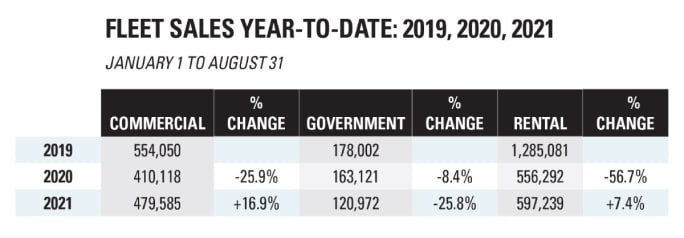
Sales to commercial, government, and rental fleets have experienced wild swings in volume in the past three years. But the difference between commercial fleet sales and rental is stark: Comparing 2021 with 2019 — a more normal comp — sales to commercial fleets only fell 13.4% through August, while sales to rental fell a whopping 53.5% in that timeframe.
Source: Bobit
Incentive Cuts
Fleets are still receiving 2021-MY vehicles on their 2021 incentive contracts, which were negotiated before the worst of the supply crunch started. For 2022, fleets should brace for price increases and dramatic incentive reductions.
Manufacturers are cutting incentives, some much more than others — but those maintaining incentives closer to 2021 levels aren’t going to have near the allocation. “If you need 100 units, you may get 35,” Ressler says.
As of late August, pricing had yet to be released for many 2022-MY vehicles, which is delaying manufacturers’ negotiations with fleets on incentive programs. “This is the latest we've ever seen dealer ordering and pricing guides released,” Ressler says.
In the case of some Class 4 to 6 trucks, the difference between 2021- and 2022-MY pricing and incentives could impact fleet pricing by thousands of dollars per unit. “If the capital (that fleet buyers) forecasted to replace 100 trucks is off by $5,000 a truck, that’s a real number,” Ressler says, adding that fleets may need to extend their lines of credit in that eventuality.
Buyers may see prices ease somewhat if they can wait until the first or second quarter of 2022. If they can wait until 2023-MY production in the third and fourth quarter of 2022, “Hopefully when the chip situation is remedied and dealer stock returns to near normal, (fleets) might be able to acquire needed inventory with better incentives and a little better overall pricing,” Ressler says.
“Ultimately, the return to the new normal for fleet vehicle availability and acquisition pricing could be twelve to eighteen months away,” he says.
Plan Ahead
How can fleets proactively manage the situation right now?
“Commercial fleets are looking more closely toward underutilized and inactive fleet assets,” says John Wuich, vice president of strategic consulting for Donlen. “Where there is fat, they can redeploy newer assets and look to replace the older ones. Inactive units are also being sold off to take advantage of the red-hot resale market.”
According to Wuich, “Companies are also examining vehicle-accrued mileage to identify opportunities for strategic swapping of like vehicles,” which extends the overall life of both units by swapping a high-mileage vehicle with a similar make and model year with lower miles. Preventive maintenance takes on even greater importance.
“Most fleet operators will be best served to streamline vehicle specifications, creating more simplicity and consistency in vehicle design to mitigate supply chain risks,” says Davis.
Davis says fleets should work with their FMC (fleet management company) to analyze data on downtime and maintenance costs to adjust replacement cycling.
Ressler suggests fleets diversify manufacturers and models, which would augment immediate and near-term vehicle supply needs and mitigate exposure to downtime from recalls as well as associated repair parts supply of a particular make and model.
The key takeaway during a panel seminar addressing supply chain issues at the NAFA Institute & Expo in Pittsburgh on Sept. 1: “Get those orders in,” said Jennifer Costabile, general director, fleet marketing at General Motors. “Those in the front of the line have a much better chance to have those orders filled.”
Long Term
To ease the number and variety of semiconductor chips, many are forecasting that automakers will streamline production with fewer make and model variations, consolidated trim levels, more standard equipment, and fewer optional features.
Fleets — particularly in rental — have recently had to hold onto units well past their normal lifecycle. With some level of constricted supply in the years ahead, higher mileage units may be the norm. “Vehicles are built to last to 200,000 miles today,” says Jonathan Smoke, chief economist for Cox Automotive. “We may be seeing the market catching up to that.”
Could this crisis spur even bigger changes?
In Ford’s second quarter conference call, CEO Jim Farley said that the chip constraints have “led us to make important permanent changes in our business model … We're placing greater emphasis on a build-to-order sales bank. We have learned that operating with fewer vehicles on lots is not only possible, but it's better for customers, dealers, and Ford.”
As Farley explained, a build-to-order model allows automakers better visibility to demand, which in turn allows them to reduce order complexity, lower inventories, and simplify incentives.
Higher automaker and dealer profit margins should follow. “Vehicles then wouldn’t be subjected to fire sales and $5,000 incentives, and used vehicle prices become more stable,” says Michael Ward, an analyst with Benchmark, an investment banking firm. “It becomes a more efficient market. Getting $8,500 back-of-invoice incentive from [a manufacturer] never really made sense.”
Others don’t predict a change. “That's a fantasy to assume build to order,” says Joe David Pacifico of Pacifico Marple Ford in Broomall, Penn. “There are always going to be buyers who need a vehicle right now, for whatever reason. Automakers and certainly dealers don’t want to lose that customer to someone else.”
Pacifico, who sells to commercial and rental fleets, brings up the instances of new job starts and unplanned repairs. Larger fleets have more flexibility with present inventory, but not smaller ones. “A small fleet with 10 trucks, if he loses a truck, that's a real burden,” he says.
Ward says to watch dealers’ floorplan assistance, which is about $250 per vehicle depending on manufacturer. Automakers pay this fee to dealers to cover the interest dealers would pay for the industry average — roughly 60 days — those vehicles sit on dealers’ lots before sale. “If this assistance is lowered or eliminated, that means the OEMs are serious about a build-to-order model,” he says.
New Norm
As build-to-order is intrinsic to the fleet process already, the change would be more material to retail buying. Yet any intent to cut down on excess supply is a move to raise initial prices, which would affect fleets of all types and sizes.
A lower level of supply — to what exact degree is debatable — could be the new norm. Certainly, smaller business fleets that rely inordinately on dealer stock will have to plan further ahead and get in the habit of ordering.
Crises spur the calls for better preparedness and an overhaul of inefficient processes. Judging from today’s ongoing supply chain disruptions, the unexpected may be the new norm, and fleets need to prepare for that.
Subscribe to Our Newsletter
More Operations

Sponsored•October 14, 2026
A buyer's guide to fleet management software in 2027
Buying fleet management software in 2027 means looking beyond features and price. As fleet operations, technology and expectations evolve, this guide explores what today’s fleet professionals should consider when choosing a system that can deliver value now and adapt to what comes next.
Read More →
What Will Shape the Next Era of Fleet Management?
EVs, AI, and autonomous vehicles are reshaping fleet management. Discover what’s ahead—and how fleet leaders can prepare for the next era.
Read More →
How Fleets Can Recruit and Train Veterans for Technician Roles
Here's how the technician shortage has affected uptime for fleets, and what to do about it.
Read More →

Avis Budget Group Deploys Neology Toll Management Technology Across Major Brands
Neology’s neoFleet platform will manage toll transactions and toll-authority operations for vehicles across Avis, Budget, Payless, Budget Truck and Zipcar.
Read More →
Fleet Personal-Use Charges Edge Higher in 2026
Nearly eight in 10 surveyed fleets allow personal use of company vehicles, while just over half of respondents report charging employees for the privilege.
Read More →
The Future of Fleet + What’s Changing Right Now | AF News Recap
Could developments overseas offer a preview of what’s coming for U.S. fleets? This week, we’re looking at the future of AI, autonomy, and electrification, plus Ford Pro’s new certified pre-owned program, smarter vehicle offboarding, and a new way for fleets to manage toll expenses.
Read More →
How to Handle Vehicle Offboarding
What do fleet managers need to do when a driver leaves?
Read More →
Sponsored•October 1, 2026
Fleet Manager’s Ultimate Playbook: Navigating the New Standard in OEM Connectivity
Rising operating costs, driver safety concerns, and unplanned downtime are putting unprecedented pressure on modern fleets. Discover how fleet managers use embedded OEM connectivity and real-time vehicle data to cut TCO, prevent downtime, and protect drivers without aftermarket telematics hardware.
Read More →
U.S. Bank Adds Verra Mobility Toll Management to Voyager Fleet Platform
The integration allows U.S. Bank Voyager fleet customers to manage toll payments and violations alongside fuel, EV charging and maintenance expenses.
Read More →
ADAS Prevents Crashes. But Repairs Cost More | AF News Recap
ADAS-equipped vehicles may crash less often, but they can cost more when they do. This week, we’re breaking down what that tradeoff means for fleets, plus Subaru’s first Forester Wilderness Hybrid, Nissan’s new e-POWER Rogue, and why Calstart has become Catalyst Mobility.
Read More →