




Operations
Fleet Personal-Use Charges Edge Higher in 2026
Nearly eight in 10 surveyed fleets allow personal use of company vehicles, while just over half of respondents report charging employees for the privilege.
 MENU
MENU SEARCH
The repair crisis gets blamed on technician shortages and parts delays. But a big part of the problem is what's happening before the vehicle even reaches the shop, and that's within your control.
When repairs take longer, the difference often comes down to how efficiently fleets manage the processes around them.
Automotive Fleet
So, vehicle supply has stabilized for 2026 (mostly). The used vehicle market looks pretty firm. With no anticipated flood of used vehicles into wholesale to depress values, TCO should be manageable.
So what’s the problem here? Keeping vehicles serviced and on the road.
Repair delays, rising maintenance costs, and technician shortages might just be the biggest challenges for fleets in 2026. Let’s not talk about fuel. That’s a different article.
In Fleetio’s 2026 Fleet Benchmark Report, 54.4% of fleet professionals cited rising costs as their biggest challenge, with technician shortages (32.5%) and parts availability (28.9%) also ranking high.
When repairs take longer, the difference often comes down to how efficiently fleets manage the processes around them.
Automotive Fleet
“Fleet repair in 2026 is not defined by one big crisis,” said Amit Shrivastava, chief product officer, at ServiceUp. “It is defined by constant friction across the repair process. Parts delays, shop capacity, approvals, and communication gaps all compound and create operational drag for fleets.”
The challenge is less about solving one issue and more about managing a system of small delays that add up to significant downtime.
“Fleets are dealing with multiple constraints at once — labor, parts, and increasing vehicle complexity — and those pressures are compounding,” said Diana Holland, managing director at Cavis.
The good news? Alleviating much of this friction is within fleet managers’ control.
In the ServiceUp research, 44% of respondents identified parts delays as one of their biggest maintenance headaches, and half said parts availability was their biggest frustration in the repair process.
Parts delays can significantly impact collision repairs, as damaged vehicles remain out of service for several weeks while parts arrive. The issue is compounded by limited shop capacity and the growing complexity of vehicles.
“We’re seeing delays in mechanical repairs at dealerships and body shops,” said Charlie Stevenson, fleet manager at Essential Utilities. “Vehicles also seem to total out much faster than they did before.”
Stevenson said some delays come down to technician availability for specific repairs. “If it’s an engine or transmission issue, you may need a higher-level technician, and sometimes only a B-level tech is available,” he said.
In response, Stevenson is holding onto vehicles just in case.
“We keep more spares,” he said, noting the fleet has held onto about 10 specialty vehicles longer than originally planned to help maintain operations during extended repairs. “Even new vehicles have some issues.”
Corey Beard, fleet manager for Crane Payment Innovations (CPI), calls it “hoarding vehicles.”
CPI is holding higher-mileage units instead of turning them in, building a buffer of 50 to 65 vehicles the company can use after a crash or during major repairs. This has driven long-term rental expenses to “practically nil,” Beard said.
Today, maintenance disruptions are no longer rare events.
“One of the most striking insights from the survey is how frequently these problems occur,” Shrivastava said. “About 72% of fleet operators say maintenance and repair challenges happen weekly or monthly. That means these issues are not occasional disruptions. They are a constant operational burden.”
And maintenance processes aren’t highly optimized. The Fleetio report found that 44.3% of fleets say they do a decent job maintaining vehicles but acknowledge room for improvement, while fewer than 10% say they excel in this area.
That often means balancing reactive repairs with preventive maintenance while navigating a fragmented repair ecosystem.
While external challenges such as parts shortages and technician availability are widely known, many delays originate inside fleet operations themselves, with disconnected systems.
“In many cases, the biggest delays aren’t happening in the shop — they’re happening between steps in the process,” Holland said. “Approvals, communication gaps, and handoffs between vendors can easily add days to a repair cycle.”
Fleetio’s report found that most fleets operate with multiple systems — software, spreadsheets, and manual processes — rather than a single unified platform, and 79.3% of fleet data is still entered manually, adding administrative burden.
Even routine services can experience unexpected delays. For example, fleets sometimes require manual approval for relatively minor work orders, which can slow down routine maintenance.
Stefano Daneri, fleet ecosystem strategist at Fleetio, noted that many of these delays come down to time spent reviewing routine repair decisions. “A lot of downtime is tied to approvals — figuring out what needs attention and what doesn’t,” he said. “If you can automate or streamline those decisions, you can remove a significant portion of that delay.”
Daneri recommended that fleets shift to “approval-first” workflows — meaning repair orders are reviewed and approved upfront, before work begins, rather than being evaluated after the fact. This change can significantly shorten repair cycle times.
Even basic logistics can create delays. Stevenson said towing availability can be a challenge when vehicles break down.
“We call our FMC and sometimes wait a few hours,” he said.
Improving visibility into the repair process can help fleets identify where delays occur.
Fleets that track repair timestamps — from issue detection to approval, repair start, and return to service — can pinpoint exactly where delays occur, whether in shop turnaround, parts availability, or internal approval processes.
Vehicle technology is also adding complexity to fleet maintenance and repairs. Advanced Driver Assistance Systems (ADAS) — like automatic emergency braking, lane-keeping assistance, and adaptive cruise control — require precise calibration after even minor repairs.
At a Southern California event hosted by the Society of Automotive Engineers (SAE) in January, SEMA President and CEO Mike Spagnola highlighted the shortage of technicians trained to perform these calibrations.
Spagnola said that only about 44% of repair shops are currently fully equipped to handle ADAS repairs and calibration, creating another bottleneck for fleets trying to get vehicles back on the road.
SEMA is working with Congress and the U.S. Department of Transportation to develop industry guidelines, including defining safe modification ranges and expanding technician training programs to support ADAS servicing.
Electric vehicles add another layer of complexity. While EVs may require less routine maintenance than internal combustion vehicles, they also require technicians trained to work safely around high-voltage systems and specialized components.
For fleets, the result is a repair environment in which vehicle technology advances faster than the technician workforce needed to service it.
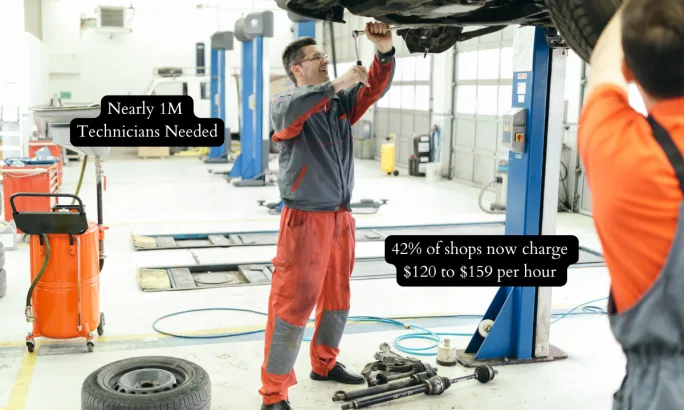
New mechanics are not entering the workforce at the rate needed to satisfy future demand.
Automotive Fleet
Fleet operators are also reassessing preventive maintenance policies to control costs and minimize downtime.
Stevenson said his fleet has adjusted its PM process based on vehicle usage.
“We’ve extended PM intervals from 5,000 to 6,000 miles on certain light-duty units, while shortening them to 2,500 miles on high-idle vehicles,” he said.
While the changes have not produced direct cost savings, Stevenson said they help contain maintenance costs and better align service schedules with actual vehicle use.
Rather than simply following fixed service intervals, fleets are increasingly tailoring maintenance schedules based on how vehicles are actually used and balancing cost control with uptime.
While controlling repair costs will always be a key priority, predictability is becoming an equally important goal.
“The lowest-cost repair isn’t always the lowest total cost,” Holland said. “If it increases downtime or adds variability, it can end up costing more operationally.”
“Fleet leaders often talk about reducing repair costs, but what they really want is predictability,” Shrivastava said. “The biggest frustration is when repair estimates change mid-process or downtime lasts longer than expected.”
Unexpected delays can disrupt driver schedules, service appointments, and operational planning. Knowing in advance how long a repair is likely to take — and what it will cost — can help fleets manage resources more effectively.
That predictability is becoming more achievable as fleets gain better visibility into repair timelines, costs, and vendor performance.
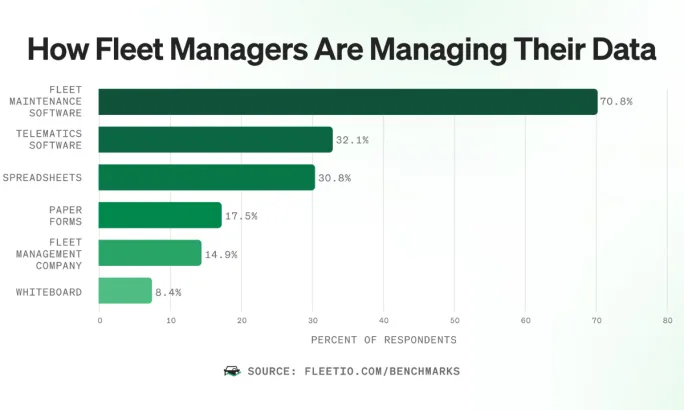
Despite widespread use of fleet maintenance software, many fleets still rely on spreadsheets and manual tools to manage data.
Fleetio
While artificial intelligence tools are increasingly capable of analyzing large sets of fleet data and detecting patterns, the real value of AI may lie less in analysis and more in decision-making.
“The goal isn’t just more data or another dashboard — it’s helping fleets make faster, better maintenance decisions,” said Daneri. “AI can prioritize issues, flag what actually needs attention, and help teams act more quickly.”
In early applications, Fleetio reports issue resolution times improving significantly — in some cases up to four times faster — as fleets spend less time reviewing and prioritizing repair decisions.
However, adoption remains early. Fleetio’s research shows many organizations are still evaluating artificial intelligence applications within fleet operations, with most fleets currently researching or piloting AI rather than deploying it widely.
As repair environments grow more complex, the fleets that succeed will be those that improve visibility and coordination across the entire repair lifecycle.
“The fleets that manage repairs best in the coming years will not necessarily have the biggest vendor networks,” Shrivastava said. “They will have the best visibility and coordination across the repair lifecycle.”
That includes understanding where vehicles are in the repair process, how long repairs typically take, and which vendors perform most effectively.
While fleets cannot control every external factor affecting repairs, many of the biggest gains come from improving how the repair process itself is managed — particularly through better visibility, faster decisions, and more efficient workflows.
Loading data...

Operations
Nearly eight in 10 surveyed fleets allow personal use of company vehicles, while just over half of respondents report charging employees for the privilege.

Safety
Insights from a commercial insurance carrier and a broker show how fleets can turn video telematic data, driver coaching, and improved claims results into a stronger case at insurance renewal.

Fleet Forward
Five fleet professionals — none with programming skills — discuss how they’re using AI to build fleet solutions in-house and in a fraction of the time.

Maintenance
Vincentric’s three-year, 60,000-mile projections reveal wide differences for both scheduled and unscheduled maintenance among selected vehicle categories. Projected maintenance visits also play a factor.
State of the Fleet Industry
Most organizations misunderstand fleet. The best managers make sure that doesn’t happen.

Remarketing
A vehicle health score could improve the value of fleet vehicles at remarketing. The path to a universal standard is forming, and fleets that understand the process early will be better positioned when it arrives.

Technology
AI is no longer a luxury but the baseline for profitability in 2026. Auto haulers that adopt these tools now will quickly outpace those that use manual workflows or take a wait-and-see approach.

Fleet Forward
The job hasn’t changed, but the expectations have. Do you have a plan on how to use AI to thrive?

Maintenance
The repair crisis gets blamed on technician shortages and parts delays. But a big part of the problem is what's happening before the vehicle even reaches the shop, and that's within your control.

Remarketing
Smart remarketing begins before vehicles enter the fleet, and is built on strong data and stronger FMC partnerships.
State of the Fleet Industry
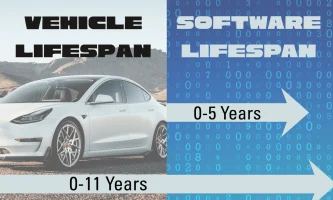
When the US’s largest EV manufacturer discontinues a model, it gives me pause to consider the software that drives it.

Operations
Here’s what is keeping fleet managers up at night this year, and what they're doing about it.

Leasing
As costs rise and scrutiny increases, fleets are refining criteria that govern eligibility for company-owned vehicles.