




Operations
Fleet Personal-Use Charges Edge Higher in 2026
Nearly eight in 10 surveyed fleets allow personal use of company vehicles, while just over half of respondents report charging employees for the privilege.
 MENU
MENU SEARCH
Nearly eight in 10 surveyed fleets allow personal use of company vehicles, while just over half of respondents report charging employees for the privilege.

Who gets to drive the company car at home? In Automotive Fleet's 2026 personal use survey, 42% of respondents permit an employee’s spouse.
*Summarized by AI
Personal use of company vehicles ticked up in Automotive Fleet’s 2026 survey, while more respondents also reported charging employees for the privilege.
Seventy-nine percent of respondents allow personal use, up from 72% in 2024. Among respondents who answered the charge question, 54% assess a personal-use fee, up from 48% in 2024.
The increase in personal-use privileges interrupts a longer-term decline in the survey results. In 2013, 87% of responding fleets allowed personal use before the share gradually fell to 72% in 2024.
The 2026 survey included 71 respondents, compared with 94 in 2024, and survey populations vary from year to year. The results are best viewed as a snapshot of current practices, with year-to-year comparisons providing directional context rather than evidence of a longer-term reversal.
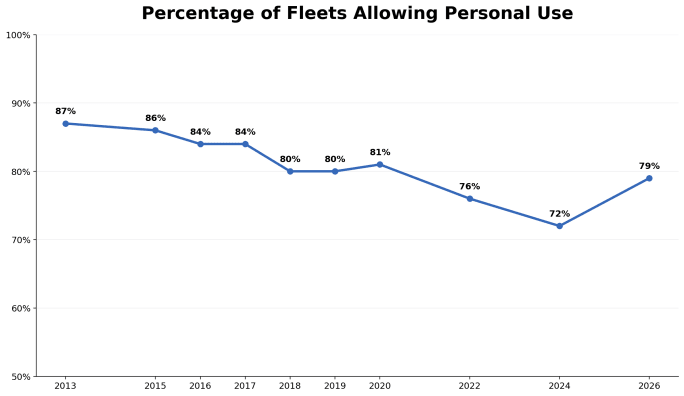
After declining from 87% in 2013 to 72% in 2024, the share of surveyed fleets allowing personal use rose to 79% in 2026.
Automotive Fleet
Among the 67 respondents answering the question about conditions for personal use, 64% said employees may use their company vehicles personally “at all times, whenever necessary,” compared with 53% in 2024. Another 9% limit personal use to travel to and from work, while 24% selected “Other.”
“Other” responses included policies based on mileage or geographic limits, management approval, department-specific rules, minimal personal use, and respondents that do not permit personal use.
Driving privileges for others changed less. In 2026, 42% of respondents permit an employee’s spouse to drive the company vehicle, compared with 38% in 2024. Nine percent allow licensed children to drive, compared with 6% in 2024.
Nearly half of 2026 respondents, 48%, said no one other than the employee is permitted to drive the company vehicle, compared with 60% in 2024. Another 17% selected “Other,” which included domestic partners, significant others, and other household members.
Respondents could select more than one authorized-driver category.
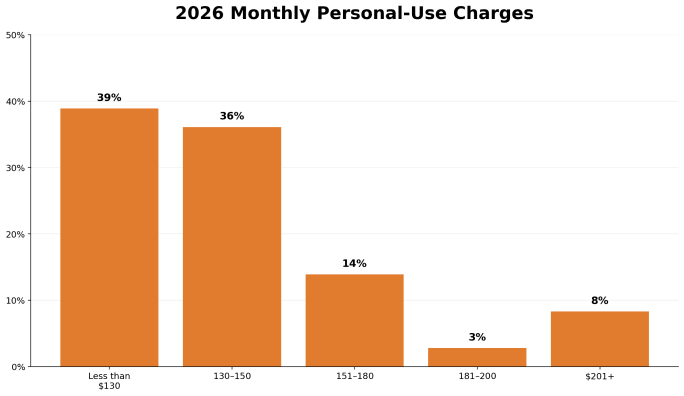
Among respondents who charge for personal use, 61% assess $130 or more per month, while 39% charge less than $130.
Automotive Fleet
Among respondents answering the personal-use charge question in 2026, 54% reported assessing a charge, compared with 48% of respondents in 2024.
Among the 36 respondents reporting a monthly charge in 2026, 39% charge less than $130 per month. Another 36% charge between $130 and $150, while 14% charge between $151 and $180. Three percent charge between $181 and $200, and 8% charge $201 or more.
Overall, 61% of respondents assessing a fee reported monthly charges of $130 or more, compared with 49% in 2024.
Because only 36 respondents reported a monthly charge in 2026, the difference should be viewed as directional. Still, the results show fewer charging respondents below the $130 threshold than in the previous survey.
The 2026 survey also asked about recent increases. Eleven respondents said their companies increased personal-use charges during 2025, and five reported another increase since the beginning of 2026. All five fleets reporting a 2026 increase had also raised their charges in 2025.
The small number of respondents prevents drawing a broader industry conclusion, but the responses show that some fleets have revisited their personal-use charges in consecutive years.
Nearly half of respondents allow no one besides the employee to drive the company vehicle, while 42% permit an employee’s spouse. Respondents could select more than one answer.
Automotive Fleet
Among 2026 respondents for whom the question was applicable, 87% require a motor vehicle record (MVR) check for authorized drivers other than the employee, compared with 77% in 2024.
The number of respondents is relatively small, so the difference is directional. MVR checks nevertheless remain a common practice among responding fleets that extend driving privileges beyond the employee.
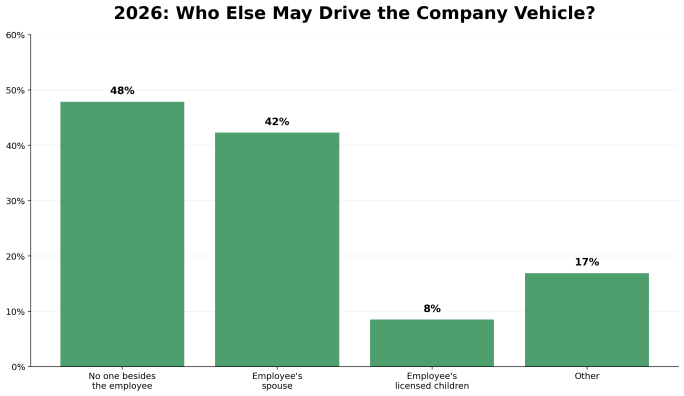
Nearly half of respondents allow no one besides the employee to drive the company vehicle, while 42% permit an employee’s spouse. Respondents could select more than one answer.
Automotive Fleet
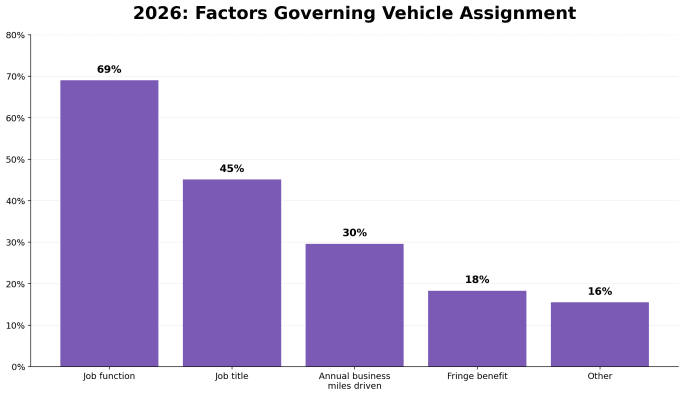
Job function remains the leading factor in determining who receives a company vehicle, cited by 69% of 2026 respondents, compared with 73% in 2024.
Job title was cited by 45%, essentially unchanged from 2024. Annual business mileage was cited by 30%, down from 36% in 2024, while fringe-benefit considerations were cited by 18%, down from 29% in 2024. Another 16% selected “Other.”
Respondents could select more than one vehicle-assignment factor, so the percentages do not total 100%.
The results continue a longstanding pattern. Job function has ranked as the leading vehicle-assignment factor in every Automotive Fleet personal-use survey since 2008.
Source: Automotive Fleet 2026 Personal Use Survey; 71 respondents. Response totals vary by question. That handles the denominator issue cleanly without cluttering the individual graphics.
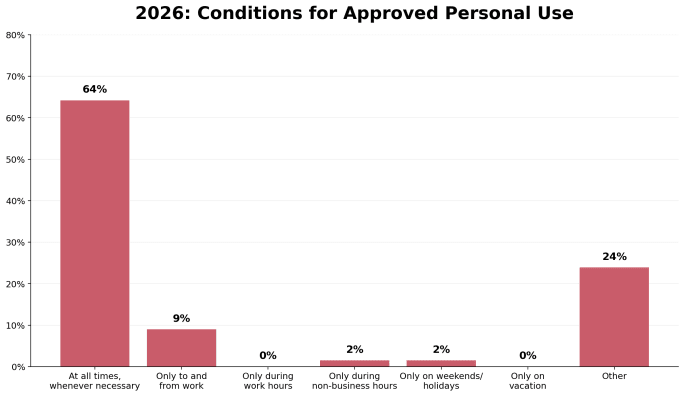
Nearly two-thirds of respondents allow personal use at all times, while 24% selected “Other,” including policies with mileage, geographic, or approval restrictions.
Automotive Fleet
Nearly 80% of surveyed fleets allow personal use of company vehicles.
*Summarized by AI
Loading data...

Operations
Nearly eight in 10 surveyed fleets allow personal use of company vehicles, while just over half of respondents report charging employees for the privilege.









Safety
Insights from a commercial insurance carrier and a broker show how fleets can turn video telematic data, driver coaching, and improved claims results into a stronger case at insurance renewal.
Fleet Forward
Five fleet professionals — none with programming skills — discuss how they’re using AI to build fleet solutions in-house and in a fraction of the time.
Maintenance
Vincentric’s three-year, 60,000-mile projections reveal wide differences for both scheduled and unscheduled maintenance among selected vehicle categories. Projected maintenance visits also play a factor.
State of the Fleet Industry
Most organizations misunderstand fleet. The best managers make sure that doesn’t happen.
Remarketing
A vehicle health score could improve the value of fleet vehicles at remarketing. The path to a universal standard is forming, and fleets that understand the process early will be better positioned when it arrives.
Technology
AI is no longer a luxury but the baseline for profitability in 2026. Auto haulers that adopt these tools now will quickly outpace those that use manual workflows or take a wait-and-see approach.
Fleet Forward
The job hasn’t changed, but the expectations have. Do you have a plan on how to use AI to thrive?
Maintenance
The repair crisis gets blamed on technician shortages and parts delays. But a big part of the problem is what's happening before the vehicle even reaches the shop, and that's within your control.
Remarketing
Smart remarketing begins before vehicles enter the fleet, and is built on strong data and stronger FMC partnerships.
State of the Fleet Industry
When the US’s largest EV manufacturer discontinues a model, it gives me pause to consider the software that drives it.
Operations
Here’s what is keeping fleet managers up at night this year, and what they're doing about it.
Leasing
As costs rise and scrutiny increases, fleets are refining criteria that govern eligibility for company-owned vehicles.