





Access Multiple Resources in the 2025 Disaster Response Guide
Adapting Fleet Policy When Disasters Strike
In the middle of natural disasters fleet managers must shift priorities to protect people and assets. What policy items should be loosened, and when should the line be held?
April 30, 2026
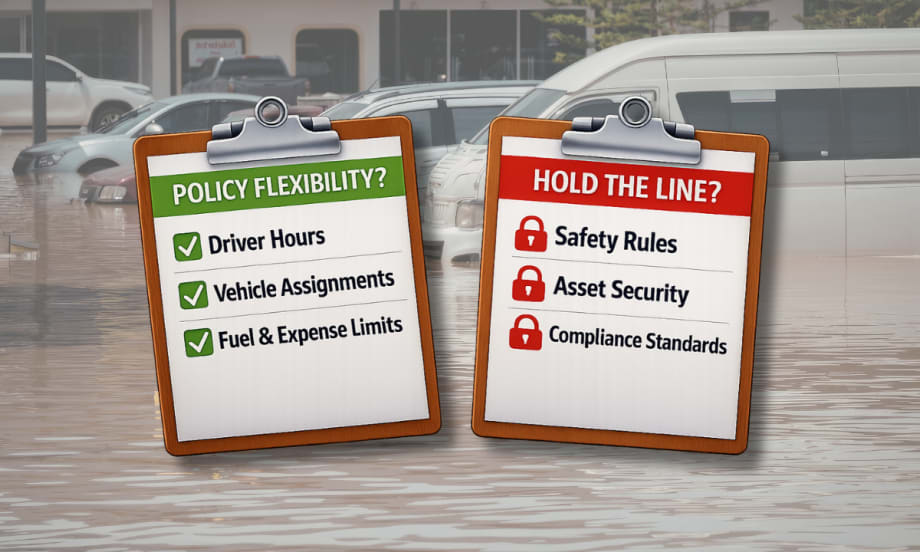
When disaster disrupts operations, fleet policy shifts from rigid rules to real-time decisions. Some controls can be loosened, while holding firm on safety and accountability.
Photo: This utilizes an AI-generated image. Refer to our Terms of Use.
7 min to read
Fleet policies are built for consistency, to standardize rules governing fuel spend, vehicle use, and replacement cycles. But disasters expose their limits.
When Mother Nature disrupts operations, fleets must quickly shift from rigid control to real-time flexibility. That means relaxing fuel restrictions, repurposing vehicles, leaning on vendor networks, and making high-cost decisions in the name of uptime.
Three fleet pros at Rollins Inc., Florida Power & Light Company (FPL), and Mike Albert Fleet Solutions weigh in on meeting the challenge of adapting policy without losing control of costs, safety, or accountability.
Employee Safety is First Priority
When a big storm rolls through one of Rollins Inc.'s service territories, Charles Schott's first priority is to take care of his people, not the vehicles.
"Forget about killing bugs for two or three weeks," said Schott, fleet director for Rollins. "Let's get people's lives back to normal."
During storms and disasters, Schott has gone so far as to dispatch drivers 100 miles to find open gas stations, load up gas cans, and run them back to employees who've lost power, or deliver bottled water to workers without refrigeration.
Tom Guy, VP of retail operations at Mike Al
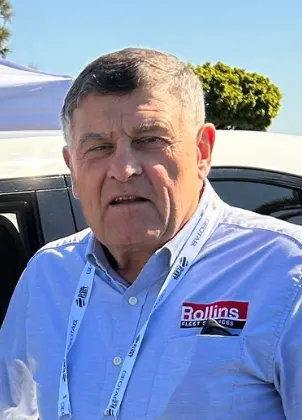
Charles Schott, Fleet Director, Rollins
Credit: Charles Schott
bert Fleet Solutions, said that when disaster strikes, three things matter immediately: staff safety, client communication, and the systems in place to support both.
"If you take care of your associates and your clients," Guy said, "typically things run pretty smoothly."
FPL has a corporate-wide system that checks on every employee after a disaster via text, email, and phone. “If people don’t respond, then their supervisor is contacted so we can make sure that people are okay,” said Patti Early, fleet manager at FPL.
Reexamining Fuel Policy
When a hurricane knocks out power across a service territory, fuel pumps can stop working too, necessitating a reexamination of fuel policy and spending controls before disasters strike.

Patti Early, Fleet Manager, Florida Power & Light
Credit: Patti Early
Under normal conditions, FPL's fuel cards are capped at three uses per day, enough for routine operations across the company's 68 internal fuel sites. When a storm is imminent, and crews must go to retail sources, "They get 10 uses a day instead of three," said Earley.
Early makes sure the switch happens in advance, not after drivers are already in the field, so they won’t hit declines.
Rollins removes fuel card restrictions entirely in affected areas, temporarily setting aside network rules and spending controls.
Vehicle Use Flexibility and Limits
When a disaster displaces employees from their homes and routines, the company vehicle becomes a resource that aids employees’ well-being. Both Schott and Early said that fleet policy should reflect that reality, to a point.
At Rollins, personal-use restrictions are lifted for employees in the affected area during an active disaster. If a driver needs to use a company vehicle to manage their own recovery, such as picking up supplies, checking on family, or getting to temporary housing, Schott said that's an acceptable use of the asset during the crisis window.

Tom Guy, VP of Retail Operations, Mike Albert Fleet Solutions
"If you can get fuel for your company vehicle, personal use restrictions come off for that period of time," Schott said, "until we get life back to normal again."
Because so much of FPL’s mission is to aid disaster relief, Early takes a more limited approach, with the first priority being to get vehicles out of harm's way.
One low-lying facility on an island off Florida's West Coast requires a barge to move equipment from it. The focus is asset protection first, operational flexibility second.
Both draw a line on non-authorized drivers such as spouses or family members, which does not change during a disaster. "We don't blur those lines," Schott said.
Guy adds a policy point that may get overlooked: always keep a passenger seat in every vehicle. Some fleets remove seats to maximize cargo space. In an emergency, that seat can be used to get another stranded driver home.
"What if?" Guy said. "Make sure there's policy around the amount of seating that's always left in the vehicle."
Vehicle Readiness, Pool Units, Preparedness Kits
Fleets are wise to keep backup or pool vehicles on hand for unscheduled maintenance and for deployment during storms.
Early holds back auction-ready vehicles during storm season rather than selling them on schedule. "We have three auctions a year," she said. "During storm season, we hold some vehicles in case we have a storm and need additional resources."
However, vehicles that sit unused develop dead batteries, rotting tires, and frozen brakes.
Guy recommends that fleets create a policy mandating that backup or pool units are not only started once a month but also driven at least once a month. "Don’t just turn it on," he said. "Somebody should drive it."
He also recommends equipping every vehicle with a basic emergency kit that includes a fire extinguisher, a tire repair kit, and a jump pack with a built-in air compressor. "You can get them for about 80 bucks," he said.
Let Revenue Drive Replacement Strategy
When a vehicle is lost to a disaster, the instinct is to replace it as fast as possible. Guy's advice is to first ask: How much revenue does that vehicle generate per day?
"You've got a vehicle that makes $10,000 a day," Guy said. "You could probably afford to buy one from a dealer rather than wait to order it from the manufacturer."
Yes, a dealer-locate costs more upfront. But for a high-revenue unit, the daily loss from downtime dwarfs the premium. For a lower-revenue vehicle, the equation is different. A manufacturer order, a rental, or even pairing two technicians in one truck may be the more economical path.
The same logic extends to fleets ordering vehicles for expansion initiatives; the units are already on order and spec’d but not yet assigned. In a disaster, Guy said, those units should pivot to replacement rather than growth.
"Make sure you are taking care of the clients you’ve been serving for years," he said. "Unfortunately, you may have to delay that new growth project a little bit."
Maximize Your Partnerships
The vendors, rental companies, and hotel chains that a fleet uses in daily life can be resources during a disaster — but must be secured before they're needed.
Guy has these various recommendations:
Cultivate multiple rental company relationships, and those with national coverage.
Pre-arranged hotel contracts for drivers who might get displaced.
Get agreements with dealers for vehicle locates.
Leverage vendor relationships that include access to covered parking, particularly in hailstorm areas.
Consider a Disaster Drill
One insight from Earley — whose fleet must be ever-ready in hurricane-prone Florida — is that FPL has an annual disaster drill.
This drill is a week-long simulation run every May that pressure tests internal plans and vendor coordination. Every year brings a different scenario, a different storm path, and a different set of logistical problems to solve. Vendors are contacted. Plans are set.
Sometimes, the scenarios get complicated.
"They asked me if a Chinook helicopter could pick up a loaded fuel trailer," Early said, describing one drill involving an FPL facility with a failing generator and washed-out bridges. "By the way, it can't."
The point wasn't the helicopter; it was that someone had thought through the problem before it was real. The team pivoted to a barge.
Guy likens this training to companies that run annual phishing awareness training. "We take enough trainings at every company," he said. "Why shouldn't this be part of it?"
Write It Down
Every insight these executives laid out, from the storm profile on the fuel card and the pool unit utilization policy to the revenue-based replacement framework and the vendor contracts, is worthless if it lives only in someone's head.
Guy insists that fleet managers document the procedures. Put a paper copy in the glove box and upload them to the fleet app drivers already use. When a disaster hits, the plan has to be accessible without making a phone call.
"Don't have this be a conversation," Guy said. "Have it written down."
Schott adds an important nuance: At Rollins, disaster policy doesn't permanently change after an event — it makes situational exceptions and then reverts to its original state. The flexibility on fuel cards, personal vehicle use, and spend limits is a pre-authorized exception to the existing policy, triggered by specific conditions and confined to the affected area.
"The disaster creates a need to maybe not change the policy, but just amend it for as the situation dictates," Schott said. "Once the situation is over, the policy is back in effect."
Subscribe to Our Newsletter
More Disaster Response
From Storm Prep to Emergency Response: The Growing Role of Telematics in Disaster Management
Telematics is transforming disaster response by giving fleets real-time visibility, improving routing, readiness, and coordination when every second counts.
Read More →
Disaster Readiness Is Not a Fleet Count, It’s a Stress Test of the Whole System
Fleet readiness isn’t about your vehicle count. It’s about condition, capacity, and whether your system can actually perform under stress.
Read More →
How Fleets Keep Fuel Flowing During Disasters
U.S. Bank Voyager explains the most common fleet payment failures during emergencies and how proactive planning helps keep vehicles moving when conditions deteriorate.
Read More →
The Waffle House Effect: How They Impacted How Storms are Measured While Keeping Hot Meals Ready
Why one restaurant chain became a benchmark for disaster response and what fleets can learn about readiness, operations, and recovery.
Read More →
When Fuel Runs Out, the Fleet Plan Falls Apart
When disaster hits, fleets fail on fuel, power, and idle planning. See the energy gaps fleet managers need to fix before the next storm.
Read More →
The Missing Data Point in Disaster Response
Human reports fill the gaps that telematics can’t during disasters. Here’s how fleets can use structured input (not social chaos) to respond faster and safer.
Read More →
Essential Strategies for Fleet Preparation and Protection During Hurricane Season
Prepare your fleet for hurricane season with proactive strategies to protect drivers, vehicles, and assets before, during, and after the storm.
Read More →
When Disaster Strikes: Equipping Your Fleet for Survival and Recovery
Discover how fleets can stay operational during hurricanes, wildfires, floods, and storms with strategic planning, technology, and data-driven maintenance.
Read More →
Mobilizing for Recovery When it Matters Most
When disaster strikes, reliable transportation becomes a lifeline for recovery, ensuring first responders and relief crews can reach those in need most.
Read More →
My GPS Position on Weather Apps
Discover how hyper-local weather alerts paired with GPS telematics can protect workers from sudden storms. Are your crews prepared for the unexpected?
Read More →