





Related: How to Protect & Position Fleet Vehicles During Disasters
The Waffle House Effect: How They Impacted How Storms are Measured While Keeping Hot Meals Ready
Why one restaurant chain became a benchmark for disaster response and what fleets can learn about readiness, operations, and recovery.
April 30, 2026
The Waffle House Index is the “officially unofficial” test for determining how much damage an area has sustained after a disaster.
Automotive Fleet
6 min to read
If there is one thing we can all agree on, it is that a hot meal during times of stress can be healing. That premise guides the philosophy behind the emergency preparedness model that has made the Waffle House the unofficial barometer of emergency response readiness.
Dubbed the “Waffle House Index” by then Federal Emergency Management Agency (FEMA) director W. Craig Fugate, it is a quick way to gauge the extent of damage in an area after a natural disaster.
“Supply chain design is traditionally optimized for cost and efficiency under stable, normal conditions. However, the Waffle House model proves that true resilience must be engineered into the operational system from the ground up, rather than treated as an afterthought,” said Panos Kouvelis, distinguished professor and director of the Boeing Center for Supply Chain Innovation at Washington University. “By standardizing their restaurant layouts, equipment, and menus, they have created a highly modular supply chain. When a disaster strikes, this standardization allows them to seamlessly plug in emergency resources like portable generators, mobile command centers, and standardized relief supplies.”
When extreme weather strikes, Waffle House's “Always Open” philosophy serves not only to feed its community but also as a beacon of safety.
The Waffle House Index Color System
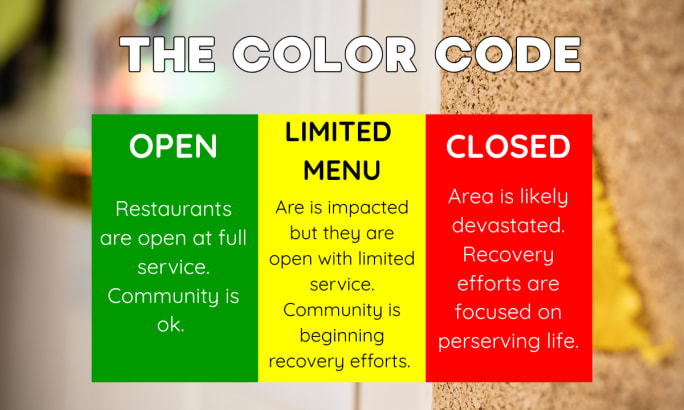
The Waffle House Index uses green, yellow, and red to signal whether a community is operating normally, facing disruptions, or experiencing severe disaster impacts.
Credit:
Automotive Fleet
Waffle House disaster recovery has such a strong reputation for success that the Federal Emergency Management Agency (FEMA) informally uses it to assess the severity of a natural disaster event.
Fugate once said, “If you get there and the Waffle House is closed? That’s really bad.”
The Waffle House Index uses a three-color code system: green, yellow, and red.
Green, like usual, means go! This is when the restaurant is open and fully operational, and the community is unaffected.
If they are serving a limited menu due to power outages, it falls into the yellow classification. Yellow suggests there may be disruptions in the area.
Red indicates that Waffle House is completely closed. This classification would suggest severe disruptions to the community with significant challenges to residents after a disaster.
The straightforward and nearly universal use of colors like green, yellow, and red makes this system effective and practical.
The Waffle House Plan
The Waffle House's ability to “get the lights on” so quickly after a disaster is directly tied to its proactive approach and advanced planning.
- Storm Center: The Waffle House Storm Center is located in Norcross, Georgia, and it serves as its own “Situation Room” during hurricanes and other natural disasters. From there, they track power levels, manage supply chains, and inform FEMA’s damage assessment.
- Mobile Command Center: They also have a mobile command center, named EM-50, that they deploy to disaster-stricken areas as needed. These command centers are custom RVs outfitted with satellite phones and internet links. It doubles as a mobile field office and works alongside the Waffle House food truck, which is also deployed during disaster relief efforts.
- Jump Teams: Jump teams consist of managers who are trained for swift disaster response. As soon as a hurricane or other disaster is expected, they mobilize and begin coordinating what may be needed in the region.
- Menu Adaptations: Waffle House has a pre-printed “no power” menu with limited items that require minimal cooking or can be prepared using alternative heating methods.
- Emotional Support: While the Waffle House Index and their emergency preparedness are tangible, their presence in disaster-stricken areas also serves the community spirit. Their ability to remain open and serve their community helps heal communities dealing with the stress and strife of natural disasters.
Why It Works
When a disaster strikes, Waffle House sticks to the plan, they keep communities informed, and when it is done, they assess and analyze what happened, what worked, and what didn’t, and then update their processes accordingly.
Credit:
The key component to the Waffle House disaster relief efforts is simple: planning.
Waffle House’s ability to operate in a “degraded” state is the cornerstone of its continuity. Total shutdowns lead to massive revenue loss, asset stranding, and delayed recovery times, according to Prof. Kouvelis.
The ability to operate in a degraded state means that organizations can continue to perform their functions even if at reduced capacity.
Prof. Kouvelis says “fleets can build this exact type of flexibility by establishing predefined, tired service protocols.”
- First, they should define service tiers in advance: what must be delivered no matter what, what can be delayed, and what can be suspended.
- During a crisis, a fleet should possess the operational agility to immediately shift to transporting only high-priority freight, such as emergency supplies or critical medical equipment.
- They should temporarily suspend standard or low-priority deliveries to conserve bandwidth and fuel.
- They should standardize contingency operating modes, such as reduced-route dispatching, alternate fueling, and pre-authorized driver reassignment.
- Finally, they should train for operating under impairment, not just for operating under ideal conditions.
Waffle House also has an in-house, written, and regularly updated crisis-management plan called the Waffle House Playbook. In a recent LinkedIn post, Fugate noted:
It’s basically the OODA Loop — Observe, Orient, Decide, Act — minus the Pentagon PowerPoint. Show up → Observe (see the reality for yourself — and remember, you’re not scrambling eggs without your team). Assess → Orient/Decide (figure out what’s broken, what’s needed, what works — no consultant required). Act → Act (fire up the grill, feed people, keep moving).
When a disaster strikes, they stick to the plan, they keep communities informed, and when it is done, they assess and analyze what happened, what worked, and what didn’t, and then update their processes accordingly.
Practical Steps for Fleet Managers
“Proactive pre-positioning aligns perfectly with advanced risk mitigation strategies because it shifts an organization from a reactive posture to an anticipatory one. Rather than reacting after the disruption hits, firms move critical materials, equipment, or personnel into strategically chosen locations before conditions deteriorate.” – Professor Panos Kouvelis, Washington University
Bobit Business Media
We asked Prof. Kouvelis what fleet managers can do now to improve continuity and recovery speed in the face of increasing disruptions, and he had the following tips:
- Conduct Rigorous Scenario Planning: Businesses must identify their most critical vulnerabilities and map out exact, step-by-step responses for various disaster scenarios. Firms should begin by identifying their essential functions, their critical suppliers and assets, and the few failure points most likely to shut them down.
- Define a Degraded Operating Model: This reduces decision latency, which is often more damaging than the disruption itself. Know in advance which services continue first, which customers are the highest priority, and which manual workarounds are acceptable.
- Invest in Redundant Systems: This is especially critical for visibility. Fleets must invest in redundant communication and tracking systems, such as satellite capabilities, to maintain asset visibility when primary cellular networks fail.
- Establish "Jump Teams" and Cross-Training: Waffle House brings in staff from unaffected regions to run their impacted restaurants. Fleets should establish reserve driver pools and cross-train dispatchers so they can step in for local personnel who need to attend to their own families and damaged properties during a crisis.
- Rehearse and Measure: Even a simple tabletop exercise can reveal astonishing weaknesses in contact lists, approval processes, fuel access, dispatch visibility, and employee accountability. Resilience is a muscle; firms that never test it are usually surprised where it snaps.
Prepositioning is also essential for successful crisis management. Prof. Kouvelis suggests fleets with heavy logistics stage essential assets just outside the anticipated impact zone before the disruption fully occurs.
This may include relocating idle trucks away from flood zones, securing mobile fueling stations, and/or positioning backup communication equipment at secondary hubs.
From an inventory strategy perspective, pre-positioning may look a bit different. For those fleets, he identifies three key items: identify a small set of truly critical items that drive continuity, position those items at safe but accessible locations, and monitor the situation so that you may act before congestion, closures, or infrastructure damage make movement difficult.
“The deeper lesson from the Waffle House example is not merely that one company stays open during storms. It is that resilient organizations design their supply chains and operations to remain functional under constraint,” added Prof. Kouvelis. “They simplify, when necessary, preposition intelligently, empower local response, and know how to operate at less than 100 percent without collapsing to zero. For fleets and small businesses facing increasingly frequent disruptions, that is the real playbook: not perfection under stress, but continuity through adaptability.”
Free Download: Disaster Energy Readiness Checklist: Fuel, Power, and Planning for Fleet Operations
Get a printable checklist designed to help you stay prepared and recover faster from a disaster. Fill out the form and download today!
Subscribe to Our Newsletter
More Disaster Response
From Storm Prep to Emergency Response: The Growing Role of Telematics in Disaster Management
Telematics is transforming disaster response by giving fleets real-time visibility, improving routing, readiness, and coordination when every second counts.
Read More →
Disaster Readiness Is Not a Fleet Count, It’s a Stress Test of the Whole System
Fleet readiness isn’t about your vehicle count. It’s about condition, capacity, and whether your system can actually perform under stress.
Read More →
How Fleets Keep Fuel Flowing During Disasters
U.S. Bank Voyager explains the most common fleet payment failures during emergencies and how proactive planning helps keep vehicles moving when conditions deteriorate.
Read More →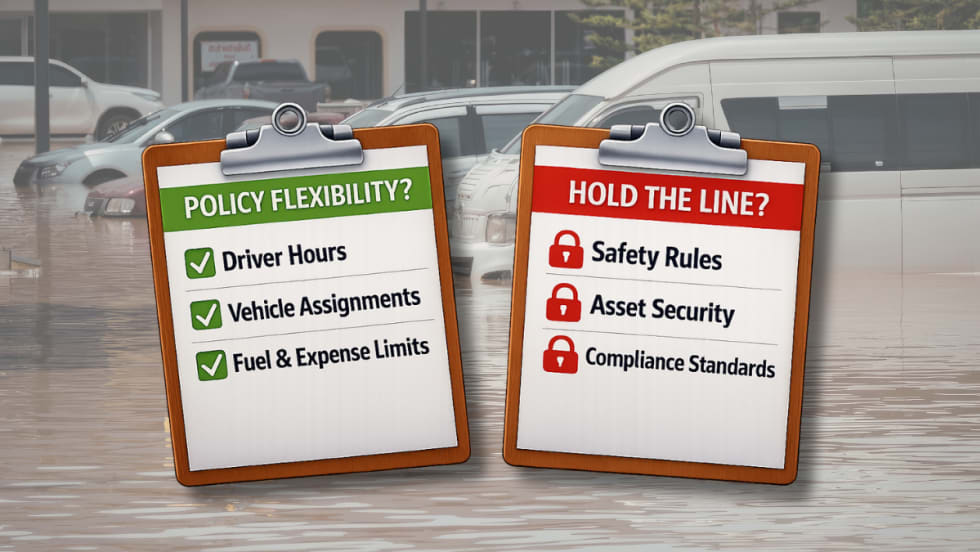
Adapting Fleet Policy When Disasters Strike
In the middle of natural disasters fleet managers must shift priorities to protect people and assets. What policy items should be loosened, and when should the line be held?
Read More →
When Fuel Runs Out, the Fleet Plan Falls Apart
When disaster hits, fleets fail on fuel, power, and idle planning. See the energy gaps fleet managers need to fix before the next storm.
Read More →
The Missing Data Point in Disaster Response
Human reports fill the gaps that telematics can’t during disasters. Here’s how fleets can use structured input (not social chaos) to respond faster and safer.
Read More →
Essential Strategies for Fleet Preparation and Protection During Hurricane Season
Prepare your fleet for hurricane season with proactive strategies to protect drivers, vehicles, and assets before, during, and after the storm.
Read More →
When Disaster Strikes: Equipping Your Fleet for Survival and Recovery
Discover how fleets can stay operational during hurricanes, wildfires, floods, and storms with strategic planning, technology, and data-driven maintenance.
Read More →
Mobilizing for Recovery When it Matters Most
When disaster strikes, reliable transportation becomes a lifeline for recovery, ensuring first responders and relief crews can reach those in need most.
Read More →
My GPS Position on Weather Apps
Discover how hyper-local weather alerts paired with GPS telematics can protect workers from sudden storms. Are your crews prepared for the unexpected?
Read More →