





Unravelling the Tariff Tangle: Four Strategic Moves to Make Today
Managing Fleet Costs and Risk in a Tight Market
Two fleet managers share cost, cycling, and safety tactics that work in their fleet operations.
October 2, 2025
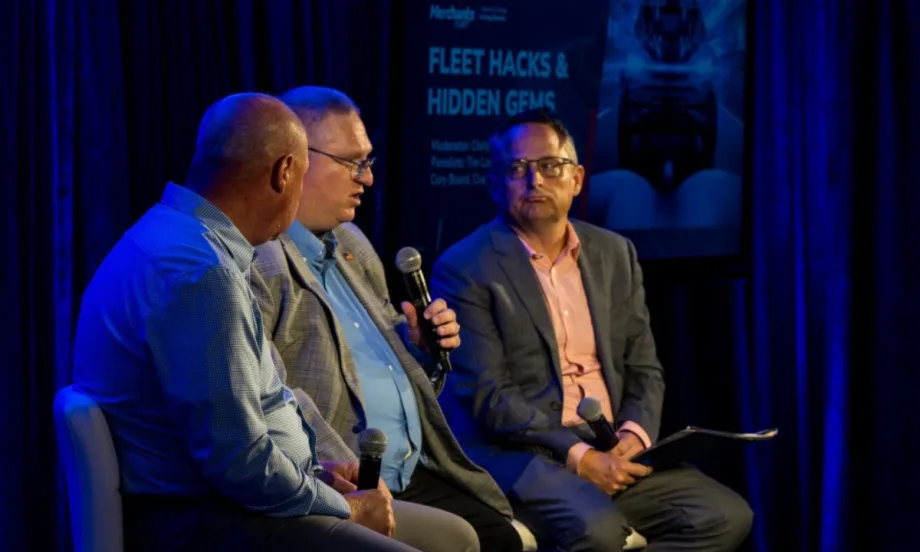
Cory Beard (Crane Payment Innovations) shares his perspective on OTD realities, rental avoidance via internal pools, and driver accountability in Hooksett, N.H., with Tim Lovett (Cameron Enterprises) and Chris Brown, who moderated.
Photo: Credit Cristen Farrell Photography
6 min to read
At the 2025 Merchants Fleet Summit in Hookset, N.H., Cameron Enterprises’ Tim Lovett and Crane Payment Innovations’ (CPI) Cory Beard compared strategies for navigating today’s uneven supply chains, elevated capital costs, and rising safety and liability risks. I moderated the panel.
The discussion spanned cost containment, “hoarding” strategies, and ways to structure an internal bailment pool, as well as order-to-delivery realities, telematics trade-offs, and how to sustain safety performance.
Two Fleets, Two Operating Realities
CPI’s largest business line is its field service operation, in which technicians install and repair payment and authentication systems across the U.S. This drives the bulk of its 800-vehicle fleet. CPI has been standardizing into Ford Mavericks from Chrysler Voyagers and “whatever we could get” to keep techs rolling, Beard said.
By contrast, Cameron Enterprises is primarily a sales and executive fleet comprising 1,100 units, mostly sedans and SUVs, with some light trucks.
Those distinct missions form the basis of Beard and Lovett’s strategies, encompassing everything from acquisition to maintenance.
Cost Pressures and Tariff Ripples
Both fleets are seeing cost pressures, but in different places. Beard pointed to the parts supply chain, especially sensors such as NOx sensors, where stockpiles built up during tariff uncertainty have been depleted. This makes parts harder to get and more expensive, which in turn increases downtime, he said.
Lovett sees the squeeze mainly in vehicle prices. Entry-level units that are $5,000 more than they were six years ago, a painful delta when you’re acquiring at scale. He noted that while tariff talk has intensified,
Cameron hasn’t yet felt a direct impact from tariffs — but expects it to come and is closely watching controllables.
Diversification and “Hoarding”: Two Responses to Scarcity
Lovett has recently leaned heavily into OEM diversification. Cameron once ran a Ford fleet only but broadened its relationships across brands to do business where supply exists and specs fit the need. “Diversification with OEMs has really helped us keep those costs down,” he said.
Beard, meanwhile, was humorously blunt: “We’re kind of hoarding vehicles.”
CPI is holding higher mileage units instead of turning them in, building a buffer of 50 to 65 vehicles staged at a facility in Illinois. That allows CPI to hotshot a ready, fully upfitted replacement to a technician after a crash or major repair, which has driven long-term rental expenses to “practically nil.”
In the conversation, I referred to it as an “internal bailment pool”—extra units on hand that shorten response times and control costs when things go awry, as often happens.
Lovett has adopted a similar, but not identical, stance. He orders in bulk and stages vehicles to accelerate replacements of high-mileage units, while avoiding a large, parked reserve. “It’s not uncommon for us to get 40 or 50 vehicles over a 60-day period,” he said, which the team turns quickly to keep maintenance exposure in check.
Approaches to OTD and Upfit Delays
Both fleets described stretched order-to-delivery and upfit timelines. CPI has seen 30- to 60-day expectations slide to 90- to 120-day expectations, prompting the team to hold vehicles longer and shuffle inventory internally while waiting for upfit.
Cameron has adjusted its cycling trigger — if the goal is to sell at 80,000 to 85,000 miles, orders now begin around 60,000 (vs. 70,000 pre-COVID) to account for longer lead times.
Personal Use and Liability
For Cameron, the company-provided vehicle is a core benefit, allowing personal use, which is especially valuable for employees who don’t or can’t maintain a second car.
CPI is re-examining personal use after some after-hours incidents raised challenging questions about liability boundaries.
“Anytime something happens, we’re still liable for it, whether you’re working or not,” Beard said, adding that incident costs can far exceed personal-use taxation.
PM Philosophy
Lovett keeps Cameron’s fleet on a 7,500-mile preventive maintenance (PM) cadence with alerts at 7,000 miles and follow-ups if drivers blow past the window. “We stay away from some of those big repairs by staying on top of it,” he said, emphasizing the role of reports and partner collaboration to intervene early.
Beard’s team aims for PMs every 5,000 miles. Tires or brakes that are near replacement are serviced while the vehicle is in the bay to avoid an extra day of downtime next month. “Time is money,” he said; the deliberate choice is to spend slightly more now to avoid unplanned expense later.
Approaches to Telematics
Lovett has not deployed a full telematics program. While he believes in the benefits of the technology, the hurdle is the investment and the management bandwidth required to act fairly and consistently on the data.
“If you don’t manage that information,” he said, “it puts us in a bad spot.” For now, Cameron utilizes embedded safety features, such as GM’s OnStar, for crash notifications.
Meanwhile, CPI employs telematics for geolocation, geofencing, speed, hard-brake thresholds, and airbag deployments. As a service fleet, CPI can communicate drivers’ locations with customers.
Beard uses safety outreach, progressive discipline, and even gamified rewards to promote better driving.
Promoting a Companywide Safety Culture
Both fleets described top-down safety cultures with explicit leadership involvement.
CPI’s approach begins on the company intranet with a banner for “stop work” authority — if a situation feels unsafe at a customer site, employees are empowered to halt the job and escalate. Any incident involving a lost-time injury triggers a C-suite review within 24 hours to identify the root cause and modify the process as needed.
Cameron utilizes annual safety modules that share real-life stories from within the company, making the consequences personal for the employee, their family, and the business. Managers also highlight streaks (“two months with no accidents”) in sales meetings to maintain high awareness.
Both leaders emphasized the importance of follow-through, as policies and dashboards are ineffective without accountability. Hold repeat offenders and frontline leaders to consistent expectations, or “you’re creating a culture of bad,” as Beard put it.
Partnerships, Data, and the “Last Mile” of Management
Data is only useful if it reaches the people who can act on it. Beard uses weekly exception reporting and holds region managers and P&L owners accountable for vendor choices that miss negotiated discounts (“Joe’s Tire Shop” vs. a national supplier).
Lovett said Cameron switched to Merchants for stronger reporting and faster decisions. He stressed it isn’t “set and forget.”
“You can’t just say, ‘Merchants has it.’ It has to be important to me and to the C-suite if we want results.”
Balancing Flexibility and Discipline
If there was a throughline to the panel, it was the balance between flexibility and discipline. Diversify where possible, stage units strategically, and update cycling to achieve longer OTD.
Utilize telematics if you’re prepared to consistently manage the data; if not, establish equivalent safety and accountability measures through training, policy, and partner reporting.
And above all, lead from the top with timely reviews and story-driven training that keeps safety relevant and achievable from the bottom up.
Subscribe to Our Newsletter
More Operations

Sponsored•October 14, 2026
A buyer's guide to fleet management software in 2027
Buying fleet management software in 2027 means looking beyond features and price. As fleet operations, technology and expectations evolve, this guide explores what today’s fleet professionals should consider when choosing a system that can deliver value now and adapt to what comes next.
Read More →
What Will Shape the Next Era of Fleet Management?
EVs, AI, and autonomous vehicles are reshaping fleet management. Discover what’s ahead—and how fleet leaders can prepare for the next era.
Read More →
How Fleets Can Recruit and Train Veterans for Technician Roles
Here's how the technician shortage has affected uptime for fleets, and what to do about it.
Read More →

Avis Budget Group Deploys Neology Toll Management Technology Across Major Brands
Neology’s neoFleet platform will manage toll transactions and toll-authority operations for vehicles across Avis, Budget, Payless, Budget Truck and Zipcar.
Read More →
Fleet Personal-Use Charges Edge Higher in 2026
Nearly eight in 10 surveyed fleets allow personal use of company vehicles, while just over half of respondents report charging employees for the privilege.
Read More →
The Future of Fleet + What’s Changing Right Now | AF News Recap
Could developments overseas offer a preview of what’s coming for U.S. fleets? This week, we’re looking at the future of AI, autonomy, and electrification, plus Ford Pro’s new certified pre-owned program, smarter vehicle offboarding, and a new way for fleets to manage toll expenses.
Read More →
How to Handle Vehicle Offboarding
What do fleet managers need to do when a driver leaves?
Read More →
Sponsored•October 1, 2026
Fleet Manager’s Ultimate Playbook: Navigating the New Standard in OEM Connectivity
Rising operating costs, driver safety concerns, and unplanned downtime are putting unprecedented pressure on modern fleets. Discover how fleet managers use embedded OEM connectivity and real-time vehicle data to cut TCO, prevent downtime, and protect drivers without aftermarket telematics hardware.
Read More →
U.S. Bank Adds Verra Mobility Toll Management to Voyager Fleet Platform
The integration allows U.S. Bank Voyager fleet customers to manage toll payments and violations alongside fuel, EV charging and maintenance expenses.
Read More →
ADAS Prevents Crashes. But Repairs Cost More | AF News Recap
ADAS-equipped vehicles may crash less often, but they can cost more when they do. This week, we’re breaking down what that tradeoff means for fleets, plus Subaru’s first Forester Wilderness Hybrid, Nissan’s new e-POWER Rogue, and why Calstart has become Catalyst Mobility.
Read More →