





What impact will a 25% tariff on imported vehicles and parts have on U.S. auto industry?
Tariff Update May 30: Tariff Shifts Shake Up Auto Industry as Legal & Trade Battles Evolve
With the Court of Appeals temporarily restoring 25% Tariffs, costs, supply chains, and the policy landscape remain uncertain.
May 30, 2025
Whether it’s challenges in the delivery sector or rising costs for vehicles and parts, the full impact of tariffs on the commercial fleet industry remains uncertain.
Photo: Automotive Fleet
22 min to read
Tariff Update May 30: Tariff Shifts Shake Up Auto Industry as Legal & Trade Battles Evolve
On May 29, a U.S. Court of Appeals temporarily reinstated certain tariffs after conflicting rulings created uncertainty in the auto industry. However, a prior ruling by the U.S. Court of International Trade declared some of these tariffs, imposed under the International Emergency Economic Powers Act, as unauthorized.
Despite this legal limbo, the tariffs remain in effect, impacting approximately 8 million imported vehicles annually.
Impact on Vehicle Prices/Market Machinations
The 25% tariffs on imported vehicles and parts, effective since April 2025, have already driven a 2.5% surge in average new vehicle prices in April, reaching $48,699, according to Kelley Blue Book.
Analysts such as Anderson Economic Group estimate that vehicles directly affected by tariffs could see price hikes of 10% to 15%, with some models potentially increasing by $2,000 to $15,000 depending on import reliance.
Current dealership inventories, built before tariffs took effect, have temporarily shielded buyers from immediate price spikes. However, as these stocks dwindle, prices are expected to rise further as tariff-affected vehicles reach lots.
Industry supply dropped to 2.6 million vehicles in April, with a 60-day supply, according to Cox Automotive.
The tariff-driven increase in new vehicle prices is pushing demand toward used cars, causing a 2.7% month-over-month price rise in April. The Manheim Used Vehicle Index reached its highest level since October 2023.
Tariff Update May 5: Repair Costs Poised to Spike Under New Parts Tariffs
A new 25% tariff on imported auto parts officially took effect at 12:01 a.m. EDT on May 3. While the measure applies broadly across imported vehicle components, the administration also introduced targeted relief to blunt its impact on domestic vehicle production.
Automakers that assemble vehicles in the U.S. may qualify for partial tariff rebates, offering a credit of up to 3.75% of a vehicle’s value in the first year and 2.5% in the second year. In addition, parts used in U.S.-assembled vehicles may be exempt from overlapping tariffs on imported steel and aluminum.
Certain auto parts imported from Canada or Mexico and compliant with the United States-Mexico-Canada Agreement (USMCA) may also avoid the new tariff, though only if they meet strict regional content requirements and are properly documented.
These relief provisions are designed to encourage North American manufacturing and support OEMs with existing domestic production footprints. However, the same protections do not extend to imported replacement parts used in vehicle repair, maintenance, and service operations.
Repair Sector Faces Full Tariff Burden
Unlike parts used in new vehicle manufacturing, imported replacement parts face the full weight of the 25% tariff with no exemptions. This distinction is especially significant for collision repair shops, dealership service departments, fleet maintenance teams, and insurers, who rely on a wide array of aftermarket components, many of which are sourced from countries like China, Taiwan, Mexico, and South Korea.
Because these parts are not tied to new vehicle production, they do not qualify for the rebate program. Nor are they eligible for tariff exclusions based on domestic assembly. The result could be a sharp and immediate cost increase for routine repairs and accident-related work, as parts such as bumpers, sensors, radiators, wiring harnesses, and brake systems now carry a quarter more in import costs.
It is unclear how these increases will be passed directly to service providers and customers, though it is more difficult to blunt their impacts compared to new vehicle costs.
The tariff is applied the moment a part enters the country, meaning repair shops and parts distributors are already absorbing the added costs. Some may seek to shift sourcing to domestic suppliers, but the U.S. currently lacks the manufacturing capacity to meet demand for many high-volume aftermarket components at scale or cost parity.
Fleet operators are among the most exposed to this shift. Non-warranty repairs are likely to see cost increases immediately, and maintenance budgets will likely need to be revisited. Insurance carriers, facing higher parts costs for claims, may begin to adjust premiums to protect margins.
Tariff Update April 24: Looming Parts Tariffs Create New Cost Pressures
While the Trump administration announced a 90-day pause on some reciprocal tariffs, the 25% duties on automotive imports remain in place. The latest round of automotive tariffs has begun to impact new-vehicle pricing, used-vehicle demand, and supply chain operations.
Tariffs in Effect
As of April 3, a 25% tariff now applies to imported vehicles and will extend to imported automotive parts by May 3. Safety-critical components, including airbags, windshields, mirrors, and seat belts, are among the targeted items.
Parts Tariffs Coming
Safety-critical components like airbags, mirrors, seats, and batteries will be subject to the same 25% tariff starting May 3. The parts tariffs also apply to derivative products containing steel and aluminum, which are proving difficult to trace and calculate accurately, especially for smaller suppliers. While imported vehicles are only subject to the 25% vehicle tariff, the new parts tariffs will increase costs for U.S.-assembled vehicles that rely on imported components.
Untangling the 90-Day Pause
On April 9, President Trump announced a 90-day suspension of reciprocal tariffs on general imports from certain countries, but it does not apply to the 25% tariffs on imported vehicles or auto parts. Moreover, any automotive-related product not explicitly covered by the 25% tariffs may still be subject to the default 10% tariff during this pause window.
Price Impacts Incoming
Automakers such as Ford, Nissan, and Mitsubishi have warned of potential vehicle price increases. Ford has stated it may raise prices on vehicles built in May. J.D. Power expects average new-vehicle prices to increase by 5% by year-end, potentially reducing retail sales by up to 1.1 million units.
OEM Production Adjustments
Nissan is ramping up production at underutilized U.S. plants, while Honda announced a plan to relocate some hybrid production from Japan to Indiana. Stellantis halted production at its Windsor Assembly Plant in Canada for two weeks and paused production at its Toluca Assembly Plant in Mexico for the month of April. Meanwhile, GM has paused production of its BrightDrop electric vans in Ontario until October 2025 to retool in preparation for the 2026 BrightDrop model.
Shipment Pauses
Many manufacturers are holding already-built vehicles affected by tariffs at ports or pausing vehicle shipments altogether. This is a fluid situation but will begin to affect fleets’ 2026-MY orders.
Used-Vehicle Prices Jump
Anticipating tighter new-vehicle availability, demand—and pricing—for used vehicles is rising. Manheim wholesale prices increased in late March and early April, and used days’ supply dropped three days quarter-over-quarter. Dealer groups are increasing reliance on trade-ins, lease buyouts, and service loaners to source inventory.
Dealer Strategy Shifts
Some retailers are using "tariff-free" messaging in marketing, while others are launching targeted service campaigns to help customers prepare for parts shortages and price hikes. The Chicago Auto Trade Association notes some dealers are already promoting pre-tariff parts and vehicles.
Supplier Strain and Compliance Challenges
Auto suppliers are sounding alarms over the 25% steel and aluminum derivative tariffs. Many suppliers say calculating the value of foreign metals within complex parts is extremely difficult, and non-compliance could result in steep penalties.
Tariff Update April 10: Trump Hits Pause on New Tariffs, Keeps 25% Vehicle Import Levy in Place
In a surprise move on April 9, President Trump announced a 90-day pause on most of the recently proposed tariffs, dialing them back to a 10% baseline rate.
The administration framed the move as a temporary de-escalation to give trading partners time to negotiate new terms. However, the administration simultaneously raised tariffs on Chinese imports to 125%, signaling a continued hardline stance against Beijing.
The announcement offers a mixed picture for the automotive industry. The tariff pause may provide short-term relief and some room to reassess supply chain strategies. Yet existing tariffs — including the 25% levy on imported vehicles and duties on steel, aluminum, and auto parts — remain in place.
The market response was swift: automotive stocks surged, with Tesla climbing nearly 23%, while other OEMs saw double-digit gains.
Yet the uncertainty seems far from over, as the 25% tariffs will continue to exert pressure on vehicle pricing and fleet acquisition costs.
April 9: How Fleets Will Feel the Tariff Shockwave
As the auto industry reacts to President Trump’s sweeping new tariff policy, experts from EY are forecasting significant economic ripple effects that could impact fleet costs, availability, and vehicle strategy decisions later this year and into 2026.
In an April 3 media briefing, EY’s panel of economic, tax, and automotive analysts pointed to rising consumer prices, delayed EV investments, and supply chain restructuring as the most likely outcomes of the administration’s move to impose universal tariffs and country-specific reciprocal rates.
Fleet Pricing Could Shift in Waves
Fleets should expect staggered cost increases. EY’s Americas Automotive Sector Leader, Steve Patton, noted that about 3 million vehicles are currently in dealer inventory — enough to delay the impact of the tariffs for a few months. However, vehicles with high imported content or luxury models could be affected sooner.
“We’ve already seen OEMs indicate there’s time to figure things out,” said Patton. “But the question is, what happens when inventories deplete? OEMs will need to decide whether to pass on cost or restructure.”
OEMs with U.S.-based manufacturing are better positioned to respond. “There is a lot of idle capacity in the U.S.,” he added. “While that can’t be exercised overnight, it does provide a relief valve.”
Economic Slowdown May Reshape Strategy
EY’s economic modeling projects a 1% drag on U.S. GDP in 2025, with potential for flat or negative economic growth. According to Andrew Phillips, EY's lead economist, consumer prices are expected to rise between 2% and 3% in the next six months.
“Imports are about a quarter of the goods used in U.S. manufacturing,” said Phillips. “A 25% tariff is effectively a 6% tax on U.S. production and exports.”
While reshoring could help in the long term, labor shortages and high domestic wage costs will make a fast pivot difficult. EY noted that companies may delay capital investments or hiring while they wait to see how long the tariffs remain in place.
OEMs May Rethink EVs & Innovation Priorities
The tariff landscape, combined with the potential rollback of EV tax credits, could add more friction to electric vehicle adoption in the U.S. — a trend already underway.
“Some OEMs are exploring backward conversion of EV platforms to internal combustion,” said Patton. “This isn’t necessarily a rejection of EVs, but a sign that adoption timelines may stretch.”
Investments in autonomy and advanced vehicle technology may also be scaled back as automakers reallocate budgets to deal with rising vehicle and component costs.
Plan Now, Not Later
EY emphasized that companies should take a proactive approach by modeling potential cost scenarios and aligning tax, trade, and supply chain planning.
“What we’re telling clients is it’s no longer a wait-and-see moment,” said Anna Maria Romero, EY’s transfer pricing and operating model leader. “Understand your business, your options, and the potential disruptions.”
Romero noted that companies new to customs compliance—such as those in pharma and automotive—are finding that tariff mitigation strategies now require deeper alignment between supply chain structure and financial planning.
Earlier updates below:
April 3: Sweeping new tariff orders begin April 5 with a 10% universal rate and 25% duties on non-USMCA goods
According to an April 2 statement by the White House, the Trump Administration has issued a sweeping executive order that will impose a 10% universal tariff on nearly all imported goods beginning April 5.
The effort is positioned as “part of a broader effort to rebalance U.S. trade deficits and bolster domestic manufacturing.”
The action, issued under the International Emergency Economic Powers Act (IEEPA), marks a significant escalation in the administration’s trade policy and will have direct implications for vehicle procurement, parts sourcing, and fleet operations across the U.S.
What’s in the New Order
10% tariff on most imported goods begins April 5.
Country-specific tariffs (potentially above 10%) will follow on April 9, targeting countries with large U.S. trade deficits.
Exemptions include energy, pharmaceuticals, semiconductors, lumber, existing steel/aluminum duties, and compliant USMCA goods.
The administration has the authority to adjust tariffs based on compliance, retaliation, and economic performance.
Other Key Provisions
Non-U.S. content in finished goods will be scrutinized at ports to determine tariff applicability.
Canada and Mexico-origin goods that do not meet USMCA standards will face 25% tariffs.
U.S. Customs and Border Protection (CBP) has been directed to verify U.S. content documentation, increasing compliance burdens.
Goods already in transit before April 5 will be exempt, provided they were loaded prior to the cutoff.
The administration indicates that tariffs may remain indefinitely, until trade balances are “resolved.”
How the Updated Tariffs Apply to Fleet Vehicles and Parts
Under the April 2 executive orders, fleet vehicles and parts will be affected by both the 10% baseline tariff and potentially higher, targeted dutiesdepending on their origin and trade status.
Here’s what fleet managers need to know:
The 10% universal tariff that starts on April 5 will apply to nearly all imported goods, including vehicles and vehicle components. This serves as a baseline rate across countries.
The additional country- and product-specific tariffs that go into effect April 9 concern vehicles and parts from countries with large trade deficits with the U.S. —such as Germany, Japan, South Korea, and China. These rates may rise to 25% or higher.
Vehicles imported from Canada or Mexico that do not meet USMCA compliance standards will also be subject to up to 25% tariffs.
Only a narrow list of goods — such as energy products, pharmaceuticals, and semiconductors — are explicitly exempt from these tariffs. Vehicles are not excluded.
Goods already in transit before the April 5 and April 9 deadlines are expected to be exempt if they were loaded prior to enforcement. Fleets should check with their fleet management company, OEM fleet rep, or fleet dealers for clarification.
Earlier updates below:
March 27: Tariffs on Car Parts Are Set To Take Effect No Later Than May 3, Foreign Cars Set for April 3
On March 26, President Trump signed a proclamation to impose a 25% tariff on all imported automobiles and certain automobile parts to address “a critical threat to U.S. national security,” according to a White House Fact Sheet.
The tariffs are set to take effect on April 3 at 12:01 am EDT. The tariffs on car parts are set to take effect “no later than May 3,” according to the proclamation signed by the president.
The 25% tariff will be applied to imported passenger vehicles (sedans, SUVs, crossovers, minivans, cargo vans) and light trucks, as well as key automobile parts (engines, transmissions, powertrain parts, and electrical components), with processes to expand tariffs on additional parts “if necessary.”
Parts Tariffs Need a System First
Auto parts that currently comply with USMCA (United States-Mexico-Canada Agreement) rules will not be subject to the new 25% tariff, for now, the White House said. However, this exemption is temporary. The government plans to eventually create a system to analyze how much of each part was made outside North America.
Once that process is set up, USMCA-compliant parts may be partially taxed based on the percentage of the part that comes from outside the U.S.
Automakers have not yet announced price increases.
Domestic Vehicle Content Statistics
The White House Fact Sheet delineated the evolution of vehicles and vehicle parts from domestic to foreign-made.
In 1985, American-owned facilities in the U.S. manufactured 11 million automobiles, representing 97% of overall domestic (American- and foreign-owned) automobile production.
In 2024, Americans bought 16 million cars, SUVs, and light trucks, and 50% of these vehicles, or 8 million, were imports.
Of the other 8 million vehicles assembled in America and not imported, the White House estimates that the average domestic content is only 50% and “is likely closer to 40%.”
“Therefore, of the 16 million cars bought by Americans, only 25% of the vehicle content can be categorized as Made in America,” according to the Fact Sheet.
March 25: Trump’s April 2 Reciprocal Tariff Strategy Takes Shape
President Donald Trump is expected to announce a set of reciprocal tariffs on April 2 aimed at reducing the U.S.’s $1.2 trillion goods trade deficit, the Wall Street Journal and Reuters reported.
Although sector-specific tariffs, such as those on autos and semiconductors, may be excluded or delayed, the final decisions remain fluid, with Trump stating that the April 2 tariffs will mark a “Liberation Day” for the U.S. economy.
Treasury Secretary Scott Bessent and top White House Economic Adviser Kevin Hassett said last week the administration is focusing on countries with the most significant trade surpluses and high trade barriers, dubbed the “Dirty 15.” The Office of the United States Trade Representative (USTR) is seeking public input on which countries and goods should be considered.
According to Reuters, USTR named Argentina, Australia, Brazil, Canada, China, the European Union, India, Indonesia, Japan, Korea, Malaysia, Mexico, Russia, Saudi Arabia, South Africa, Switzerland, Taiwan, Thailand, Turkey, Britain, and Vietnam as being of particular interest, adding that they cover 88% of total goods trade with the U.S.
Trump said in February that he intended to impose auto tariffs but later agreed to delay some auto tariffs after a push by the three largest U.S. automakers for a waiver. So far, Trump has imposed new 20% duties on Chinese imports, reinstated 25% tariffs on global steel and aluminum, and applied 25% tariffs on certain imports from Canada and Mexico that do not comply with a North American trade agreement over the U.S. fentanyl overdose crisis.
March 13: One-Month Exemption for Automakers, Steel and Aluminum Tariffs in Place
Last week, President Trump granted a one-month exemption on recent tariffs on imports from Mexico and Canada for U.S. automakers. The pause came after Trump spoke with leaders of the “big 3” automakers, Ford, General Motors, and Stellantis, on March 5.
The 30-day exemption would give the automakers extra time to prepare for the new taxes, start investing, or shift production to the U.S. to avoid the tariffs entirely.
But pausing the 25% taxes on autos and auto parts traded through the North American trade pact USMCA would only delay reciprocal tariffs to match the taxes and subsidies other countries charge on imports to take place on April 2.
Additionally, Trump imposed sweeping 25% tariffs on all steel and aluminum imports on March 12, which could potentially boost America’s steel and aluminum industries or raise prices on crucial ingredients used by U.S. manufacturers.
According to the U.S. International Trade Administration, nearly a quarter of U.S. steel imports and more than half of aluminum imports are from Canada. Car, tool, and machine manufacturers may feel the effect of those tariffs the most.
March 4: Tariffs Take Effect, Potential Automotive Tariffs Soon To Follow
Tariffs on Canada and Mexico started today, March 4, including an additional 10% tariff (20% in total) on Chinese goods. The new tariffs could impact the fleet and automotive industries in areas such as parts supply, vehicle pricing, and the delivery sector.
In response, China announced a new 15% tariff on several U.S. goods (mainly agricultural exports). At the same time, Canada and Mexico indicated plans to impose retaliatory tariffs on American imports to their respective countries.
According to Holman, immediate effects may be seen in rising costs for parts, maintenance, and upfitting, with 5-10% price increases on common Chinese-imported parts.
New vehicle prices are also expected to rise, with U.S. models potentially increasing by an average of $3,000 and some Canadian and Mexican-assembled vehicles seeing hikes of up to $6,000. In Canada, costs could climb even higher, with specific models increasing by as much as $25,000 (CDN).
Beyond rising costs, the tariffs may disrupt supply chains as manufacturers seek alternative suppliers, potentially causing production delays and limited availability. An economic uncertainty like this could also reduce consumer demand, leading automakers to scale back or relocate production.
While some automakers discuss how to adapt to the new tariffs, others, like Honda, are making moves to avoid them altogether. Honda recently decided to produce its next-generation Civic hybrid in Indiana instead of Guanajuato, Mexico.
More information on the automotive imports announced by Trump on February 18 could come out as soon as April 2.
February 25: Tariffs to Proceed as Scheduled Next Week
President Donald Trump said Monday, February 24, that sweeping U.S. tariffs on imports from Canada and Mexico “will go forward” when a 30-day delay on their implementation expires next week.
“The tariffs are going forward on time, on schedule,” Trump said when asked at a White House press conference if the postponed tariffs on the two U.S. trading partners will go back into effect after the pause.
According to S&P Global, the potential for a prolonged 25% tariff on imports from Mexico and Canada, along with recently announced updates to tariffs on steel and aluminum, could have a multi-billion-dollar impact on Ford’s and GM’s profitability metrics.
“Such tariffs would slash billions from automakers’ profits, triggering ripple effects across the broader supply chain due to potential production disruption and driving up costs for the end consumer,” said Nishit Madlani, autos managing director at S&P Global Ratings.
The company forecasts that most tier 1 suppliers will pass a substantial burden of higher costs on to automakers, who would eventually have to pass it on to consumers through higher prices.
Aftermarket suppliers have greater pricing power and less production in Mexico, but tariffs on China could hurt some aftermarket suppliers. However, dealers would experience fewer impacts overall and have a greater cushion on their credit metrics.
On February 18, President Trump also announced plans to impose a new tariff on automotive imports, tentatively scheduled to go into effect on April 2. The tariffs will “be in the neighborhood of 25%” and may include another tariff on semiconductors (used extensively in automotive production).
February 13: Steel and Aluminum Tariffs Add to Inflation Concerns
On Monday, February 10, President Donald Trump removed exceptions and exemptions from his 2018 tariffs on steel.
All steel imports will be taxed at a minimum of 25%, with other countries predicting they could lead to higher inflation. Trump also ordered 25% tariffs on aluminum imports, compared to 10% in 2018.
Canada, the largest source of steel imports, was among the first to criticize the new tariffs, while the European Union vowed harsh countermeasures. Trump maintains that tariffs will help level the playing field and make U.S. factories more competitive, but this comes at the risk of higher inflation.
Although U.S. companies may benefit from the tariffs and be able to increase prices, a result of that is higher prices on anything made with steel and aluminum, like cars, parts, and components.
February 3: Where the Tariff Discussion Started
Since the 2020 United States-Mexico-Canada Agreement (USMCA) brought trade changes, some U.S. business leaders have raised concerns about the potential effects of the latest proposed tariffs.
Tariffs imposed by President Donald Trump via executive order would add a 25% tax on imported goods from Mexico and 10% on imports from Canada and China. According to the White House, the tariffs “are in addition to any other duties, fees, exactions, or charges applicable to such imported articles.”
However, President Trump agreed to a 30-day pause on tariffs related to Mexico and Canada for border and crime enforcement concessions. The additional 10% tariff ordered on China still went into effect as scheduled on Tuesday, February 4.
Whether it’s challenges in the delivery sector or rising costs for vehicles and parts, the full impact on the commercial fleet industry remains uncertain.
Tariffs Could Threaten North American Auto Trade
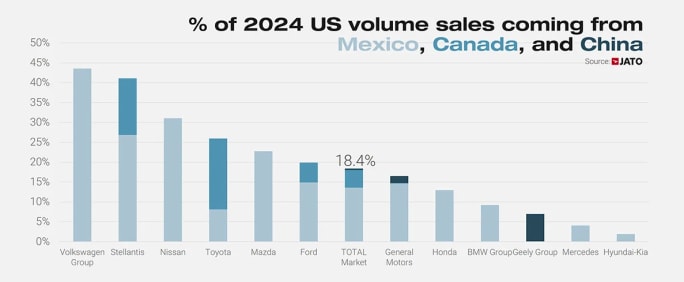
In 2024, sales of new light vehicles in the U.S. totaled 16.1m units, 61% of which were manufactured locally. According to JATO Dynamics data, Mexico, Canada, and China accounted for 18% of total sales of new vehicles in the U.S. in 2024.
“While the situation is constantly evolving, the imposition of tariffs on the United States’ closest trade partners will have a major impact on the automotive industry in North America, affecting the millions of cars that enter the country from markets such as Canada, China, and Mexico every year,” Felipe Munoz, global analyst at JATO Dynamics, said.
Mexico is the second largest country of origin for new vehicles sold in the U.S. and a significant production and export hub for many carmakers. In 2024, Mexican-made light vehicle sales reached 2.19m units, accounting for 14% of the market and growing 13% yearly, outpacing U.S.-made vehicle growth of 1.7%.
Major automakers like Volkswagen, Stellantis, Nissan, Mazda, Honda, and Ford rely heavily on Mexican production and exports.
Major automakers like Volkswagen, Stellantis, Nissan, Mazda, Honda, and Ford rely heavily on Mexican production and exports.
Source: JATO Dynamics
Meanwhile, Canada’s role in U.S. auto imports has declined, ranking as the fifth-largest country of origin. In 2024, more vehicles sold in the U.S. came from the European Union than from Canada.
Toyota and Stellantis rely on Canadian-made vehicles for 18% and 14% of their U.S. sales, respectively, while only 5% of Ford’s U.S. sales came from Canadian plants.
Separately, 56,800 vehicles made in China were sold in the U.S. in 2024, giving the country a market share of 0.35%. “The US is imposing severe restrictions on Chinese-made vehicles despite the marginal role the country plays in America’s auto industry,” Munoz said.
Fleet Leaders Weigh In on Tariff Challenges
Fleets are essential to the U.S. economy, providing public services like emergency response and transit, delivering goods, and supporting businesses. According to the NAFA Fleet Management Association, fleets represent 25% of vehicles on the road — 60 million cars, trucks, and equipment — and account for 20% of all vehicle purchases, move $10 trillion in goods annually, and contribute $800 billion to the economy.
“Widespread application of tariffs, particularly on our largest North American trading partners, has the potential to raise costs broadly for fleets in ways that would flow through to America’s consumers and taxpayers,” NAFA said in a statement.
In a statement from the Board of Directors, the Automotive Fleet & Leasing Association (AFLA) warns that impending tariffs on Canada, Mexico, and China could majorly impact the fleet industry.
As the industry was recovering from pandemic-related challenges, new uncertainties around supply chain disruptions emerged.
Key concerns include:
Delivery delays for vehicles and parts sourced internationally.
Rising vehicle and operational costs due to import tariffs and demand-driven pricing.
Budget constraints and extended vehicle lifespans (requiring fleet managers to adjust their strategies).
Given the interconnected nature of the U.S., Canadian, Mexican, and Chinese trade partnerships, AFLA is closely monitoring the situation and its potential effects on its members.
However, MEMA, The Vehicle Suppliers Association, supports the U.S. agreements with Mexico and Canada to delay proposed tariffs and continue trade discussions.
According to the company, this negotiation period offers a chance to find solutions that maintain North American trade stability and protect the vehicle supplier industry, which is a significant source of U.S. manufacturing jobs.
MEMA acknowledges President Trump’s priorities on border security and fentanyl trafficking but emphasizes the need for a collaborative approach that avoids disrupting the integrated North American supply chain.
“The unique partnership between the United States, Canada, and Mexico has enabled the creation, over many decades, of a robust automotive and commercial vehicle industry and strengthened US manufacturing competitiveness globally,” MEMA said in a company statement.
How Tariffs Are Impacting Small Fleet Operators and Costs
For smaller fleet operators that rely on global supply chains, the impending tariffs aren’t just a policy shift — they’re a direct threat to operational costs and pricing stability.
David Ziker, who just sold his stake in his 105-year-old family company, Indiana-based Ziker Cleaners, is following the updates.
“The obvious question is (price spikes) fuel for the delivery fleet,” Ziker said. “Our main suppliers, like poly and hangers, don’t come from Mexico, Canada, or China, but I have to assume everything will go up in price. The team back in South Bend is looking at this and gauging whether price increases for our customers will be the net result.”
“I’m about to order uniforms, and the prices in China have increased at least 15%,” said Jeb Lopez, CEO and owner of Wheelz Up, a last-mile delivery contractor.
From fuel for delivery fleets to the rising costs of essential supplies, business owners are bracing for higher expenses that could force difficult decisions on pricing and profitability.
Uncertainty Looms Amid Pause, Tariffs Could Increase
Although the 30-day pause offers temporary relief, fleet operators and suppliers remain on edge as unresolved trade negotiations or retaliations could lead to long-term disruptions.
The executive orders signed by Trump noted that if Mexico, Canada, or China retaliates against the U.S. concerning tariffs, the president may “increase or expand in scope the duties imposed under this order to ensure the efficacy of this action.”
Editor's Note: This article was originally published at 8:00 a.m. EST on February 5 and is being continuously updated to add the latest information, predictions, and commentary on U.S. tariffs.
More Operations

Fleet Personal-Use Charges Edge Higher in 2026
Nearly eight in 10 surveyed fleets allow personal use of company vehicles, while just over half of respondents report charging employees for the privilege.
Read More →
The Future of Fleet + What’s Changing Right Now | AF News Recap
Could developments overseas offer a preview of what’s coming for U.S. fleets? This week, we’re looking at the future of AI, autonomy, and electrification, plus Ford Pro’s new certified pre-owned program, smarter vehicle offboarding, and a new way for fleets to manage toll expenses.
Read More →
How to Handle Vehicle Offboarding
What do fleet managers need to do when a driver leaves?
Read More →
Sponsored•October 1, 2026
Fleet Manager’s Ultimate Playbook: Navigating the New Standard in OEM Connectivity
Rising operating costs, driver safety concerns, and unplanned downtime are putting unprecedented pressure on modern fleets. Discover how fleet managers use embedded OEM connectivity and real-time vehicle data to cut TCO, prevent downtime, and protect drivers without aftermarket telematics hardware.
Read More →
U.S. Bank Adds Verra Mobility Toll Management to Voyager Fleet Platform
The integration allows U.S. Bank Voyager fleet customers to manage toll payments and violations alongside fuel, EV charging and maintenance expenses.
Read More →
ADAS Prevents Crashes. But Repairs Cost More | AF News Recap
ADAS-equipped vehicles may crash less often, but they can cost more when they do. This week, we’re breaking down what that tradeoff means for fleets, plus Subaru’s first Forester Wilderness Hybrid, Nissan’s new e-POWER Rogue, and why Calstart has become Catalyst Mobility.
Read More →
Moventum Fleet Management Names Mark Iorillo Head of Sales
Iorillo brings nearly 20 years of fleet management and sales experience to the role, including previous positions at Element Fleet Management, CEI, Donlen and Ryder.
Read More →
Fleet Has a Talent Pipeline Problem. What Comes Next? | AF News Recap
Where will fleet’s next generation of leaders come from? This week, we’re looking at the industry’s talent pipeline, what certification can add to a fleet career, how to build an award-worthy track record, and the return of Automotive Fleet’s Personal Use Survey.
Read More →
Smith System Launches Driver Risk Management Program
Fleets have more driver data than ever, but identifying risky behavior doesn't necessarily correct it. Smith System's new Driver Risk Management program combines monitoring, training, and follow-up coaching to help fleets connect risk signals with driver intervention.
Read More →
Automotive Fleet Opens 2026 Personal Use Survey for Commercial Fleet Managers
Less than two weeks left! Commercial and corporate fleet managers are invited to share how their organizations handle company vehicle personal-use policies, charges, and driver eligibility.
Read More →