





Try It Out: Compare Vehicle Costs & Incentives with this Bobit Tool
2024: The Year of Steady Ownership Costs
Vincentric's quarterly snapshot of ownership costs reveal an entire year of relative calm after two years of pandemic volatility.
January 20, 2025
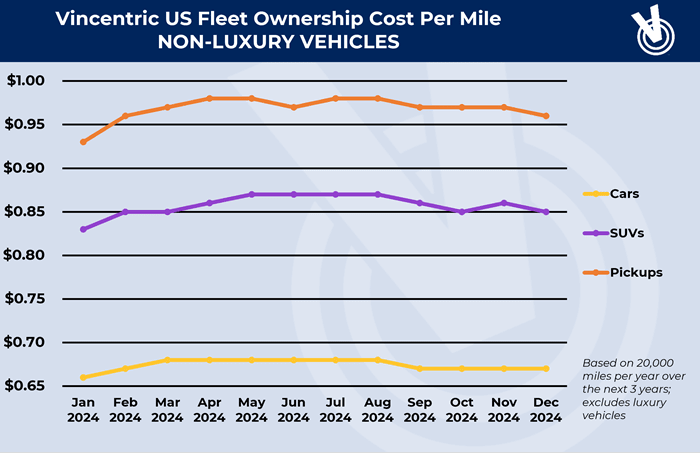
Costs in the Cars, SUVs, and Pickups categories have been essentially on a flat line for 2024.
Image: Vincentric
2 min to read
Welcome to the latest installment of Fleet Data Depot, which provides snapshots of information, trends, and analysis relevant to the fleet market.
The total cost of ownership (TCO) experts at Vincentric deliver another quarterly update on ownership costs for fleets. These fleet cost-per-mile calculations are for the third quarter of 2024.
This analysis is based on vehicles driven 20,000 miles per year for three years. As usual, Vincentric calculates its standard eight cost elements: depreciation, financing, fees and taxes, fuel, insurance, maintenance, opportunity cost, and repairs.
Q4 2024: Placid Fleet TCO
In the fourth quarter of 2024, Vincentric’s Fleet Cost per Mile for each vehicle category either decreased slightly or remained the same:
Luxury Cars: No change
Luxury SUVs: No change
Passenger Cars: No change
Pickups: decreased ~1%
SUVs: decreased ~1%
Every vehicle category saw a significant decrease in the Fuel category of 10% to 11%. This is due to steadily decreasing fuel prices since October.
However, every vehicle category also saw an increase in costs in the Depreciation category of 1% to 5%, which offset the fuel cost decrease for most categories.
Full-Year 2024: Calm Waters in All TCO Segments
From March 2020 to the end of 2023, vehicle ownership costs experienced the highest peaks and lowest valleys in any time in history. After continual rough storms, TCO (total cost of ownership) is finally in a tranquil sea, as Vincentric data demonstrates.
Costs in the Car category have been essentially on a flat line for 2024, with average costs within $.66 and $.68 cents per mile the entire year.
While Luxury Cars and Luxury SUVs saw more dramatic cost spikes to start the year, both categories leveled off during the final three quarters of 2024.
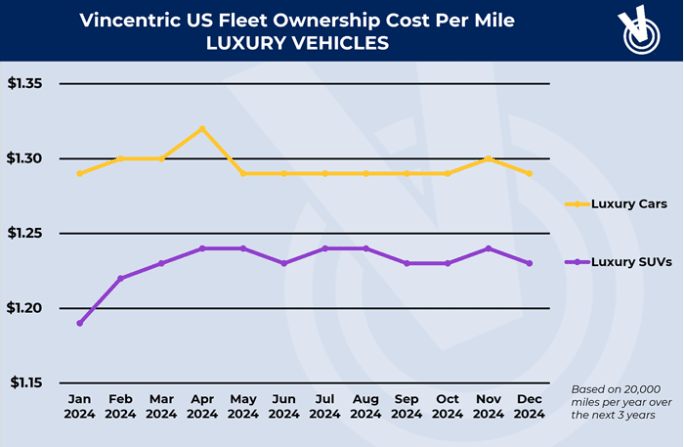
While Luxury Cars and Luxury SUVs saw more dramatic cost spikes to start the year, both categories leveled off during the final three quarters of 2024.
Image: Vincentric
Vehicle TCO: Rocky or Calm for 2025?
Yet while costs are level — a welcome circumstance for budget planning — they aren’t likely to come down.
These factors contribute to higher TCO:
Average vehicle transaction prices are again close to all-time highs.
With elevated inflation and low unemployment, the Fed is unlikely to cut interest rates.
Parts, labor, and overall maintenance costs show no signs of abating.
However, there are mitigating factors that should keep TCO spiking in the coming year:
With depreciation being the biggest cost factor of TCO, used-vehicle values stabilized in 2024, according to Cox Automotive, and will return to normal depreciation patterns in 2025. Fewer lease maturities will buoy values.
In the second biggest category, fuel, the U.S. Energy Information Administration (EIA) predicts that gasoline prices will decrease by 10 cents a gallon in 2025 and fall further in 2026.
More Operations

Fleetio, ASE Launch Scholarship Program for Automotive Technicians
The second annual program will award 15 scholarships totaling $35,000 to support ASE certification, testing fees, and equipment costs.
Read More →
Reading the Global Signals: What AI and the Energy Transition Mean for Fleets Now
How can fleet managers navigate a never-ending, changing industry landscape?
Read More →
90% Use Telematics. Are Fleets Getting Safer? | AF News Recap
This week, we're breaking down which industries have the highest rates, how Jamie McKay manages 2,400 vehicles, what's happening with the 2027 fleet awards, and why software-defined vehicles could introduce new costs.
Read More →
What's Best Handled by an FMC, and What's Better Done Directly?
Fleet managers continue to rely on FMCs for essential services but are taking a closer look at where working directly with suppliers can improve efficiency and responsiveness.
Read More →
Fleet Meets: Erin Gilchrist
Meet Erin Gilchrist, the inaugural Mike Antich Spirit of Fleet Award winner, as she shares insights on leadership, mentorship, the power of industry connections, and why people remain at the heart of fleet's future.
Read More →
How 2026 Fleet Visionary Jamie McKay Manages 2,400 Vehicles Across 37 States
How do you keep 2,400 vehicles running across 37 states? Fleet Visionary Award winner Jamie McKay shares how collaboration, flexibility, and a few simple strategies help her tackle fleet management challenges at Aptive Pest Control.
Read More →
Managing Fleet Costs in an Era of Permanent Volatility
Fleet operating costs have risen more than 20% since 2020, raising a key question: When does extending a vehicle's service life stop making financial sense?
Read More →
The Next Evolution of Fleet Management: Autonomous Operations
This opening keynote session at the Fleet Forward Conference highlights the future of autonomous driving for fleets.
Read More →
How to Reduce the Total Cost of Risk From Catalytic Converter Theft
A stolen catalytic converter can cost fleets far more in downtime and lost productivity than in repairs. A total-cost-of-risk approach can help fleet managers quantify their exposure and prioritize theft prevention.
Read More →
Personal-Use Charges Rise as Vehicle Values Fall | AF News Recap
Personal-use charges are climbing, wholesale used-vehicle values are declining, and commercial fleet sales growth is slowing. This week, we're breaking down the latest fleet data, plus how Element Fleet Management is helping Waymo prepare for its first Canadian robotaxi market.
Read More →