




Where Is Fleet Growing?
We combined research and economic metrics to determine the industry types and segments that are poised to add company-owned vehicles.
March 5, 2025


Healthcare industries will see massive growth in the next 10 years, and fleet growth will follow in certain sectors.
Photo: Automotive Fleet
6 min to read
Where is fleet growing in the U.S.?
First, let’s define “fleet” for this analysis as any non-consumer vehicle owned or leased by a business entity or organization, from one to thousands of units.
The next step is to identify the hot sectors of the economy and growth industries, and then analyze them by revenue growth, output, or job creation.
To start the analysis, we chose job creation because it is more directly related to the growth of workers who require job tools such as vehicles or equipment.
We used data from the U.S. Bureau of Labor Statistics (BLS) that projects growth by sector from 2023 to 2033, detailing percent change and numeric job increases. We benchmarked against BLS data that projects total employment to grow 4% annually in that time period, which will add an estimated 6.7 million jobs.
By analyzing which industries in the BLS data rely on fleet vehicles, we can predict where fleet expansion is most likely in the next decade.
For added color in some industry subsegments, we included a compound annual growth rate (CAGR) and total market size that can be benchmarked against the historical U.S. GDP growth rate of 2%-3%.
Industries Driving Fleet Growth
Per BLS data and with growth rates compiled by Grand View Research, here are the fastest-growing industries by job creation and their fleet implications:
1. Healthcare (15.2% growth, +1.14M jobs)
As Baby Boomers enter their 60s, 70s, and 80s — and as life expectancy increases — the U.S. population is aging at a scale never seen before. To meet this need, telemedicine, robotics, personalized medicine, and AI are being woven into healthcare services and long-term care.
Pharmaceutical & Medical sales (5.72% CAGR, total value $602B): Passenger car fleets are staples of this major segment of corporate fleets. Five of the top 10 pharmaceutical companies headquartered in the U.S.
Home Healthcare (7.48% CAGR, $142.9B): The shift to home-based care means more nurses, therapists, and caregivers traveling to patient homes. AF estimates that 20% to 40% of home healthcare needs will be satisfied by company-owned vehicles.
Durable Medical Equipment (CAGR 5.61%, $66.8B): The medical device industry needs cargo vans and refrigerated medical transport vehicles to transport equipment such as mobility aids, hospital beds, oxygen tanks, and medical devices.
Healthcare & Technical Practitioners (8.6% CAGR, 841k jobs): This subsegment of health includes nurse practitioners, surgical technologists, and physicians’ assistants. Most use personal vehicles, but fleet use would include hospital transportation, emergency services, and mobile medical units.
Other growing fleet-dependent sectors in healthcare include non-emergency medical transport (NEMT) and specialty vehicles for mobile diagnostic and imaging clinics (11.2% CAGR, $1.66B).
2. Computer & Mathematical (12.9% growth, +699K jobs)
The monumental surge in cloud computing and AI-related jobs is fueling hockey stick growth in this large industry. Also including information technology, this industry was valued at $489.2B in 2023.
While tech industry jobs are largely remote, companies still need field IT services and tech equipment transport.
Data centers are coming online to meet the need, requiring fleet vehicles to construct them and vans to service backup systems, networking hardware, and cybersecurity operations.
3. Community & Social Services (8.1% growth, +247K jobs)
In the public sector, this is where the growth is, though most jobs in community and social services rely on personal vehicles and the overall market size is hard to quantify. BLS projects the subsegment of social workers to grow 13% from 2020 to 2030.
Fleet use includes government service vehicles and nonprofit transportation. Social workers, child welfare agents, and mental health counselors frequently conduct home visits, often using agency-owned vehicles.
Food banks & community outreach programs use box trucks and cargo vans to distribute aid.
4. Renewable Energy (6.9% growth, $269B)
While BLS stopped measuring “green” industries in 2013, we felt it worth breaking out the renewable energy category based on its long-term CAGR potential, overall market size, and subsequent fleet needs.
This sector encompasses solar and wind energy jobs that require bucket trucks, cargo vans, and heavy trucks to transport solar panels and wind turbines. EV charging infrastructure needs service trucks and technician vehicles. Biofuels and hydrogen need specialized tanker trucks and fleet fueling solutions.
This growth may be hampered, at least in the short term. The present administration is attempting to block federal funding from the Inflation Reduction Act and Infrastructure Investment and Jobs Act, two major funding sources for new projects.
5. Installation, Maintenance & Repair (5.3% growth, +343K jobs)
This is an extremely broad category consisting of small business trades likeHVAC, plumbing, electrical services, general maintenance, and telecommunications, which are all dependent on fleet vehicles.
The growing utilities and telecommunications sector relies on fleet vehicles for installation, maintenance, and repair of essential services like electricity, water, and internet.
While overall growth is relatively modest, these jobs are not in danger of disruption, with technology-related jobs fueling growth.
6. Transportation & Material Moving (4.3% Growth, +530K Jobs)
Including trucking, last-mile delivery, and logistics, this is another broad category with various subsegments experiencing different growth rates.
Although e-commerce (CAGR 10.35%, $1.31T) growth slowed after the pandemic, this sector of the economy remains a powerhouse and is driving expansion. Fleet use includes last-mile delivery vans, straight trucks, and semis.
General Freight Trucking is expected to grow at the overall average rate.
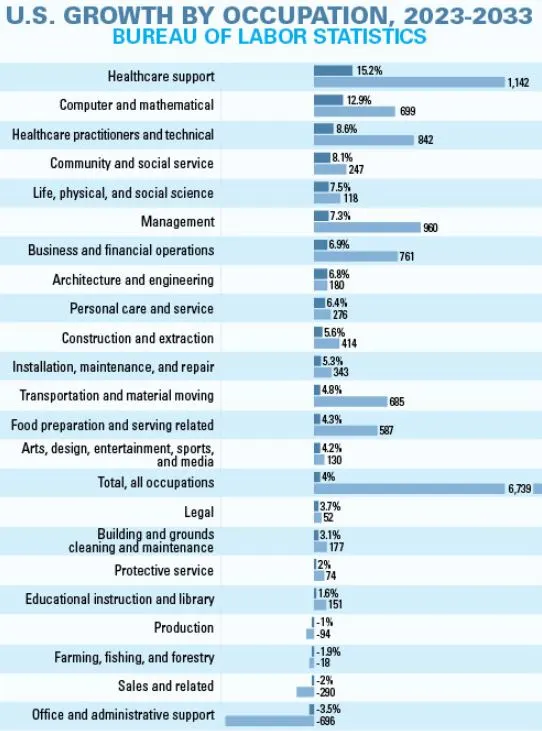
The dark blue bar denotes the percentage change by industry, while the light blue bar signifies the change in thousands of jobs. Smaller industries may experience a greater growth percentage but not add as many jobs as larger ones.
Chart: Automotive Fleet
Growing Industries with Minimal Fleet Presence
Not all growth industries have significant fleet vehicle needs, but are worth noting:
Education (6.3% Growth, +674K Jobs): The integration of online learning platforms and educational technology is a major driver of growth in areas like e-learning and “digital upskilling.”
The school bus fleet market is stable, but job growth is in teaching positions, not transportation.
Food Preparation & Serving (4.3% Growth, +1.1M Jobs): Cloud (or “ghost”) kitchens are emerging as the fastest-growing segment, as 30% of new restaurant concepts are projected to be delivery-exclusive by 2025.
Satisfying the need are gig delivery services such as DoorDash and Uber Eats, but not company-owned fleets.
Management (3.9% Growth, +656K Jobs): Growth in corporate roles does not translate into fleet expansion.
Industries with Flat to Declining Growth
Some industries are adding jobs but may see fleet contractions due to technology, automation, or shifting business models. Those include:
Retail (-500K Jobs): Declining brick-and-mortar stores mean less demand for retail delivery fleets.
Manufacturing (Flat Growth): Automation and offshoring limit the need for logistics fleets tied to factory production.
Farming, Fishing & Forestry (-1.9%): The jobs are expected to decline over the decade.
Ocean acidification and rising water temperatures, along with increasing wildfires and insect infestations, are negative factors in these industries. However, automation in agriculture should fuel some fleet growth.
Industry Growth by Region
While BLS does not publish forecasts based on regions or states, it is affiliated with Projections Managing Partnership (PMP), a repository where states can report growth projections by job type and industry.
Looking at the PMP data by region, the fastest job-growth states are in the Southwest and Mountain West in Utah, Idaho, and Colorado.
Mountain West and Southwest states will see growth in renewable energy projects and technology, whilestates like Florida, Georgia, and the Carolinas are experiencing rapid growth in healthcare infrastructure to support their aging populations.
Subscribe to Our Newsletter
More State of the Fleet Industry

Is the Future of U.S. Fleets Already Unfolding Overseas?
Fleet Forward Conference keynote speaker John Rossant examines how AI, autonomy, and electrification are converging, and why developments in China, Europe, and the Middle East could preview what’s coming for U.S. fleets.
Read More →
Fleet Meets: Amy McAdams
In this edition of Fleet Meets, Amy McAdams shares how an unexpected career move led to more than 15 years in fleet.
Read More →
From Tactical to Strategic: A Fleet Manager's First 90 Days
The first 90 days as a fleet manager can be daunting, and the role has changed a lot over the years. What's important now?
Read More →
Fleet Industry Mourns the Passing of Donna Bibbo
Fleet leader Donna Bibbo passed away after a long battle with uterine cancer and a failing heart.
Read More →
Personnel Update: BrickHouse GPS, PRO-VISION, Auto Driveaway, and Proaction
Check out the latest must-know fleet personnel updates from the last couple of months.
Read More →

‘Mike Just Gives Cars to People’ — And Other Misconceptions Fleet Managers Need to Fix
Most organizations misunderstand fleet. The best managers make sure that doesn’t happen.
Read More →
Why Union Leasing Rebranded to Moventum Fleet Management
Mark Hogland discusses Union Leasing’s transition to Moventum Fleet Management and how the rebrand reflects the company’s growing focus on strategic fleet management and lifecycle support.
Read More →
From Storm Response to Data Strategy: Fleet Trends to Watch | AF News Recap
In this AF news recap, host Faith Howell covers this week's most pressing industry updates.
Read More →
Report: 36% of Fleet Managers Are Delaying Replacements
Element’s 2026 Market Pulse Report finds fleets are slowing replacement cycles amid tariffs, economic uncertainty, and rising costs.
Read More →