





Blast from the Past: Check out the 2011 Survey to See How Far You've Come.
2024 Personal-Use Survey: Weighing Perks & Charges
Personal-use charges have not kept pace with rising vehicle ownership costs, even as some fleet managers report a distinct rise in personal-use miles.
November 27, 2024
Photo: Automotive Fleet
8 min to read
The company car has been a staple of the corporate world since the advent of passenger car fleet leasing in the early 1950s.
As company cars are both a tool and a perk — just ask Mary Kay’s independent beauty consultants about their pink Cadillacs — fleet managers and CFOs have wrestled for generations with balancing the business and personal use of those vehicles. Policies have evolved to maintain cost efficiency, ensure compliance with tax regulations, and address employee satisfaction.
Automotive Fleet has been gauging this evolution by surveying its fleet manager readers on their personal-use policies since 2008. What’s changed since then?
Some answers can be found by comparing the results of the 2024 survey with previous years.
2024 Personal-Use Survey Findings
The 2024 survey was deployed from Sept. 6 through Oct. 17 with 96 responses received. Here are some findings and trends:
In the 2024 survey, 72% of respondents allow personal use of company vehicles. This percentage has steadily declined since the survey’s inception in 2008, when 87% of respondents permitted personal use.
The majority of respondents (52%) charge nothing for personal use. The next highest category is “Less than $130,” at 25%. The average monthly charge for personal use in the 2024 survey, excluding respondents who identified “no charge,” is $123. Only 13% of respondents said personal use charges rose last year.
Personal-use charges have crept up since 2008, when the average monthly amount was $108. However, personal-use charges in subsequent surveys have not kept pace with the rise in vehicle ownership costs.
About 60% of respondents reported that only the employee is allowed to drive the vehicle, while 38% allow a spouse or “significant other” to drive. A much smaller 6% allows employees’ licensed children to drive the vehicle. These percentages have roughly held steady since the survey’s inception.
In the current survey, only 44% of respondents require a motor vehicle record (MVR) check of authorized drivers other than the employee. This percentage has been trending downward since the 2008 survey, when 58% required an MVR check of non-employee drivers. In the 2019 survey, the figure was 49%.
In the current survey, only 53% of respondents allow their drivers to use the company vehicles “at all times, whenever necessary.” This percentage has been decreasing and is at the lowest point since the inaugural survey (76%).
In the 2024 survey, 41% of respondents indicated they never perform a personal-use reconciliation or “true-up” with their drivers, the highest percentage since the inaugural survey reported 17%.
Fleet managers from two large sales and service fleets weigh in on their challenges in managing personal use in today’s environment and with a new generation of drivers.
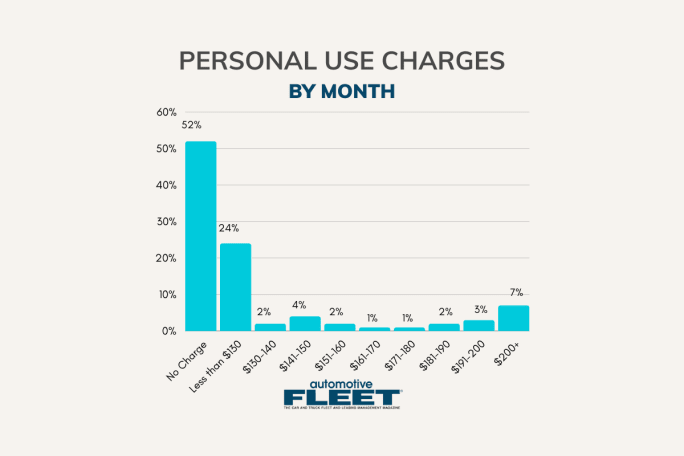
In this year’s survey, 52% of respondents identified as not charging for personal use — underscoring the value of a company car as a perk and a driver of employee retention.
Image: Automotive Fleet Research
Mondelez International:Managing an Alarming Personal Use Increase
Vincent Ricciardi, North American fleet senior manager for Mondelez International, owner of Nabisco and other food brands, recently analyzed the pros and cons of raising the personal use deduction for his drivers.
Mondelez’s deduction is $115 per month, a scale that has remained the same since 2016.
He calculated that bumping the deduction by $5 would have minimal impact on the company, “and I figured it wasn’t worth it to change, given other employee initiatives," Ricciardi said.
He said that the benefit of a company car is an important part of employees’ compensation packages and helps with retention. Besides, Ricciardi has other levers to pull to manage his fleet’s total cost of ownership, which has decreased in aggregate over the past few years.
Mondelez allows personal use for in-household spouses and significant others who have been at the address for at least six months. The personal-use deduction amount is based on the employee’s salary, usually tied to the car.
The cars are on open-end leases with a 36- to 48-month term. They top out at about 65,000 miles.
About 80% are in retail sales, doing daily store deliveries and putting 20,000 to 30,000 miles on the car. The remaining 20% are from customer teams, who put a lot fewer miles on the car and may hit the threshold to revert to reimbursement.
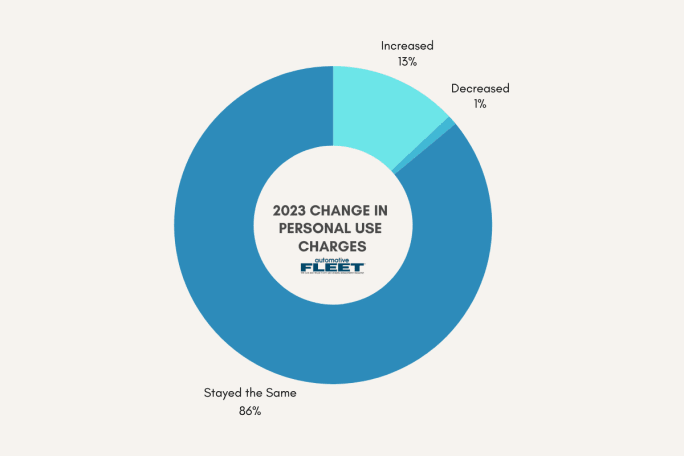
The overwhelming response to this question in every survey since its inception has been “stayed the same.” This highlights that personal-use charges increase incrementally, and fleet managers do not raise them in successive years.
Image: Automotive Fleet Research
Drivers Blowing Through Mileage Caps
Ricciardi has seen an alarming increase in personal use of company vehicles since the pandemic, particularly with newer drivers. “They wouldn't be driving for rideshare companies, but what are they doing? Some are meeting their mileage caps within 18 to 24 months.”
The fleet is not equipped with telematics, so Ricciardi tries to piece together a breadcrumb trail based on fueling frequency and location. When egregious personal use is identified, “We work with their managers and human resources, and approximately half the time, it stops,” he said.
Keeping personal-use miles in check should also lessen exposure to crashes. The fleet has recently suffered a couple of total losses with a spouse behind the wheel. "We are looking to make some policy changes, and our risk department agrees with these needed changes," he said.
Any changes moving forward will not include a cap on personal mileage.
Mondelez does not run MVRs on spouses or significant others, nor does it require a drug test. The responsibility for the vehicle falls on the employee even when they aren’t driving.
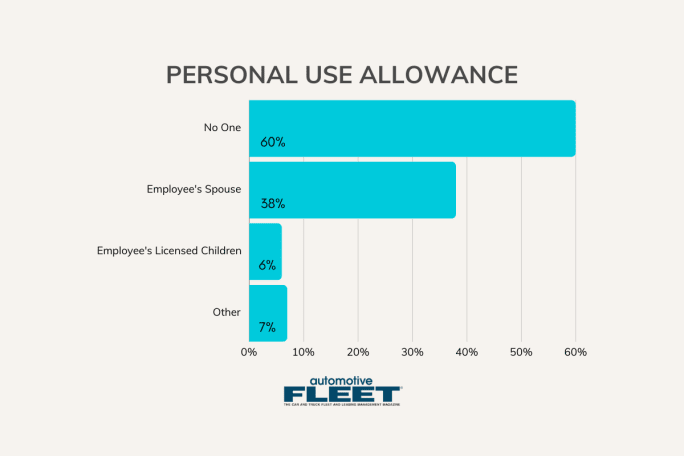
The percentage of respondents who only allow employees to drive the company’s cars has increased dramatically from the early years of the survey, when percentages of employee-only use ranged between 20% and 34%. (Other responses were primarily “domestic partner.”)
Image: Automotive Fleet Research
BD: Benchmarking Makes the Case for Upping Personal Use Charges
Jennifer VrMeer, the fleet manager for BD, a global medical device company, manages a sales and service fleet of about 2,500 passenger vehicles in North America. Driving predominantly midsize SUVs, company reps primarily visit hospitals, followed by surgery centers, clinics, and doctors’ offices.
Like Ricciardi, VrMeer has kept a lid on the personal use charge. But that recently changed. “Over the last 10 years, we haven’t made any adjustments and tried to absorb the continuously increasing program costs as much as we can, as we were trying to exit the pandemic,” she said. “But this past year, we felt it was time to reassess our strategies.”
Like the Mondelez fleet, personal use of a company vehicle is limited to employees and their spouses or domestic partners. Eligible employees have the option of an allowance, which became available in 2021. “It's in recognition of a newer generation of our sales force,” she said.
Some employees live in metro areas where a company car poses parking and other challenges, while others prefer to use their vehicle and feel they’re pocketing a bit in the exchange.
Overall, the mileage driven by BD’s company car drivers has dropped slightly since the pandemic. VrMeer looks to de-fleet at three years and 75,000 miles for sales reps and 80,000 miles for service reps. If the mileage is lower, they’ll stay in the car longer.
When BD acquires a company, one challenge is to harmonize car policies, including personal use deductions, between the parent and acquired companies.
With help from her fleet management company, VrMeer set about benchmarking her fleet’s personal use against similar types of companies, fleet makeup, and duty cycles.
The benchmarking data told her that other companies also use a flat rate and have increased their personal use slightly.
With this data, she got management approval to slightly increase the personal use deduction in October, mainly to keep up with the ongoing inflation.
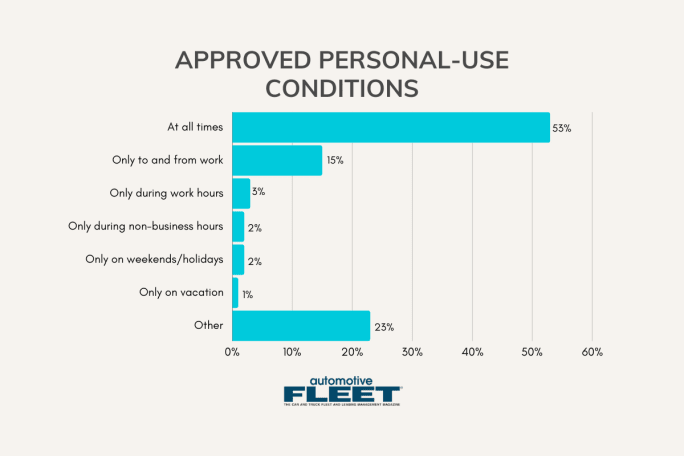
The percentage of respondents who allow personal use “at all times, whenever necessary” has trended downward since the first few surveys, which averaged about 75%. (“Other” responses in this survey were primarily “personal use not allowed.”)
Image: Automotive Fleet Research
The Case for Increasing Personal-Use Rates
Like Ricciardi, VrMeer has also noticed an increase of about 5% to 8% in personal-use miles since the pandemic and believes this number could be higher due to underreporting.
“We felt this year we had a very strong case to bring (an increase) forward,” she said.
VrMeer recognizes that while their adjustment is not alarming, any increase needs to be appropriately communicated to employees. The benchmarking data allows her to show her fleet drivers that rising costs and more personal-use miles precipitate the increase.
BD’s safety program includes online training and requires ongoing MVR checks of both primary and authorized drivers (significant others).
The company’s system for infractions is based on point accumulation. The threshold of points to disqualify a driver from using the vehicle is much lower for a significant other than for an employee. She said these types of disqualifications rarely come up based on MVR data.
While VrMeer has seen mileage increase outside of business hours, she hasn’t identified a trend of unauthorized use. However, business mileage has decreased overall since the pandemic.
The cause is partly a change in how their reps conduct business. She said some of those meetings are not directly related to sales but are more about maintaining customer relationships, and many of these meetings are now held digitally.
Another pandemic change was the hybrid work environment that now includes home offices. For drivers under reimbursement, VrMeer said issues have arisen regarding whether the employee can be reimbursed from home to the first customer and from the last customer to home.
She said education and awareness of IRS guidelines and regulations can sometimes be challenging.
The advent of electric vehicles in fleets might be the next reason to revisit another personal-use adjustment. BD has not yet embarked on a large-scale deployment of EVs.
With depreciation higher on both hybrids and EVs, “I think personal use is really something that we need to keep an eye on and benchmark,” she said. “The cost of the program will continue to go up, and we need to be more proactive in addressing some of these challenges vs being reactive.”
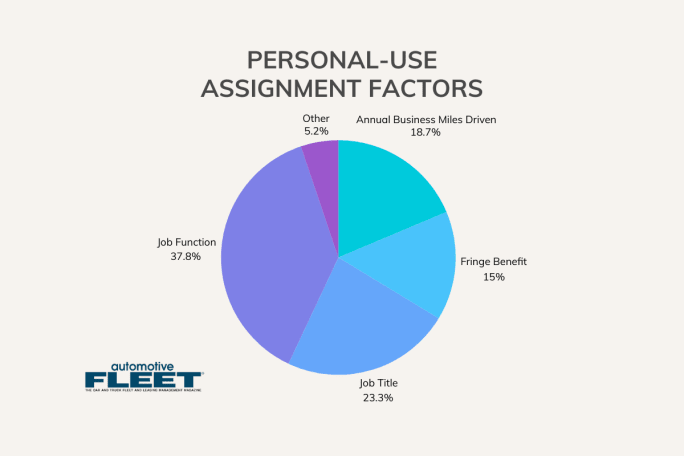
“Job function” remains the number one response to this question since the survey’s inception. (“Other” responses include “case by case” or “management approval.”)
Image: Automotive Fleet Research
Recognizing the New Generation of Fleet Drivers
In addition to pandemic-related changes in driving patterns and drivers’ needs, Ricciardi and VrMeer are aware of subtle generational changes.
Ricciardi said the newer sales force has grown up where a car isn’t as important to them as a new cell phone. They may even enter the workforce with less practice driving a car. “For some, it’s the first car they’re getting,” he said, noting his findings are anecdotal.
He said two employees in the management training program didn’t even want a car, which is a shift in attitude from experienced drivers.
VrMeer has observed that the new generation is more open to foreign automakers, such as Korean brands like Hyundai, whereas the more seasoned sales force and those from a generation ago would have pushed back and preferred the more traditional makes and models.
The new generation is generally more concerned with specs and trunk space over the make or model. "They’re not as tied to the prestige or reputation of the brand as the previous generation when it comes to their company car,” she said.
Subscribe to Our Newsletter
More Operations
Here's When You Should Make an Exception to Fleet Policy
Fleet policies are designed to create consistency, but not every driver or situation fits neatly within standard rules.
Read More →
AI-Native or AI-Acquired: What Should Fleet Managers Look for in an AI Platform?
Six questions can help fleet managers look beyond AI marketing claims to evaluate integration, data access, and real-world operational performance.
Read More →
Sponsored•October 14, 2026
A buyer's guide to fleet management software in 2027
Buying fleet management software in 2027 means looking beyond features and price. As fleet operations, technology and expectations evolve, this guide explores what today’s fleet professionals should consider when choosing a system that can deliver value now and adapt to what comes next.
Read More →

What Will Shape the Next Era of Fleet Management?
EVs, AI, and autonomous vehicles are reshaping fleet management. Discover what’s ahead—and how fleet leaders can prepare for the next era.
Read More →
How Fleets Can Recruit and Train Veterans for Technician Roles
Here's how the technician shortage has affected uptime for fleets, and what to do about it.
Read More →
Avis Budget Group Deploys Neology Toll Management Technology Across Major Brands
Neology’s neoFleet platform will manage toll transactions and toll-authority operations for vehicles across Avis, Budget, Payless, Budget Truck and Zipcar.
Read More →
Fleet Personal-Use Charges Edge Higher in 2026
Nearly eight in 10 surveyed fleets allow personal use of company vehicles, while just over half of respondents report charging employees for the privilege.
Read More →
The Future of Fleet + What’s Changing Right Now | AF News Recap
Could developments overseas offer a preview of what’s coming for U.S. fleets? This week, we’re looking at the future of AI, autonomy, and electrification, plus Ford Pro’s new certified pre-owned program, smarter vehicle offboarding, and a new way for fleets to manage toll expenses.
Read More →
How to Handle Vehicle Offboarding
What do fleet managers need to do when a driver leaves?
Read More →
Sponsored•October 1, 2026
Fleet Manager’s Ultimate Playbook: Navigating the New Standard in OEM Connectivity
Rising operating costs, driver safety concerns, and unplanned downtime are putting unprecedented pressure on modern fleets. Discover how fleet managers use embedded OEM connectivity and real-time vehicle data to cut TCO, prevent downtime, and protect drivers without aftermarket telematics hardware.
Read More →