




How Cellular Networks Keep First Responders Connected When It Counts
From hurricanes to wildfires, staying connected is everything. Here’s how AT&T and FirstNet help first responders stay online when disaster strikes.
May 1, 2025

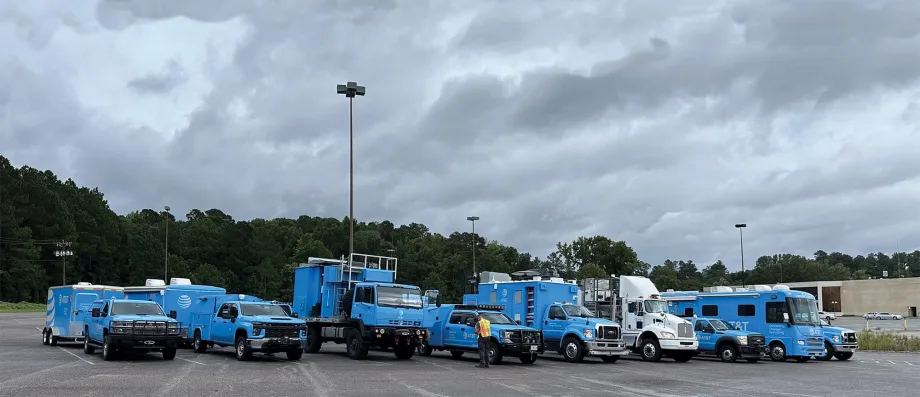
FirstNet deployable network assets deliver critical connectivity to first responders during disasters.
Credit:
AT&T
7 min to read
When a natural disaster hits, first responders are among the first to face the chaos. They’re restoring power lines, navigating flooded streets, delivering emergency care, and coordinating rescue efforts. But none of it works without one critical element: communication. Emergency crews need to know that their calls, messages, and data will go through in a world where nearly everything depends on staying connected. That’s where cellular providers step in with tools designed specifically for crisis response.
WHY DISASTER ZONES STRAIN THE NETWORK
A hurricane, wildfire, earthquake, or widespread power outage can seriously impact communication infrastructure. Damaged cell towers, downed fiber-optic lines, and power grid failures can all lead to slower speeds, dropped calls, or complete service loss.
We track incoming stormsand other events in real-time to position equipmentand staff even before the worst hits.
Disasters trigger a spike in overall network use, making situations worse as people scramble to call loved ones, access news updates, and coordinate their own response efforts.
That massive increase in traffic can create a virtual traffic jam on the network. And emergency communications could get stuck in the same gridlock without the right systems in place.
HOW AT&T REINFORCES ITS NETWORK FOR CRISIS
AT&T has invested heavily in keeping its network resilient in the face of disaster. Its response includes a dedicated Network Disaster Recovery (NDR) team and a host of deployable tools designed to restore service quickly when infrastructure takes a hit.
Since 1992, the company has spent over $1 billion to build this specialized unit. The NDR team has over 750 deployable network assets, 11,000 portable generators, and thousands of supporting equipment and heavy machinery. That includes cell towers on wheels (COWs), cells on light trucks (COLTs), and Compact Rapid Deploy ables (CRDs) that can be set up directly at the site of a disaster.
“When disaster strikes, our team is already in motion,” said Alex Annunziato, product manager for AT&T Connected Solutions. “We track incoming storms and other events in real-time to position equipment and staff even before the worst hits.”
FIRSTNET PRIORITY ACCESS AND PREEMPTION: THE NETWORK FAST LANE
Even with the strongest infrastructure, the technology behind the scenes makes a difference for first responders. FirstNet subscribers have two key tools to help ensure their communications don’t get lost in the noise: priority access and preemption.
Here’s how it works. Think of a typical cellular network like a highway. In normal conditions, everyone shares the same lanes. But during a crisis, traffic piles up fast.
With FirstNet’s priority access, emergency personnel are automatically moved to the fast lane. Their messages, calls, and data requests jump to the front of the line, always prioritized and never competing with commercial traffic.
Preemption takes it even further, pushing other users out of the lane entirely to make room for critical communications.
With nationwide coverage, FirstNet traffic is never throttled anywhere or at any time in the U.S., ensuring emergency responders stay connected when it matters most.
“FirstNet gives us the ability to put emergency responder sat the front of the network,” Annunziato said. “It’s always on, always ready, and doesn’t require any manual steps from the user.”
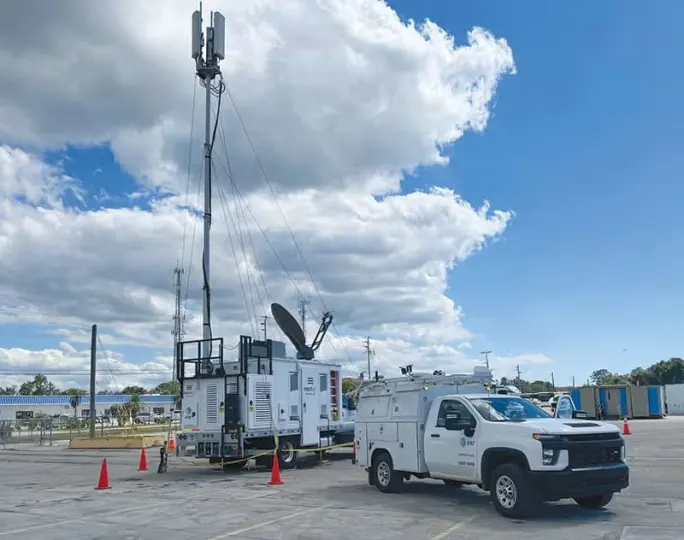
AT&T FirstNet teams work on-site to restore and maintain communications in disaster zones.
Credit:
AT&T
FIRSTNET AND BAND 14: AMERICA’S PUBLIC SAFETY NETWORK
Through a public-private partnership with the federal FirstResponder Network Authority, AT&T operates FirstNet, a nationwide broadband network exclusively for first responders. The system spans more than 250,000 square miles and provides 99.99% reliability.
A key advantage of FirstNet is the Band 14 spectrum is reserved just for public safety, for which AT&T has exclusive access for FirstNet. It acts as a dedicated lane for emergency use, which helps cut down on network congestion and gives crews access when needed most.
FirstNet service goes beyond just police, fire, and EMS teams. It’s available to what AT&T defines as Primary Users and Extended Primary Users, a group that includes not only traditional first responders, but also utility workers, public works, and others critical to disaster response and recovery.
There are two types of users: Subscriber Paid Users, who verify eligibility and enter a Customer Service Agreement with AT&T, covering their service costs, and Agency Paid Users, whose service is covered by their Public Safety Entities (PSEs), ensuring communication during emergencies without personal financial responsibility.
WHAT HAPPENS WHEN INFRASTRUCTURE FAILS?
Even the strongest infrastructure can take a hit, so mobile and backup systems are important. If a tower goes down, it
doesn't mean the response stops.
AT&T's fleet of deployables can be sent into disaster zones to replace or boost coverage. FirstNet customers also have access to a dedicated fleet of over 180 mobile assets at no additional cost. Some agencies even purchase their own CRDs or mini-CRDs to expand coverage on demand. High-Power User Equipment (HPUE) is also available to amplify the reach and strength of signals in areas with weak coverage.
This layered approach helps reduce blind spots and ensures teams stay connected, even if traditional infrastructure fails.
SATELLITE VS. CELLULAR: CHOOSING THE RIGHT TOOLS
When it comes to disaster communication, no one solution fits every need. A hybrid approach (cellular and satellite) is often the most reliable.
Cellular networks are fast, familiar, and relatively affordable. However, they depend on land-based infrastructure, which can be damaged or overwhelmed. On the other hand, satellite offers global coverage and independence from local systems.
In rural areas or places with heavy damage, satellite communication can fill in the gaps where towers don't reach. It's especially helpful for agencies operating in remote locations or fleets crossing wide areas with patchy service.
AT&T's integrated approach allows responders to shift between platforms as needed without swapping devices or systems.
Aspect | Cellular | Satellite |
|---|---|---|
Infrastructure | Land-based towers and fiber | Satellites and ground stations |
Coverage | Depends on physical infrastructure | Independent of local damage |
Reliability | Depends on physical infrastructure | Independent of local damage |
Latency | Low | Higher |
Cost | Affordable | More expensive |
Speed | Fast with 4G/5G | Improving butslower |
Best Use | Everyday use and rapid deployments | Backup and remote access |
USING DATA TO STAY AHEAD
Technology is only part of the equation. The ability to predict, prepare for, and respond to disasters depends on smart data.
AT&T monitors natural disasters daily using artificial intelligence (AI) and data analytics to anticipate risks and pre-position assets. These tools help shorten response times, prioritize recovery tasks, and support decisions in the moment.
"Every time we deploy during a disaster, we learn something," Annunziato said. "That data helps us get faster, smarter, and more targeted with each event."
While the company declined to share specific service-level timelines for restoring towers, they emphasized that every major event fuels new improvements in their disaster response playbook.
STEPS FLEETS CAN TAKE BEFORE DISASTER HITS
Waiting for a disaster to hit before making a plan isn't an option for businesses and public agencies that rely on connectivity. Building a disaster recovery strategy with redundant communication paths can make the difference between downtime and resilience.
Even basic steps like having walkie-talkies or offline data backups can help keep operations moving. More advanced measures might include equipping vehicles with satellite backup, investing in HPUE devices, or integrating CRDs into your facility plans.
"Don't assume the network will always be there," Annunziato said. "We work hard to ensure it is, but every organization needs a plan that covers the what-ifs."
LOOKING AHEAD: NEW TOOLS ON THE HORIZON
Emergency communication is evolving, and AT&T is at the forefront of this change. As 5G advances, technologies like network slicing are no longer just concepts; they're already in action. This early wave of 5G innovation enables more precise service levels, including the ability to separate public safety traffic at a software level for unmatched reliability and priority access when it matters most.
The integration of satellite constellations, such as AST SpaceMobile, could also reshape what is possible for mobile coverage in remote or rapidly changing environments. And as Al continues to play a larger role, expect faster decision-making and more automated network recovery tools.
Staying ready means understanding your tools, building redundancy, and partnering with providers who understand what's at stake when the signal matters most.
When a disaster happens, communication isn't a luxury; it's a lifeline. Whether managing a city fleet or overseeing regional emergency response, knowing your tools and building backup systems can mean the difference between delay and decisive action.
Subscribe to Our Newsletter
More Disaster Response
From Storm Prep to Emergency Response: The Growing Role of Telematics in Disaster Management
Telematics is transforming disaster response by giving fleets real-time visibility, improving routing, readiness, and coordination when every second counts.
Read More →
Disaster Readiness Is Not a Fleet Count, It’s a Stress Test of the Whole System
Fleet readiness isn’t about your vehicle count. It’s about condition, capacity, and whether your system can actually perform under stress.
Read More →
How Fleets Keep Fuel Flowing During Disasters
U.S. Bank Voyager explains the most common fleet payment failures during emergencies and how proactive planning helps keep vehicles moving when conditions deteriorate.
Read More →
The Waffle House Effect: How They Impacted How Storms are Measured While Keeping Hot Meals Ready
Why one restaurant chain became a benchmark for disaster response and what fleets can learn about readiness, operations, and recovery.
Read More →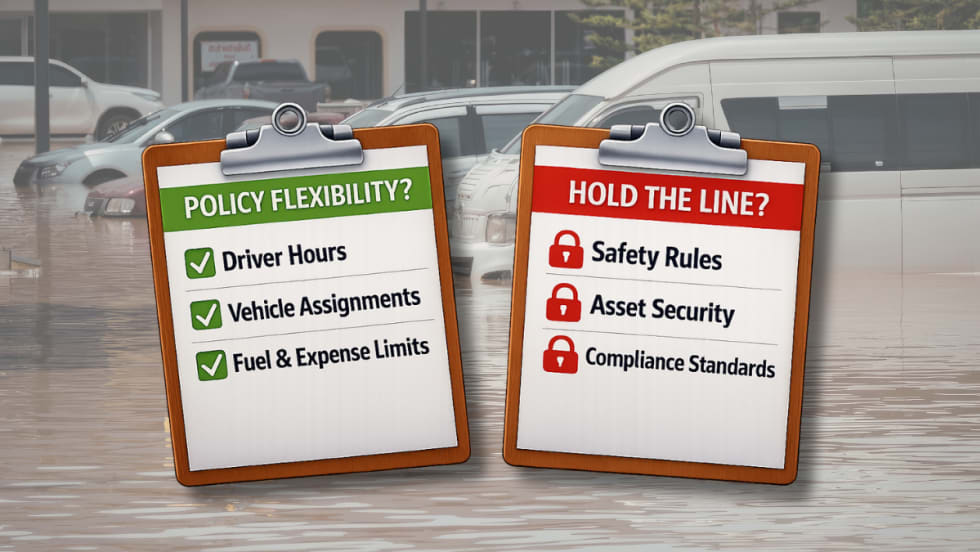
Adapting Fleet Policy When Disasters Strike
In the middle of natural disasters fleet managers must shift priorities to protect people and assets. What policy items should be loosened, and when should the line be held?
Read More →
When Fuel Runs Out, the Fleet Plan Falls Apart
When disaster hits, fleets fail on fuel, power, and idle planning. See the energy gaps fleet managers need to fix before the next storm.
Read More →
The Missing Data Point in Disaster Response
Human reports fill the gaps that telematics can’t during disasters. Here’s how fleets can use structured input (not social chaos) to respond faster and safer.
Read More →
Essential Strategies for Fleet Preparation and Protection During Hurricane Season
Prepare your fleet for hurricane season with proactive strategies to protect drivers, vehicles, and assets before, during, and after the storm.
Read More →
When Disaster Strikes: Equipping Your Fleet for Survival and Recovery
Discover how fleets can stay operational during hurricanes, wildfires, floods, and storms with strategic planning, technology, and data-driven maintenance.
Read More →
Mobilizing for Recovery When it Matters Most
When disaster strikes, reliable transportation becomes a lifeline for recovery, ensuring first responders and relief crews can reach those in need most.
Read More →