





Use this vehicle research tool to compare lifecycles costs and fleet incentives by model & class.
Carbon Emissions Vs. Ownership Costs: Pickup Trucks
When comparing a vehicle’s carbon emissions and its total cost of ownership, which vehicles and powertrain types in the half-ton pickup segment offer the maximum benefit for the money? [Part 2 of 5]
March 6, 2025
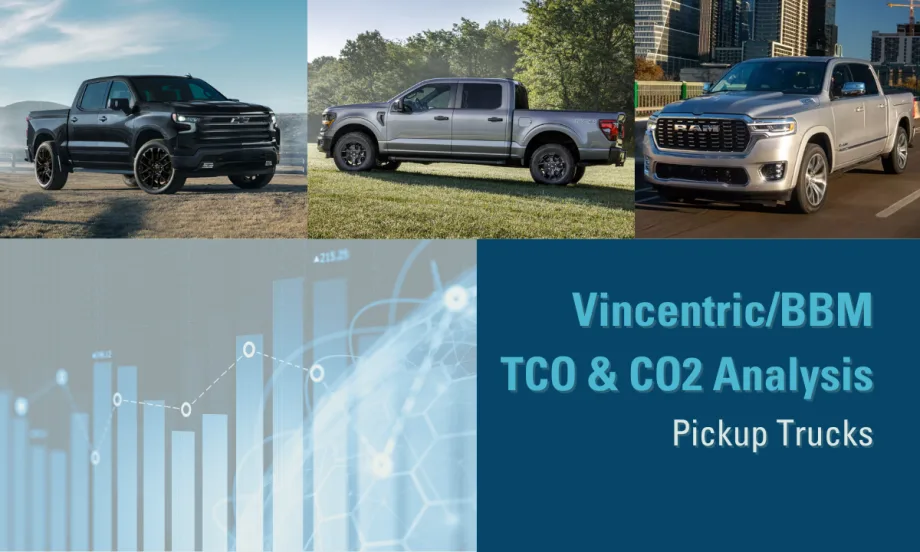
The half-ton pickup segment offers gas, diesel, hybrid, and electric powertrains and has the most configurations per model of any segment.
Photo: BBM
4 min to read
For most corporate fleet managers, balancing sustainability initiatives while keeping fleet costs in check is a top priority. Yet sourcing vehicles’ carbon emissions, matching them to vehicle routes, defining ownership costs, and then performing the cost-benefit analysis is a time and resource-consuming endeavor.
This study may help overcome these initial hurdles. We asked the lifecycle cost experts at Vincentric to provide total cost of ownership (TCO) data for 2024 model-year vehicles driven 20,000 miles per year for five years in these categories: half-ton pickups, cargo vans, passenger cars, compact SUVs, and luxury vehicles.
The resulting list produced close to 1,300 total vehicle configurations with gas and diesel (ICE), battery electric (BEV), hybrid electric (HEV), and plug-in hybrid electric (PHEV) powertrains.
As usual, Vincentric calculated its standard eight cost elements: depreciation, financing, fees and taxes, fuel, insurance, maintenance, opportunity cost, and repairs. This time, Vincentric also provided annual in-use carbon (CO2) emissions for each vehicle.
We divided the analysis by segment. Compact SUVs was the first one, the second is pickups. But first:
How Emissions Are Calculated
Vincentric broke out four sets of CO2 emissions by metric tons per year:
Electric generated (BEVs and PHEVs): Defined by the amount of CO2 emissions produced by power plants needed to power these vehicles.
Tank-to-wheel (ICE & HEV): Defined by the amount of CO2 emissions produced from burning fuel within a vehicle while the vehicle is in motion.
Well-to-tank (ICE & HEV): CO2 emissions produced from extracting, refining, and delivering fuel to the vehicle.
Annual in-use CO2 emissions: Totals the above three values for all vehicles in a single value demonstrating the yearly release of CO2 and Nitrous Oxide.
With this data, Automotive Fleet calculated the average annual in-use CO2 emissions and TCO for every vehicle configuration, sorted by vehicle segment. We then calculated the average percentage improvement in CO2 emissions when switching from an ICE engine to a BEV, HEV, BEV, or PHEV. (Note: for BEVs, the analysis does not include charging infrastructure costs.)
AF also included the top 5 TCO performers in each segment.
On to the analysis:
Pickup Trucks
The half-ton pickup segment offers gas, diesel, hybrid, and electric powertrains and has the most configurations per model of any segment in this analysis. In this segment, spec’ing matters — switching to electric depends heavily on whether the BEV model can perform the same duty cycle as the replaced ICE truck.
ICE: 314 configurations (285 gas, 19 diesel)
5-Yr TCO average: $91,730
Average yearly CO2 output (metric tons): 11.59
Gas versions of the Ram 1500, particularly the low-priced Tradesman model, took seven of the top 10 overall TCO slots. Ford F-150 took the other three.
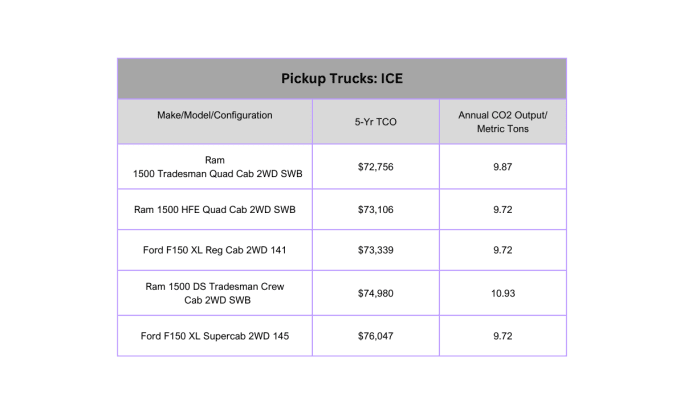
Gas versions of the Ram 1500, particularly the low-priced Tradesman model, took seven of the top 10 overall TCO slots.
Source: BBM
BEV: 12 configurations
5-Yr TCO average: $105,891
Average 5-Yr premium BEV over ICE: $14,161
Average yearly CO2 output (metric tons): 4.09
Average yearly CO2 savings by switching from ICE to BEV: 64.8%
Ford F-150 Lightning, Chevrolet Silverado EV, and Rivian R1T constitute the BEVs in this segment. (The Hummer EV SUT is included in the overall average but not listed.)
The CO2 emissions gap between ICE and electric pickups is substantial, giving fleets that can make this switch a strong “bang for their buck” in carbon emissions savings.
Of the 12 electric configurations, the TCO for the F-150 Lightning Pro Supercrew 4WD falls within the range of the TCO of numerous ICE pickup models popular with fleets.
When spec’ing the electric pickups, expect about 30% less payload capacity and 28% less towing capacity with diminished range.
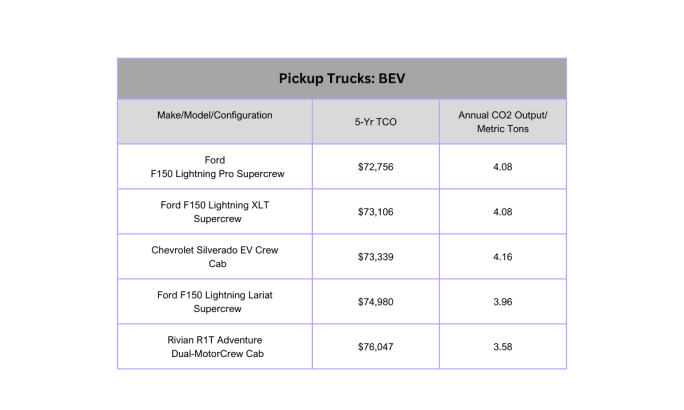
Ford F-150 Lightning, Chevrolet Silverado EV, and Rivian R1T constitute the BEVs in this segment.
Source: BBM
HEV: 21 configurations
5-Yr TCO average: $94,239
Average 5-Yr premium HEV over ICE: $2,509
Average yearly CO2 output (metric tons): 10.12
Average yearly CO2 savings by switching from ICE to HEV: 12.7%
While offering the benefit of not needing to be charged, hybrid pickups offer slightly less payload and towing capacity due to the extra weight of the hybrid-electric system.
Ford, Ram, and Toyota offer hybrid (non-plug-in) models with an average TCO that is closer to ICE models than BEVs. However, the benefit is milder, with about a 12% decrease in annual CO2 output from ICE.
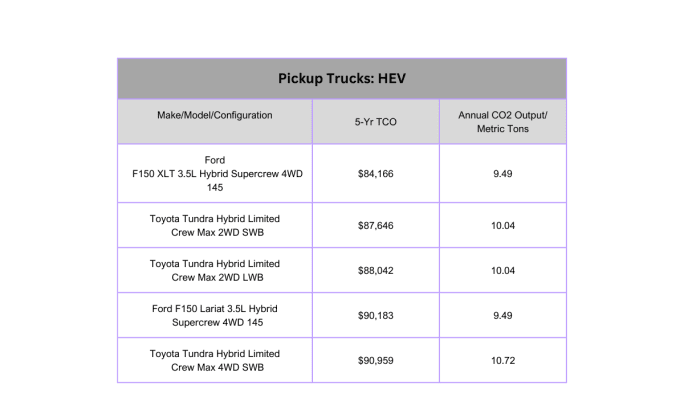
Ford, Ram, and Toyota offer hybrid (non-plug-in) models with an average TCO that is closer to ICE models than BEVs.
Source: BBM
Notes & Cautions
This analysis is meant to be directional only. It does not account for nuances in the capacities and capabilities of individual models within a segment.
The overall list includes manufacturers that don’t have a formal fleet program. They were included in the averages but not in our top 5 lists.
Often, one model dominates the top 5 TCO list. We point these cases out in the text. For the list, we include the top model’s best TCO configuration and move on to the next best-performing model.
Subscribe to Our Newsletter
More Vehicle Research
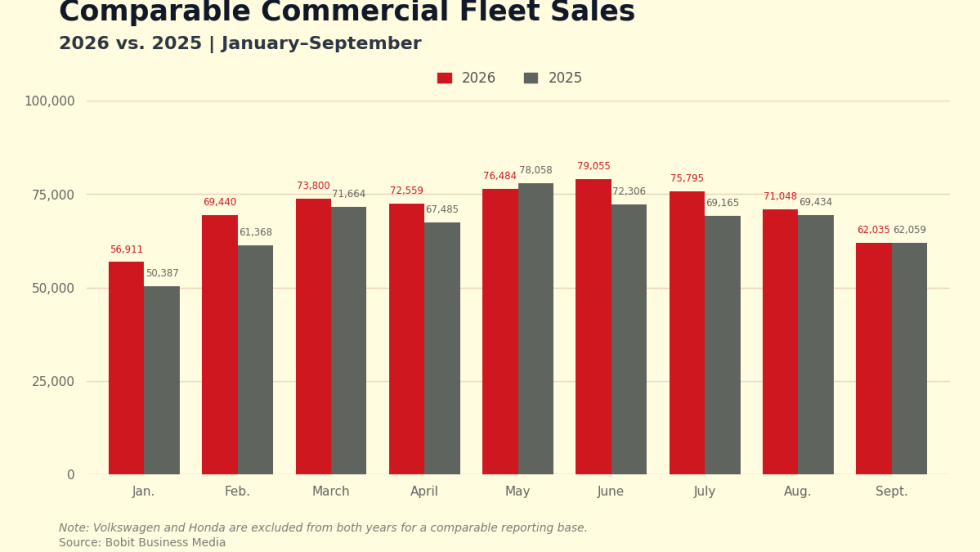
Commercial Fleet Sales Rise 5.8% Through September 2026
September commercial fleet sales were essentially unchanged from a year earlier, slowing year-to-date growth while keeping volume ahead of 2025.
Read More →
Hall of Fame Inductee: John Dmochowsky
The longtime Mondelēz International fleet executive joins the Automotive Fleet Hall of Fame.
Read More →
Hall of Fame Inductee: Lee Miller
After more than four decades at Boehringer Ingelheim, Lee Miller leaves a legacy built on fleet expertise.
Read More →
Hall of Fame Inductee: Mark F. Petersen
From managing fleets of thousands of vehicles to advancing safety and mentoring fellow professionals, Mark F. Petersen made his mark across both the corporate and supplier sides of fleet.
Read More →
When Charger Downtime Becomes a Fleet Availability Problem
As EV deployments move beyond pilot programs, charger reliability can directly affect vehicle readiness, driver productivity and route scheduling.
Read More →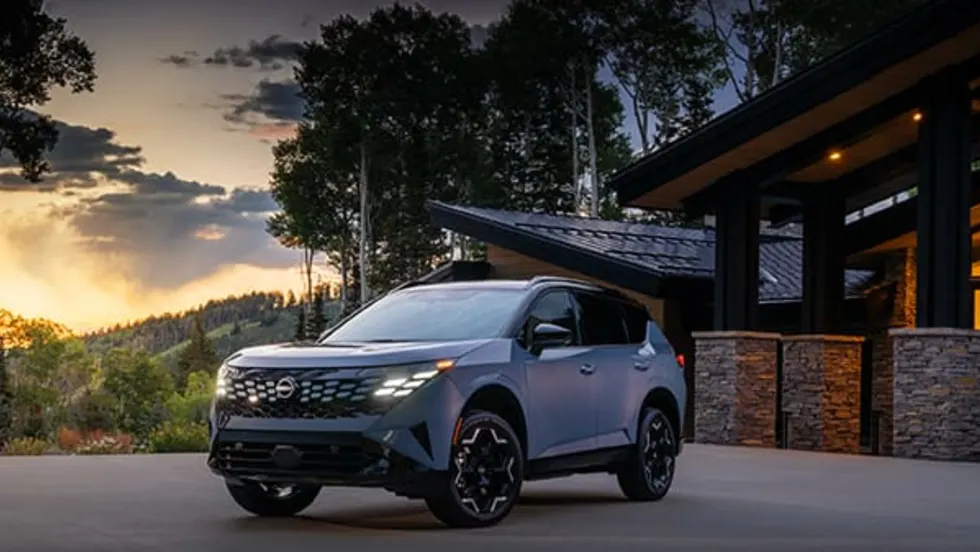
2027 Nissan Rogue Hybrid Adds e-POWER, Standard AWD
The new Rogue Hybrid uses Nissan’s e-POWER system with dual electric motors, offers an estimated 40 mpg and starts at $35,490.
Read More →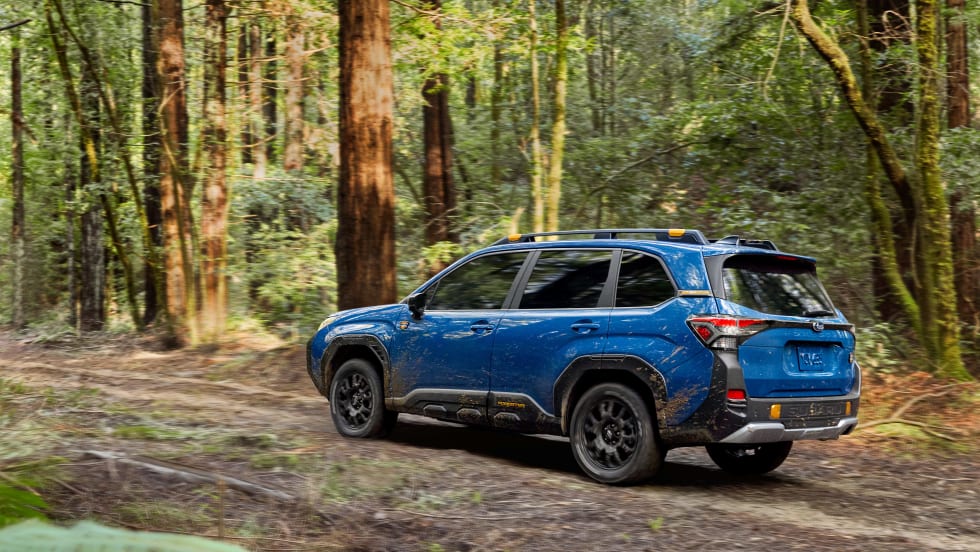
2027 Subaru Forester Adds First Wilderness Hybrid
The 2027 Forester lineup starts at $29,995 and adds a Wilderness Hybrid with 194 combined horsepower and 9.3 inches of ground clearance.
Read More →
EV Realty Names Henrik Holland President as Charging Platform Expands
The former Prologis Mobility and Shell executive will help expand EV Realty’s truck charging business and move its power-first infrastructure model into autonomous vehicle depots and other fleet sectors.
Read More →
Mercedes-Benz Introduces Electric GLC With Up to 350 Miles of Range
The GLC 400 4MATIC Electric features an 800-volt architecture, 330-kW DC fast charging and a 94-kWh battery, along with Mercedes-Benz's new MB.OS operating system.
Read More →
Fleet Has a Talent Pipeline Problem, not a Talent Problem
Where will the next generation of fleet leaders come from, and what does the industry need to do differently to find them?
Read More →