





How to Win a Fleet Manager Award: Make Your Nomination Count
Commercial Fleet Sales Rebound 16.9% Through October
October's stronger results lifted commercial fleet sales growth to 6.7% through the first 10 months of 2026.
November 5, 2026
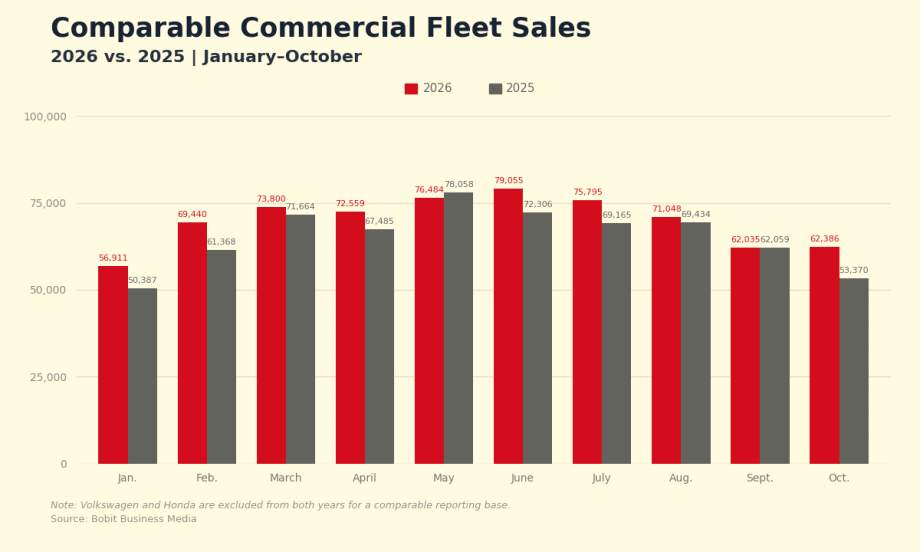
Commercial fleet sales rebounded in October after a nearly flat September, posting their strongest year-over-year percentage increase since the beginning of 2026 and lifting year-to-date growth to 6.7%.
Credit:
Automotive Fleet
5 min to read
Commercial fleet sales increased 16.9% in October 2026 compared with a year earlier, according to fleet sales data collected by Bobit Business Media.
On a same-automaker basis, October sales totaled 62,386 vehicles, compared with 53,370 in October 2025. The increase followed a nearly flat September, when commercial sales declined slightly year over year.
Through October, comparable commercial fleet sales totaled 699,513 vehicles, up 6.7% from 655,537 during the same period in 2025.
The comparison excludes Volkswagen and Honda to maintain consistency with previous Automotive Fleet reports.
Commercial Fleet Sales Lead Year-to-Date Growth
Commercial fleets remained the largest source of year-to-date growth among the three major fleet sales segments, adding 43,976 vehicles compared with the first 10 months of 2025.
Rental fleet sales increased 2.2% in October and were essentially flat year to date, up 0.1% to 1,037,991 vehicles.
Government fleet sales declined 8.9% in October but remained 1.2% ahead of 2025 through the first 10 months, totaling 204,348 vehicles.
Combined commercial, rental, and government fleet sales increased approximately 1.7% year to date on a comparable-automaker basis.
Monthly fleet sales can fluctuate with production schedules, vehicle availability, replacement cycles, and the timing of large orders. October's strong year-over-year increase should therefore not be interpreted as a corresponding increase in underlying fleet demand.
Previous Updates:
Commercial fleet sales increased 5.8% through September 2026 on a same-automaker basis, according to fleet sales data collected by Bobit Business Media.
Comparable commercial fleet sales totaled 637,127 during the first nine months of 2026, up from 601,926 during the same period in 2025.
The comparison excludes Volkswagen and Honda from both years to maintain consistency with Automotive Fleet’s previous updates. Including those automakers, reported commercial fleet sales totaled 641,738 through September.
The commercial category encompasses vehicles purchased for business use, including passenger cars, crossovers, SUVs, vans, and trucks through Class 7.
September Sales Hold Steady
Comparable commercial fleet sales totaled 62,035 vehicles in September, nearly identical to the 62,059 sold in September 2025.
The flat result followed a 2.3% year-over-year increase in August and a 9.6% increase in July. Year-to-date growth consequently moderated from 7.1% through July to 6.5% through August and 5.8% through September.
Commercial fleets purchased fewer vehicles in September than in July or August, when comparable sales totaled 75,795 and 71,048, respectively. However, the September year-over-year comparison shows volume holding steady against the same month in 2025.
Monthly fleet sales can vary with production schedules, vehicle availability, replacement cycles, and the timing of large orders. These results should not be interpreted as a direct measure of underlying fleet demand.
Commercial Gains Lead Year-to-Date Growth
Commercial fleet sales remained the largest source of year-to-date growth among the commercial, rental, and government fleet segments, adding 35,201 vehicles compared with the first nine months of 2025.
Comparable rental fleet sales increased 22.5% in September, narrowing their year-to-date decline to 1.8%. Through September, rental volume totaled 903,069 vehicles, down from 919,945 a year earlier.
Government fleet sales increased 2.2% year to date to 184,860 vehicles, despite a 4.5% decline in September.
Together, the three segments totaled 1,725,056 vehicles through September on a comparable basis, up 1.3% from 1,702,838 during the same period in 2025.
Previous Updates:
August Growth Slows After Stronger July
Commercial fleet sales increased 2.3% in August on a comparable basis, with 71,048 vehicles sold compared with 69,434 in August 2025.
That represented a slower year-over-year increase than July, when comparable commercial fleet sales rose 9.6%.
Commercial fleet sales have shown uneven growth in 2026. Sales increased 9.1% during the first quarter before growth moderated to 4.7% in the second quarter. July volume then increased 9.6% year over year before the smaller gain in August.
The year-to-date increase consequently moderated from 7.1% through July to 6.5% through August.
Monthly fleet sales can fluctuate based on factors including automaker production and delivery schedules, business replacement cycles, vehicle availability, and the timing of large fleet orders. As a result, monthly sales results should not necessarily be viewed as a direct measure of underlying fleet demand.
Commercial Sales Continue to Offset Rental Decline
Commercial fleet sales continue to drive the largest growth among the commercial, rental, and government fleet segments in 2026.
Through August, comparable commercial sales increased by 35,225 vehicles from the same period in 2025. That gain almost exactly offset a 34,312-unit decline in comparable rental fleet sales.
Government fleet sales also remained above 2025 levels through August.
Previous Updates:
Commercial Fleet Sales Rise 7.1% Through July 2026
According to fleet sales data collected by Bobit Business Media, commercial fleet sales increased 7.1% on a same-automaker basis and were the primary source of growth across the commercial, government, and rental fleet segments.
Reported commercial fleet sales totaled 508,155 through July 2026, up 8% from the same period in 2025, according to sales data collected by Bobit Business Media. The reported 2026 total includes 4,111 sales from two automakers without corresponding 2025 volume in the reports.
Excluding those sales provides a same-automaker comparison of 504,044 commercial fleet sales in 2026, up 7.1% from 470,433 in 2025.
Commercial fleet sales totaled 75,795 in July 2026 on a comparable reporting basis, up 9.6% from 69,165 in July 2025.
Commercial Sales Drive Overall Fleet Growth
Commercial fleet sales were the primary source of growth across the commercial, government and rental segments during the first seven months of 2026.
The commercial category covers vehicles purchased for business use, ranging from passenger cars and SUVs to trucks through Class 7.
On a comparable basis, commercial volume increased by 33,611 vehicles. That gain more than offset a 32,025-unit decline in rental fleet sales. Government fleet sales also increased, adding 5,959 vehicles.
Combined sales across the three segments totaled 1,380,314 through July on a same-automaker basis, up 7,545 vehicles, or 0.5%, from 1,372,769 during the same period last year.
Commercial fleet growth moderated as the year progressed before strengthening again in July. Comparable sales increased 9.1% during the first quarter and 4.7% in the second quarter. July volume was 9.6% above July 2025.
These results do not represent continuous month-to-month growth. Commercial fleet deliveries can fluctuate based on automaker production schedules, business replacement cycles, vehicle availability and the timing of large orders.
Commercial fleet’s year-over-year progression was:
- First quarter: up 9.1%
- Second quarter: up 4.7%
- July: up 9.6%
- January through July: up 7.1%
More Vehicle Research

Introducing the 2027 Fleet Fact Book
Automotive Fleet, Government Fleet, Work Truck, and Heavy Duty Trucking present the 2027 Fleet Fact Book, bringing together data and research from commercial, government, vocational, and heavy-duty fleets in one edition.
Read More →
Can AEB Really Prevent Intersection Crashes? | AF News Recap
This week we covered the latest AEB test from AAA, a new scholarship opportunity, and Holman's huge leadership change.
Read More →
Holman Announces Fleet Leadership Changes as Bob White Retires
Nick Caller will become president of Fleet, while Mark Bryan will take on the role of executive vice president and chief operating officer of Fleet, effective Jan. 1, 2027.
Read More →
Toyota Fleet Briefs Fleet Leaders on Rapidly Growing Fleet Service Program, Successes of Hybrids, and Supply
During the annual Toyota Fleet Executive Meeting, fleet leaders learned about Toyota’s legacy of driving fuel efficiency with hybrids, its investments in U.S. production, the early success of Toyota Fleet Service Advantage, and much more.
Read More →
NAFA Launches CAFM Scholarship Program for Fleet Professionals
The new program will award up to four scholarships annually to help eligible fleet professionals cover the cost of Certified Automotive Fleet Manager certification.
Read More →
Your Fleet Experience Deserves a Vote in the 2027 Fleet Awards
Cars, trucks, vans, SUVs, and upfits. Help choose the 2027 fleet award winners and unlock early-access resources for voters. Ballots close December 31.
Read More →
Which Vehicles Earn Your Fleet’s Vote? Voting Opens for 2027 Fleet Vehicle of the Year
Which vehicles earn your fleet’s vote? Cast your ballot to unlock early access to our analysis of ownership costs across 55 vehicle nameplates.
Read More →
Crash Tests, Catalytic Converter Theft & Fleet Safety | AF News Recap
A stolen catalytic converter can cost a fleet far more than the replacement part. This week, we're exploring how to reduce theft-related risk, what fleet managers learned from live IIHS crash testing, the 2027 Jeep Compass's new safety features, and why supporting original industry reporting matters.
Read More →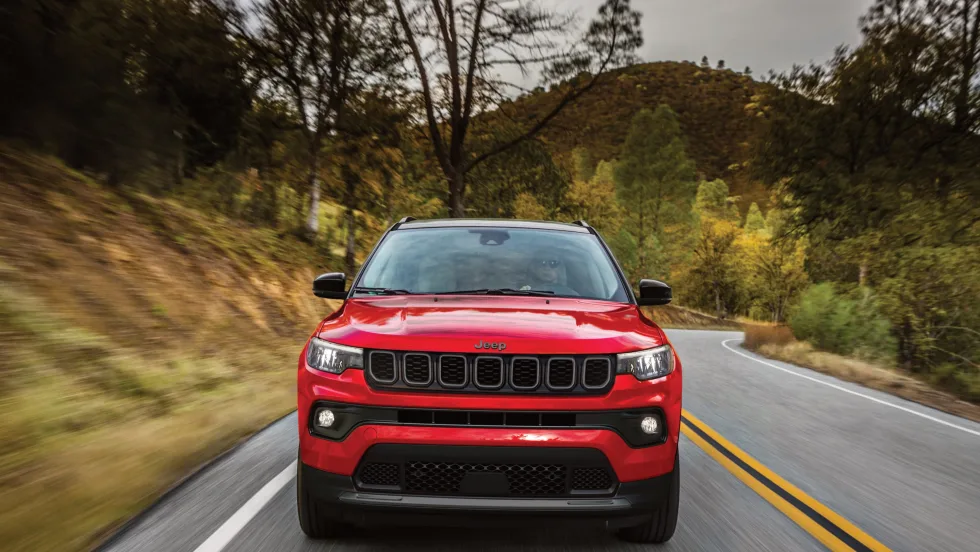
2027 Jeep Compass Adds Standard Driver-Assistance Features, Starts at $31,985
The 2027 Jeep Compass adds standard adaptive cruise control across the lineup, along with additional technology and equipment options on select trims.
Read More →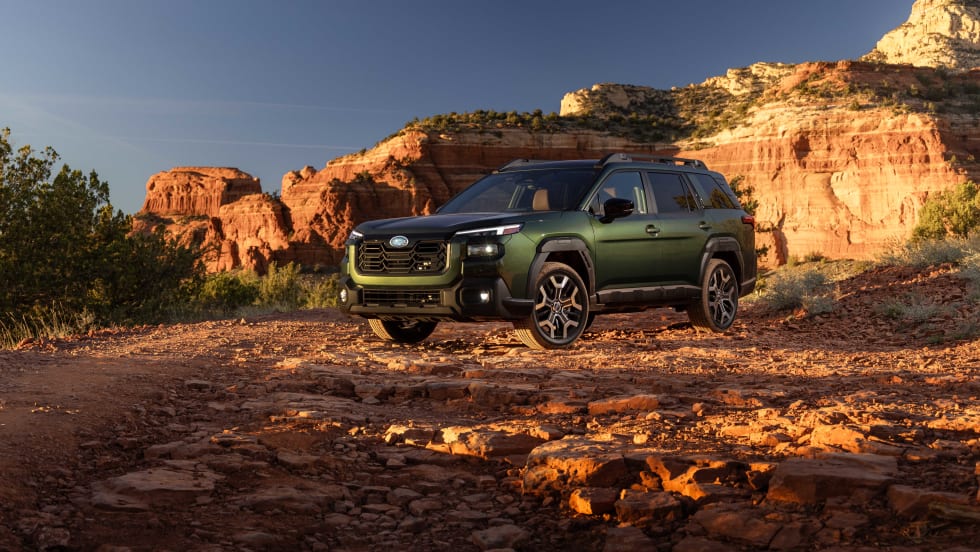
2027 Subaru Outback Adds Base Trim, Lowers Pricing Across Lineup
The 2027 Outback starts at $32,995, with price reductions on several trims and expanded availability of hands-free driver-assistance technology.
Read More →