




More Vocational Fleets Adopt Lightweighting Strategy
A growing trend in second-stage manufacturing is light-weighting, which involves specifying lighter-weight materials to achieve an overall weight reduction to an upfitted vehicle. Specifying lighter-weight upfit materials decreases the vehicle’s curb weight, which, in turn, lowers operating costs by reducing fuel consumption and decreases emissions.

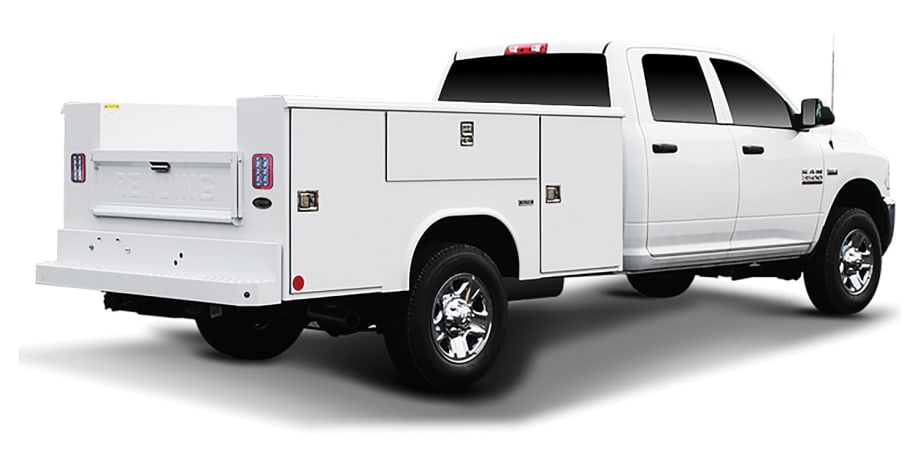
Photo: Reading Truck Body
A growing trend in second-stage manufacturing is light-weighting, which involves specifying lighter-weight materials to achieve an overall weight reduction to an upfitted vehicle. The increased use of lightweight materials in upfit packages has been on the rise for several years and there are many advantages to doing so.
First, specifying lighter-weight upfit materials decreases the vehicle’s curb weight, which, in turn, lowers operating costs by reducing fuel consumption. In addition, by reducing fuel consumption, fewer greenhouse gases are emitted, which contributes to meeting corporate green fleet goals. Similarly, many lightweight materials used in upfits are recyclable, further contributing to a corporation’s overall sustainability initiatives.
A second benefit to reducing GVW is that it creates the potential opportunity to downsize to a smaller vehicle. In certain situations, the lightweight upfit may enable the fleet to select a smaller chassis that not only improves fuel economy, but also lowers initial acquisition cost. A corollary benefit to lightweighting is the ability to increase the legal payload of the vehicle without having to migrate to a larger truck. The decreased weight from lighter service bodies, racks, bins, and shelves is reciprocally converted into increased payload, allowing fleets to carry more cargo and accomplish more with the same vehicles. Similarly, the additional capacity may result in fewer trips per day because the vehicle can carry more payload. It is important to note, that while lightweighting may allow a fleet to increase payload or reduce fuel consumption, it cannot achieve both simultaneously.
A lightweighting strategy is designed to take weight out of the vehicle by specifying upfit components built from lightweight materials, such as aluminum, fiber-reinforced composites (FRC), or fiber-reinforced plastic (FRP) composites. Similarly, today’s cargo van interiors feature increased use of lightweight materials to reduce overall vehicle weight. Upfitters are transitioning from steel racks and bins to heavy-duty plastic composites and aluminum.
Lightweighting also extends to auxiliary equipment mounted on a service body, such as aerial platforms and other equipment, that use high-strength steel, which is thinner and lighter than traditional steel, but with comparable strength. “The point of using high-strength steel is to use less material by having thinner walls. The same aerial boom made of high-strength steel is lighter than the thick-wall version made of a lower strength steel. Over the past five decades, the use of steel in the automotive market has stayed largely the same, about 75% of the vehicle; yet, as the stronger grades became available, the sheet metal got thinner.
Corrosion resistance is another benefit of some lightweight materials, specifically aluminum, fiberglass, and plastics, which helps extend the service life of an upfit, especially those operating in Snowbelt states and coastal regions.
Steel is the material of choice for the understructure of a service body, especially in utility applications, because of the twist and torque of the body when a truck travels off-road or is mounted with a crane or aerial device. However, there are opportunities for lightweighting a service body at nonstructural areas in the body, such as side compartments, doors, floor pan, aluminum tool boxes, ladder racks, and other service-body-mounted equipment.
Many truck fleet managers recommend a “blended approach” to lightweight material and steel selection to provide a balance between weight savings, strength, durability, and cost. Conventional steel continues to be the predominant material used in service bodies because of its relative low cost and its durability under severe work conditions.
Lightweight materials aren’t appropriate for every application. Lighter-weight materials, in many cases, have a lower strength compared to steel. Also, lightweight materials, for the most part, have a higher initial cost relative to conventional steel, depending on the type of material and amount of that material used in the upfit design. While lightweight materials may increase fuel economy, will the vehicle travel a sufficient number of miles per year to recoup the higher materials price? In a low-mileage duty cycle, the total cost of ownership (TCO) of steel may pencil out better because the vehicle won’t be driven enough to justify the higher materials cost. Some lightweight materials do not have the same durability as steel, which are required for extended lifecycles or severe-duty applications.
When used in the manufacture of truck bodies and van equipment, lightweight materials, such as thinner gauge high-strength steel, aluminum, fiberglass, and plastic composites, enable fleets to reduce vehicle weight to improve fuel economy, increase legal payload, and even drop down to a smaller (often more fuel-efficient) vehicle.
Another area gaining greater attention among vocational fleet is aerodynamics.
Interest in stowing methods for ladders in cargo vans has ramped up, fleets are paying attention to properly identifying the need for long ladders that require roof stowage versus deploying shorter ladders that can be stowed inside a van.
More Vehicle Research

2027 Nissan Rogue Hybrid Adds e-POWER, Standard AWD
The new Rogue Hybrid uses Nissan’s e-POWER system with dual electric motors, offers an estimated 40 mpg and starts at $35,490.
Read More →
2027 Subaru Forester Adds First Wilderness Hybrid
The 2027 Forester lineup starts at $29,995 and adds a Wilderness Hybrid with 194 combined horsepower and 9.3 inches of ground clearance.
Read More →
EV Realty Names Henrik Holland President as Charging Platform Expands
The former Prologis Mobility and Shell executive will help expand EV Realty’s truck charging business and move its power-first infrastructure model into autonomous vehicle depots and other fleet sectors.
Read More →
Mercedes-Benz Introduces Electric GLC With Up to 350 Miles of Range
The GLC 400 4MATIC Electric features an 800-volt architecture, 330-kW DC fast charging and a 94-kWh battery, along with Mercedes-Benz's new MB.OS operating system.
Read More →
Fleet Has a Talent Pipeline Problem, not a Talent Problem
Where will the next generation of fleet leaders come from, and what does the industry need to do differently to find them?
Read More →
Fleet Hacks: What Are You Still Doing Manually?
From daily recaps to repeatable workflows, fleet professionals share how AI can cut through busywork while keeping human judgment at the center.
Read More →
How One Fleet Manager Put a New Spin on Safety Training
Joe Lewis turned a pre-trip inspection lesson into an AI-assisted song, then four safety albums. The experiment also revealed why human oversight matters when AI enters driver training.
Read More →
2027 Ram ProMaster City Starts Under $40K
Ram is returning to the smaller commercial van market with a new ProMaster City aimed at delivery, service, trade, and passenger applications. Starting at $39,995 with destination, the 2027 van offers up to 2,000 pounds of towing capacity, more than 2,000 pounds of payload, and multiple cargo and passenger configurations.
Read More →
New Tariff Threats & a Leadership Change at Wheels | AF News Recap
A new tariff threat is creating more uncertainty for fleet ordering, Wheels has named a new president, and we’re asking whether certification is really worth the investment.
Read More →
Certification: What’s in It for the Fleet Manager?
From smarter fleet decisions to stronger career credibility, certification can give fleet managers knowledge they may never gain inside a single operation.
Read More →