




8 Trends: Work Truck Week 2026 Reveals a Fleet Industry in Reset Mode
Walking the show floor this year, the new focus was around “practical innovation” and pragmatic solutions. And oh yeah, a new small van.
March 16, 2026

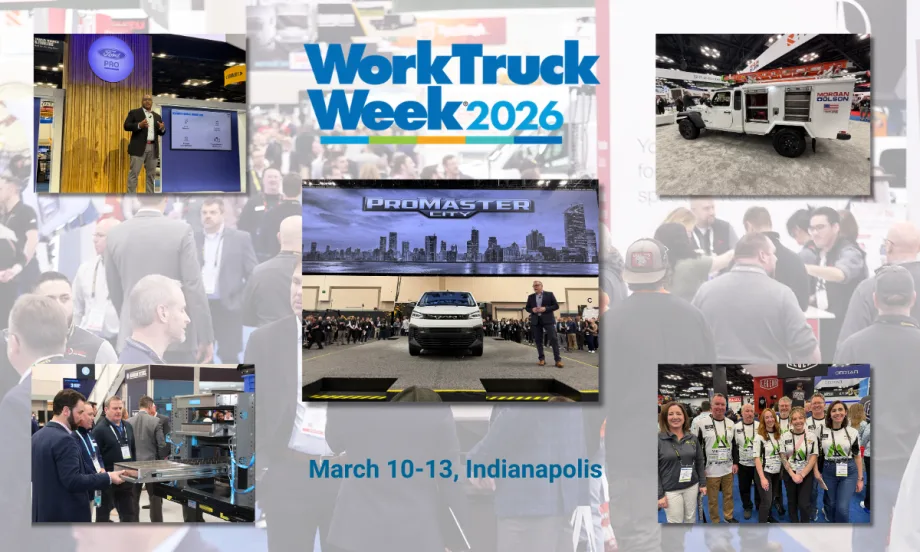
From electrification recalibration to hybrid powertrains, software-driven vehicles, and industry consolidation, Work Truck Week 2026 revealed a commercial vehicle market shifting toward pragmatic solutions for fleets.
Credit: NTEA, Chris Brown
9 min to read
If you can believe it, NTEA’s Work Truck Week wasn’t always in Indianapolis. In the aught years, the Work Truck Show (as it was called) bounced around between Indy, Chicago, and Atlanta, with stops in St. Louis and Baltimore. In 2011, it moved to Indianapolis, where it has stayed put. Can you imagine it anywhere else?
The 2006 event “broke records” with some 7,000 attendees. Today, the show regularly draws 15-18k, though official numbers for this year aren’t out just yet.
Work Truck Week has always been ground zero for the trends and motivators of the commercial vehicle industry. It’s a blend of established and cutting-edge products, technologies, and service offerings, which is the right mix, as it grounds attendees (and journos like me) in reality while giving us all a glimpse of the future.
And so, March 10-13, we once again descended on the Indiana Convention Center, Lucas Oil Stadium, and St. Elmo’s for steaks and fiery shrimp cocktails. (Pro tip: St. Elmo’s has a basement with a surprising number of tables and a massive wine cellar, through which you can reach a private glassed-in dining room that Peyton Manning used to take his offensive line, as we were told. Check it out next time.)
Here are my trends and takeaways for 2026:
A Market in Permanent Disruption
“Permanent disruption” is the biggest universal trend exiting the pandemic across all industries. There will never be a status quo. The new normal is “no normal.” It’s just a question of which Black Swan event we couldn’t see coming but must pivot to, assess, and manage quickly.
Having worked through the extreme supply chain disruptions of 2022-2024, we’re still working through the last Black Swan event, tariffs. Commercial Truck Trader data show that commercial vehicle sales declined by about 6% in 2025, largely due to uncertainty about regulations and economic conditions.
Market data from S&P Mobility shows how uneven that disruption has been. According to Mark Hazel, who leads S&P’s commercial vehicle team, the overall market appeared flat last year, but only because two different trends offset each other. Light-duty commercial vehicles grew, while medium- and heavy-duty trucks saw registrations decline by nearly 24%, largely due to tariffs and economic uncertainty delaying fleet purchases.
And the next Black Swan event? It’s already arrived in the form of severe fuel price volatility brought on by the Middle East conflict. The risk extends beyond the pump to raising the cost of moving and producing goods and new inflationary concerns.
This sea of uncertainty is forcing the commercial vehicle industry to recalibrate around realism, or “practical innovation.” Electric trucks remain part of the future, but fleets and manufacturers are increasingly focused on technologies that work in real-world operations.
That broader perspective is even reflected in the conference itself. The long-running Green Truck Summit gets a new name in 2027: the Future Truck Summit (and they’re partnering with NAFA!). This expands the Tuesday event’s focus beyond alternative fuels to include digital tools, safety technology, and other innovations shaping the commercial vehicle ecosystem.
Electrification Moves from Hype to Targeted Deployment
Electric vehicles were still a major topic at Work Truck Week, but the discussions centered on the specific use cases where electrification works best.
GM echoed that more pragmatic view during the Green Truck Summit keynote. Ian Hucker, vice president of GM Envolve, said EVs “remain our North Star as an organization,” but acknowledged that fleet adoption has not grown at the pace many in the industry once expected. Instead, he pointed to specific use cases — such as depot-based fleets with charging infrastructure and companies with carbon-reduction goals — where EVs continue to make operational and financial sense.
According to S&P Mobility data, EVs currently represent roughly 2% of commercial vehicle share, concentrated primarily in electric cargo vans. Mark Hazel of S&P said hybrids could become a major growth area in commercial vehicles, with fuel savings without the infrastructure challenges of full electrification.
Startup manufacturer Harbinger introduced a cab-chassis platform featuring a range-extended electric powertrain. The system uses a small gasoline engine and a 48-gallon gas tank to recharge the battery while driving, delivering up to 500 miles of range.
Internal Combustion Isn’t Going Away
If anything, Work Truck Week highlighted that internal combustion engines aren’t going anywhere anytime soon, as manufacturers continue to invest in gas and diesel powertrains.
S&P Mobility’s analysis shows that since 2018, gas-powered commercial vehicles have actually increased their share of the market, while diesel has declined slightly and EVs have grown from near zero to about 2%.
In its presser, Stellantis executives trumpeted the return of the Hemi engine to the Ram lineup, noting that they received more than 10,000 orders in the first 24 hours after announcing the engine’s return.
General Motors is developing a new V8 engine that will debut in the 2027 Silverado 1500.
On the larger truck side, Cummins showed off its first gas engine, the B6.7 Octane, which offers performance on par with its diesel counterpart but without diesel’s maintenance headaches.
Trucks Are Now Software Platforms
“The single biggest change coming to multi-stage commercial vehicles in the next five to 10 years is the transition to software-defined platforms,” said Hucker in his Green Truck Summit address.
A technology roundtable highlighted that advanced driver assistance systems (ADAS), vehicle diagnostics, predictive maintenance, and connected telematics platforms are now almost always powered by software and data rather than mechanical improvements.
As commercial vehicles are “computers on wheels” (like passenger cars), they pose new challenges for technician training, upfits integration, and fleet maintenance workflows.
Ford used the show to launch Ford Pro AI, which is embedded in its Ford Pro telematics platform. Ford said fleet managers are spending an average of 23 hours per week on admin tasks such as scheduling service, tracking vehicle issues, and analyzing costs. AI could reduce that time by 40%, Ford said.
This is your near future: using AI to identify vehicles that need service, prioritize repairs based on real-time diagnostics, analyze driver behavior, and generate reports or recommendations automatically and instantly on maintenance scheduling, fuel usage, and fleet optimization.
Fleetio pulled the cover off its AI Service Advisor, which analyzes incoming service requests and flags potential issues such as cost discrepancies, duplicate repairs, or warranty opportunities. Fleetio said early users have seen a 16% reduction in the time vehicles spend in the shop.
Vendor and Fleet Consolidation Continues
Consolidation in the work truck ecosystem isn’t new, but it continues. Announced at the show, JB Poindexter & Co. announced it had bought ambulance manufacturer Demers Braun Crestline Medix.
Meanwhile, Aebi Schmidt Group is merging with The Shyft Group, creating a global player combining municipal equipment, specialty trucks, and delivery vehicles.
Safe Fleet has taken a similar approach in recent years, steadily acquiring smaller companies in areas ranging from lighting and safety systems to upfit equipment.
Yet the industry still includes large independents such as Knapheide, REV Group, and Oshkosh Corporation. Who might be next?
Consolidation is happening on the fleet side as well. S&P Mobility data shows smaller fleets shrinking while larger fleets continue to grow, often through acquisitions.
Much of that growth is driven by private equity investment. I met a fleet manager friend who said there are essentially six PE-owned companies with fleets of 3k to 6k vehicles that are actively buying smaller brands in home services industries such as HVAC, plumbing, and electrical contracting.
Those fleet managers’ tasks are to standardize vehicle specs, upfits, and equipment across multiple brands and make it all work nationwide.
Upfitting Innovation: Modularity, Vehicle Flexibility
Whereas lightweighting has been an ongoing trend in upfitting, an emerging trend is adaptability and flexibility.
Sortimo’s new modular shelving and cargo systems use rail-based mounting platforms that allow equipment to be swapped in minutes. Fleets can swap out drop-down shelving and connect a completely different package for seasonal or rental use.
Rental (or short-term lease) is a perfect use case. “The peak season for last-mile delivery is between Black Friday and Christmas,” said Reinhold Braun, CEO of Sortimo. “After that, you have to readjust the whole van and restructure it for another purpose.”
Braun also noted that the shift to electric vehicles may require more adaptable interiors. “If you go for electric, the lifetime of electric vehicles is way longer than for an ICE vehicle,” he said. “You have to come up with multi-purpose solutions.”
Ranger Design also highlighted flexible upfits with the introduction of its new Trazer Canopy, part of a modular truck utility system that will expand as trades fleets’ needs evolve.
That kind of flexibility also makes vehicles more versatile across different jobs. This helps explain why one missing vehicle segment made a comeback at Work Truck Week.
The Return of the Small Commercial Van
The biggest trend came in the form of an announcement, which was, without a doubt, the biggest news coming out of Work Truck Week.
Ram unveiled the 2027 Ram ProMaster City, reentering the small commercial van segment after several automakers, including Ram itself, exited the category earlier in the decade.
At one point, five OEMs competed in the small van segment in the U.S., but left due to tightening regulations and shifting product strategies, even though fleet demand never disappeared.
“There have been almost a million small and midsize vans sold in the U.S. market, and more than half of those vehicles are still on the road today,” said Dave Sowers, director of Ram Professional operations.
Many businesses have adapted by moving into larger vans than they really need, adding caps to pickup trucks, or even using passenger minivans for commercial tasks. Those solutions often come with higher costs, reduced maneuverability, or less efficient use of cargo space.
At its peak, the small van segment represented a $4 billion annual market, largely driven by trades, delivery services, and small businesses.
I spoke with Chip Cooper of Cooper Motor Company on the show floor. Cooper and other Ram dealers are ready to sell the heck out of the new ProMaster City to electricians, plumbers, HVAC technicians, contractors, urban service providers, local delivery services, and mobile repair businesses.
What It All Comes Back To
For all the talk of electrification, AI, and software-defined vehicles, one announcement at Work Truck Week reminded us what this industry is really about.
Knapheide introduced a new national positioning called “America’s Work Truck.” The idea is to highlight the role work trucks play in the skilled trades and the people who rely on them every day.
“For 178 years, our mission has stayed the same: build tools that help America work,” said Bo Knapheide, the company’s president and CEO. And yes, that summed up the vibe of Work Truck Week pretty well.
The technology is changing; powertrains are evolving; software is essential. But at the end of the day, it’s all about the truck itself. Work trucks are still tools for getting the job done.
Oh, and one more thing, and long overdue: Ongoing thanks to Kristen Simpson of Simpson Communications and her team that manages (herds) the gaggle of media folks like me. Year in, and year out, they do a fantastic job, take care of us, and make us feel at home.
Subscribe to Our Newsletter
More Blog Posts

How to Win a Fleet Manager Award: Make Your Nomination Count
Strong fleet accomplishments can go unrecognized when the nomination doesn’t make the case. Here’s what judges need to see.
Read More →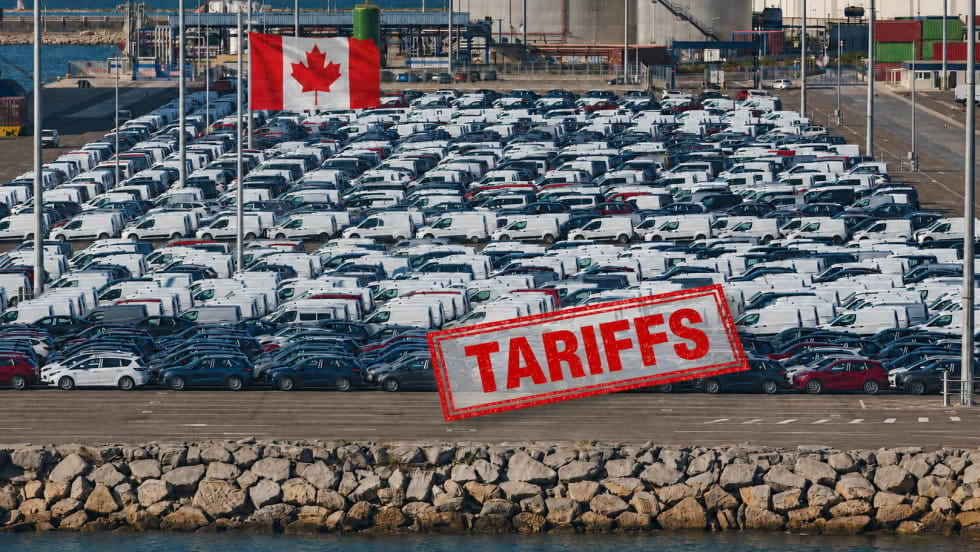
The Only Certainty with the New Tariff Threat Is Uncertainty
Trump’s Canadian tariff threat will not move production overnight, but the uncertainty could influence ordering and pricing now. Longer term, forces beyond tariffs may determine which North American plants survive.
Read More →
What Does It Mean to Embody the Spirit of Fleet?
Presented alongside Fleet Manager of the Year, Fleet Visionary, and Fleet Hall of Fame at AFLA, the new Mike Antich Spirit of Fleet Award is unique in that it recognizes service to the overall profession. Just like Mike.
Read More →
What Separates Great Fleet Managers From Everyone Else?
What do Visionary candidates with fewer than 10 years of experience have in common with Hall of Fame nominees with a lifetime under their belts?
Read More →
The Next Fleet War Won't Be Won on Specs Alone
The 2026 Stellantis Pro One Fleet Preview was less about vehicles and more about what happens after you buy them.
Read More →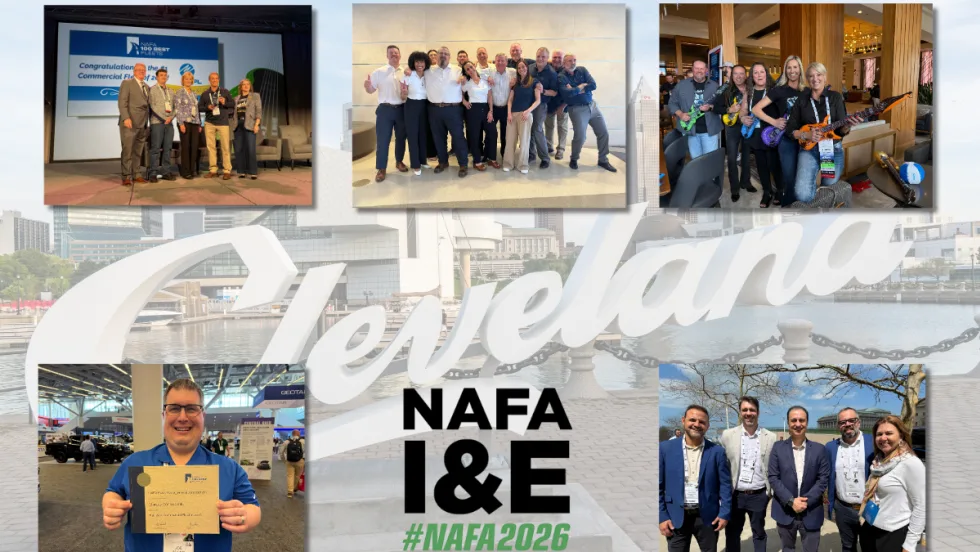
Navigating Brundlefly and Fleet AI at 2026 NAFA I&E
AI is becoming the operating layer for fleets. In Cleveland, the buzz was about harnessing AI in an increasingly complex, permanently disrupted environment.
Read More →
The Moment AI Became Operational
“AI isn’t assisting us anymore. It’s doing the work,” said CEO Neil Cawse at Geotab Connect 2026. What does this mean for fleet managers?
Read More →
For Mike Antich, it Was Always About the People
He stood tall in the industry in so many ways, but he measured success by the people he served.
Read More →
Solving the Flexible-Lean Fleet Paradox
The lean fleets of yesterday are the fragile fleets of today. Where do we find the balance?
Read More →
We’ve Been Here Before
If every generation of fleet managers thought they had the worst problems, what makes ours any different?
Read More →