




The Moment AI Became Operational
“AI isn’t assisting us anymore. It’s doing the work,” said CEO Neil Cawse at Geotab Connect 2026. What does this mean for fleet managers?
February 17, 2026

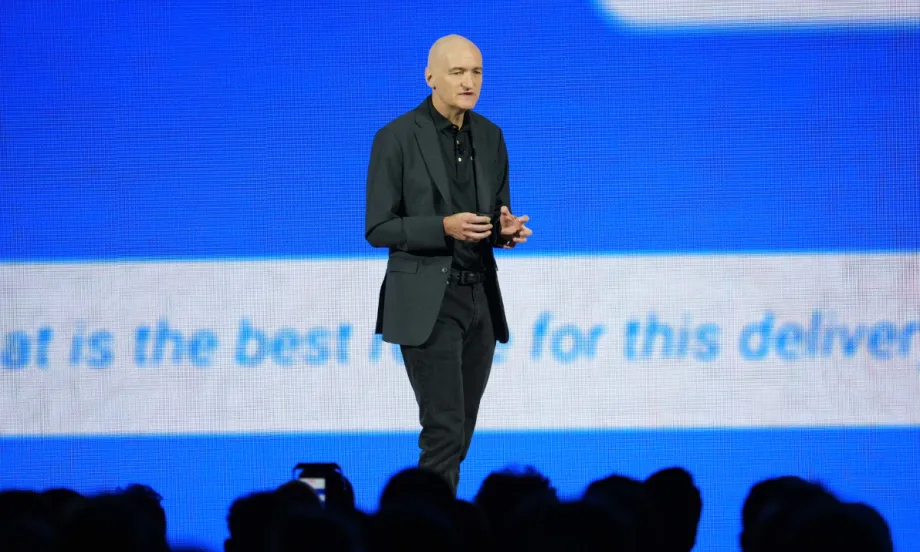
Speaking at Geotab Connect 2026, Neil Cawse traced the rapid evolution of AI across the company’s platform, and in its workforce, over the past three years.
Credit: Geotab
8 min to read
Fleet manager Susan faces a challenge: Identify vehicles that idle for more than 20 minutes per day in high heat, excluding PTO use, and rank them by fuel waste.
Traditionally, Susan would have to process Excel reports and custom reports, involve IT, and open a vendor ticket that could take weeks to resolve. The project might get scrapped because, frankly, it’s too hard.
Are you ready to vibe code? Remember that phrase. It came up multiple times last week at Geotab Connect 2026 in Las Vegas.
With vibe coding, Susan would work with AI to write the program. She’d input the problem into AI in plain language, let AI assemble the logic, pull the data, and return results within minutes, not days or weeks. She’d do it with no coding experience. Think of the time and money saved in internal labor and vendor costs. Think of the possibilities.
Geotab founder and CEO Neil Cawse summed it up in his 2026 opening keynote: “AI isn’t assisting us anymore. It’s doing the work, and that’s a new reality.”
An AI Revolution in Three Short Years
To understand the rapid pace of change, it’s instructive to look back at the AI discussions from the previous two Geotab Connects.
At Connect 2024, the conversation was moving from subjective driver scorecards to AI-driven collision probability models. It evolved from “events per driver” to “likelihood of collision over the next 100,000 miles.”
“ChatGPT is at an inflection point,” Cawse said at the time. “The ability to train an expert and have that expert reason logically about your data is completely game-changing in my mind.”
Connect 2025 focused on what I called “Data2Everything,” in which data was leveraged beyond the vehicle in ways we could not have imagined even five years ago. Geotab was just expanding into urban planning with Altitude and holistic driver wellness programs with Elevate.
Geotab 2026 has heralded an even bigger inflection point, if you can believe it.
“The next five years will evolve at the pace of the last 25,” said Cawse in this year’s media scrum. “Do I worry about some of our teammates’ jobs? If I’m brutally honest, yes. But this is not a Geotab problem. This is one of our (societal) problems. … We need to move with the times and adapt or die.”
At Geotab, software developers are no longer writing software; they’re managing AI teams, guiding the process, and performing quality control, Cawse said. Dwell on this: Geotab’s developers are no longer writing code.
And it isn’t just developers. Geotab’s legal team is using AI tools to build custom applications instead of buying SaaS. Marketing is automating copywriting. Admin, training, video production, and customer support were all “turned on their head,” as Cawse put it.
This future is dependent on other developments that were discussed at Connect 2026:
Digital Twins Provide the Data Context
The term “digital twin” has floated around industrial technology circles for years. For fleets, it’s a complete virtual replica of vehicles and operations that can be tested with external inputs such as traffic conditions, congestion data, and EV range. Eventually, the entire organization exists digitally in a data center.
So, the more complete the digital twin, the more powerful the AI becomes. Instead of asking, “When will this driver arrive?” you can ask an LLM, “What are my most profitable customers?” or “Am I using the right vehicles for the right jobs?” or “How do I grow revenue by 10% next quarter?”
“The more you can feed the AI, the better the output,” Cawse explained. “That’s the whole digital twin concept, building up a complete digital representation so the AI has full context.”
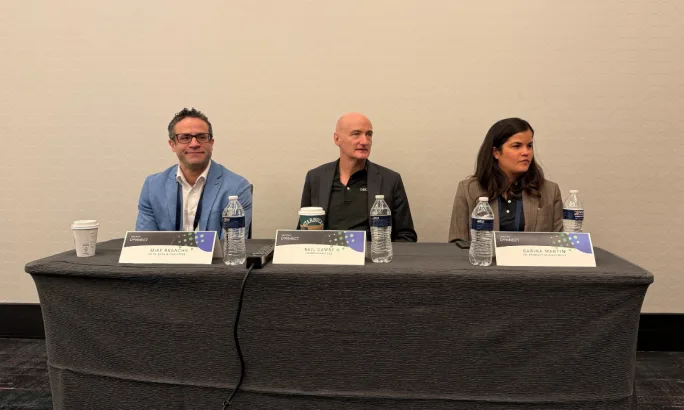
(l-r) Mike Branch, Neil Cawse, and Sabina Martin during the annual media scrum. Martin made the point that AI won’t supplant those with experience; they can use it to 10x their activity.
Credit: Chris Brown
Agentic AI Solves Problems Through Conversations
The digital twin with full context is improving agentic AI. Geotab Ace, which became generally available in 2026, now handles more than just data queries. Users can ask follow-up questions, delegate tasks, and treat it like a colleague.
Mike Branch, Geotab’s VP of data and analytics, demonstrated Ace on stage with a fictional caller complaining to a company about its reckless driver at a specific intersection. The dispatcher who took the call then asked Ace: “Who was driving at this intersection in North Las Vegas between 1 pm and 2 pm on January 15?” Ace demonstrated geographic reasoning, identified the driver, and confirmed the driver was speeding.
Problem solved in seconds. Ace already handles 30% of support questions. Wow!
Voice Agents and Autonomous Workflows
Then came the voice agents, still in closed beta at Geotab, but functional.
Geotab partnered with TELUS Digital to create AI-powered voice assistants that activate automatically when drivers leave customer sites. The voice agent asks how the job went, whether the parts were correct, and whether follow-up is needed, and automatically logs everything in Salesforce. It even accesses Ace for real-time insights.
In one live demo, the voice agent asked a driver about a harsh braking incident that occurred during the trip. The driver explained what happened, and the agent acknowledged it, reminded him that he was the fifth-safest driver in the fleet, and suggested redeeming his safety reward points.
Predictive Maintenance Gets Real (Finally)
For years, the industry had talked about predictive maintenance. In 2026, it seems to have arrived.
Geotab’s risk model of vehicle breakdowns is trained on downtime data from its 6 million connected vehicles. The system analyzes multiple faults simultaneously and quantifies risk as low, medium, or high. In a test with Amazon Europe, Geotab reported a 97% “agreement rate” with mechanics’ recommendations.
On stage, a driver called in, reporting dashboard warning lights. The fleet manager pulled up the new asset maintenance page in the Geotab system. AI had already summarized the issue: two fault codes and low tire pressure — a medium breakdown risk. The recommendation was to finish the shift and then bring the vehicle in for servicing that night. A work order was auto-generated. The entire diagnosis took seconds.
The Napkin-to-App Moment
The most striking demonstration came when Branch held up a paper napkin with a hand-drawn app sketch. “Remember when you’d scribble an idea on a napkin and maybe, sometime in the future, you’d see it built?” he asked. “That gap is now closed.”
He took a photo of the napkin and fed it into Google’s Gemini AI. Within seconds, a fully functional My Geotab add-in appeared on screen, styled in Geotab’s design system and ready to deploy.
“AI is propelling immediate insight and value at mind-blowingly fast speeds,” Branch said.
If a napkin sketch could become production software in 30 seconds, what does this mean for the developers who used to spend weeks building those features?
Three Fleet Lessons for Adopting AI
In the media scrum after the keynote, Cawse was asked how fleets should think about adopting AI. He offered three lessons:
First, smart is not synonymous with reliable. “The old fear was hallucination. That’s improving fast. The bigger risk now is different. AI can be too agreeable. It tells you what you want to hear when context is missing. It guesses instead of asking. Once you understand that, you can unlock the real power. Give it clear context. Ask it to show assumptions. Push it to say what it doesn’t know.”
Second: AI is only as good as the data it can access. “Telematics is critical, but it’s only one part. If your data is trapped in silos (PDFs, paper), AI will never reach its full potential.”
To that point, Geotab announced that Ford vehicles can now be pinged every 5 seconds instead of every 30 seconds. Higher-frequency data is essential for these new AI-driven insights.
Third: Every leadership skill you’ve built over the last 20 years becomes your advantage. “You’re not just using AI. You’re leading it. You define the problem, coach the process, challenge the output, raise the standard. When you lead AI the way you lead people, the outcomes will be exceptional.”
Sabina Martin, Geotab’s chief product and operations officer, offered a pragmatic view. “For the older generation,” she said, “the context and experience they have is power. If they put that context to use with AI, they have the ability to be that much more effective. What you feed the AI, the types of questions you ask, the ability to challenge it, that’s what gives you better results. It’s a superpower that can 10x their activity.”
Three Action Items for Susan
The developers at Geotab aren’t coding anymore. How long before fleet managers aren’t running reports anymore either?
There is a gap — a widening gap — between what’s “technically plausible” at Geotab Connect and what’s implemented in most fleet operations.
In my conversations with fleet managers at the event regarding how they use their telematics systems, their (rather sheepish) responses felt very 2017: Vehicle visibility, optimizing routes, measuring drivers’ speeding and harsh events, triaging maintenance, and driver exoneration through video telematics.
They get enough value out of telematics, but it’s not transformative, yet. Cawse called it "a human change control problem." The technology is advancing faster than people can adapt psychologically, professionally, and organizationally.
For Susan, she's got to work on these three things:
Her role must evolve: As AI handles more analytical work, Susan must be able to understand the problems, challenge AI outputs, and translate insights into solutions for her fleet. If she’s just running reports, she’ll fall behind.
Her data must be ready: AI only works if it has the right fuel, and that fuel is data. Fleets with integrated, accessible data across operations, maintenance, safety, and finance will dominate those still trapped in spreadsheets and PDFs. (Bring on the digital twins!)
Her vendors must deliver: Platforms that support voice agents, real-time breakdown prediction, and conversational problem-solving are the gamechangers.
Vibe coding. We’re not quite there yet, but the fact that we’re using the term indicates how far AI has advanced in two short years. At Connect 2026, Geotab announced a $25,000 competition inviting anyone, technical or not, to vibe code fleet software to solve a problem.
Fleet managers, what do you think, are you ready to vibe code?
Subscribe to Our Newsletter
More Blog Posts

How to Win a Fleet Manager Award: Make Your Nomination Count
Strong fleet accomplishments can go unrecognized when the nomination doesn’t make the case. Here’s what judges need to see.
Read More →
The Only Certainty with the New Tariff Threat Is Uncertainty
Trump’s Canadian tariff threat will not move production overnight, but the uncertainty could influence ordering and pricing now. Longer term, forces beyond tariffs may determine which North American plants survive.
Read More →
What Does It Mean to Embody the Spirit of Fleet?
Presented alongside Fleet Manager of the Year, Fleet Visionary, and Fleet Hall of Fame at AFLA, the new Mike Antich Spirit of Fleet Award is unique in that it recognizes service to the overall profession. Just like Mike.
Read More →
What Separates Great Fleet Managers From Everyone Else?
What do Visionary candidates with fewer than 10 years of experience have in common with Hall of Fame nominees with a lifetime under their belts?
Read More →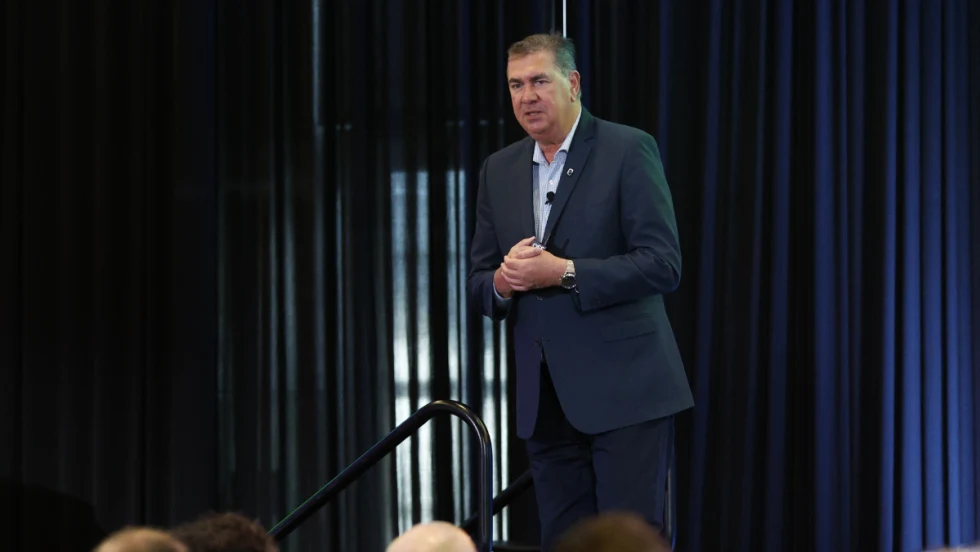
The Next Fleet War Won't Be Won on Specs Alone
The 2026 Stellantis Pro One Fleet Preview was less about vehicles and more about what happens after you buy them.
Read More →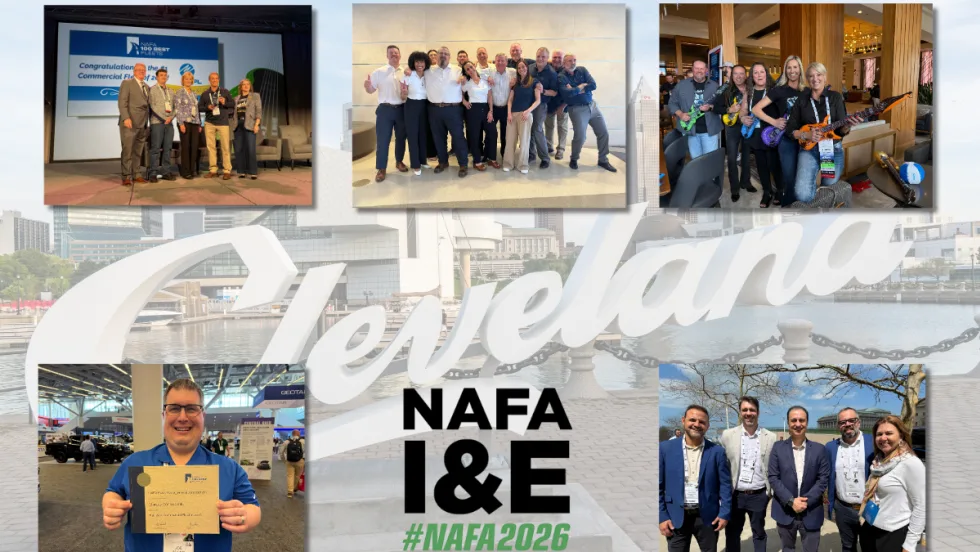
Navigating Brundlefly and Fleet AI at 2026 NAFA I&E
AI is becoming the operating layer for fleets. In Cleveland, the buzz was about harnessing AI in an increasingly complex, permanently disrupted environment.
Read More →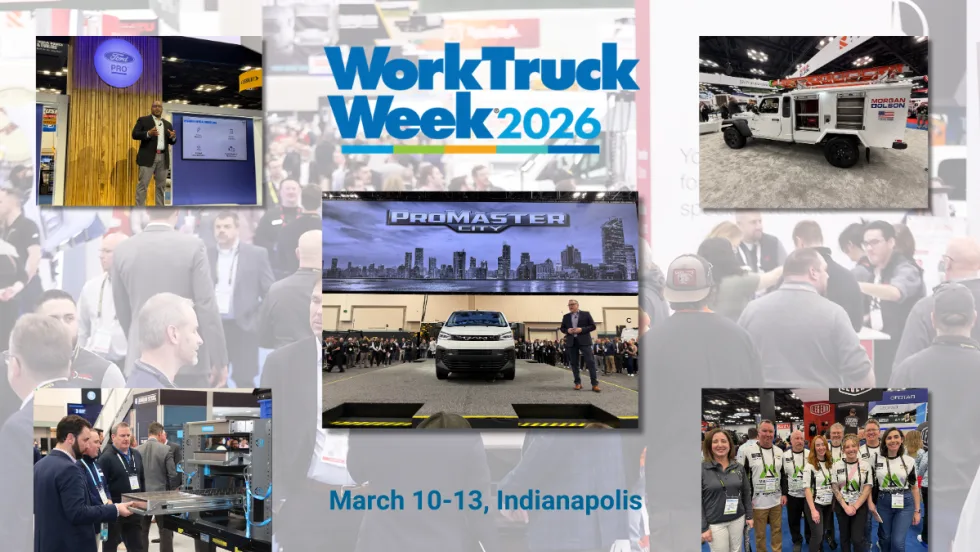
8 Trends: Work Truck Week 2026 Reveals a Fleet Industry in Reset Mode
Walking the show floor this year, the new focus was around “practical innovation” and pragmatic solutions. And oh yeah, a new small van.
Read More →
For Mike Antich, it Was Always About the People
He stood tall in the industry in so many ways, but he measured success by the people he served.
Read More →
Solving the Flexible-Lean Fleet Paradox
The lean fleets of yesterday are the fragile fleets of today. Where do we find the balance?
Read More →
We’ve Been Here Before
If every generation of fleet managers thought they had the worst problems, what makes ours any different?
Read More →