




Navigating Brundlefly and Fleet AI at 2026 NAFA I&E
AI is becoming the operating layer for fleets. In Cleveland, the buzz was about harnessing AI in an increasingly complex, permanently disrupted environment.
April 22, 2026

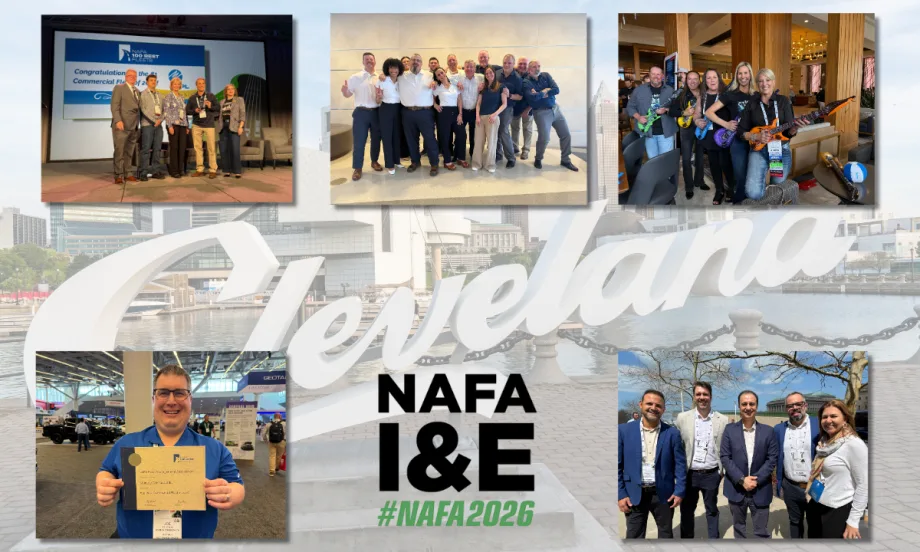
The 2026 NAFA I&E drew more than 2,300 fleet professionals to Cleveland. The need for greater community, tools, and perspective for fleets was more prevalent than ever.
Credit: Automotive Fleet
8 min to read
I recently rewatched the 1986 movie “The Fly,” in which eccentric scientist Seth Brundle (Jeff Goldblum) accidentally mixes his genetic code with that of a housefly. What follows, after he sprouts coarse bristles on his back, is a euphoric realization of newfound strength and energy. He starts calling himself Brundlefly.
At his most potent state, Brundlefly is the best version of technology and biology, streamlined to 10x his business and personal performance.
Let’s (ahem) forget about the end of the movie for now. I had that movie on my mind when I went to Cleveland for the 2026 NAFA I&E. No, I didn’t expect the 2,300 or so attendees to climb walls and buzz across the convention center (but it’s a potent image).
Nonetheless, when it comes to AI, we’re getting to the point where it is intimately entwined with everything we do — not in a Brundlefly bio-sense (yet!) — but definitely as an always-there, avatar companion designed to make us faster, smarter, better.
You can’t go to any fleet show today, or any B2B show for that matter, that doesn’t focus on AI. At NAFA I&E this year, the AI conversations were omnipresent, and shifting from “wow, this is AI” to “embrace AI, here’s how, or get left behind.”
There were plenty of other things going on at NAFA, and we’ll get to those, but AI was certainly the major theme. The AI sessions were packed.
AI Requires Change Management
At Lori Olson of Geotab’s excellent session on adopting AI, she stressed not to overlook a barrier to adoption — change management. We’re already overwhelmed by new information and systems, and AI is another layer to worry about. As a result, adoption must be intentional and gradual, something that we must “architect.”
She brought up the “centaur” approach, in which humans and AI work together, with the system generating insights while humans must be responsible for judgment and correction. (That tech-bio thing again — and much less dystopian!)
Olson stressed the importance of validating outputs and not blindly trusting AI. “Be harder on your AI agent than you would on any employee,” she said.
She was also clear that AI is more than a competitive advantage; it’s now a business necessity. Yet humans must remain in the center.
Another AI session led by Scott Knabe and Parsh Wanash of Wheels highlighted how fleet safety is moving beyond traditional behavioral scoring to predictive modeling that identifies risk before it becomes obvious.
Beyond telematics-identified events (harsh braking, speeding, etc.), new systems use AI to combine telematics, video, and historical behavior data to detect subtle signals, such as small lane deviations, that indicate fatigue or elevated risk.
A session conducted by Ruth Alfson and Kate Vigneau of Matrix Consulting Group, and Allison Betz of ABA Technologies, also focused on using AI for fleet safety and risk prediction, emphasizing that predictive modeling is only the starting point. They stressed how AI can help to change behavior in real time.
AI is bringing fleet safety from reactive to predictive and proactive. And as such, fleets need to shift how they respond, too — from relying on reviews to coaching and guidance in the moment, tailored to each driver.
Chatbots Are Table Stakes
The AI demos in the exhibit hall and the media product launch session showed that we’ve reached the point that (seemingly) every platform now has an AI assistant that starts with a chatbot.
From Motorq’s Fuse Assistant and Collective Data’s “Ask Anything” tool to a myriad of FMIS platforms, natural language has effectively become the new user interface for fleet software. Forget navigating dashboards and building reports. Now, you just ask a question, and the system responds with a chart, a table, or a recommendation.
But the real differentiation isn’t whether a platform has AI; it’s what happens after you ask the question. Similar to the aforementioned predictive safety models, these new AI interfaces recommend next steps for repair orders, inventory planning, and lifecycle decisions.
Motorq’s Fuse can interpret even vague queries, pull from multiple data sources, and generate answers on the fly (see what I did there?) to help with financially relevant decisions.
The Mixed ICE/EV Reality
“For a while, EVs were wagging the tail in fleet,” Joe Hoiberg, who runs the fleet at Stanley Consultants, said from the audience in one of the sessions. “Now, AI is wagging the tail.”
It sure seems that way. Compared with I&E two years ago, the number of exhibitors focusing on electrification declined notably, and the ride & drive, powered by Bobit, had fewer EV models.
But EVs have not gone away, and there were seminars for those fleets already in EVs. The audience for those was mostly public-sector fleets, who are incrementally adding more EVs and working through their next steps.
One session centered on managing a mix of gasoline, diesel, hybrid, and electric vehicles, which is likely the operating model for the foreseeable future: UCLA’s Clinton Bench, who runs the UCLA fleet, spoke about moving from initial charger placement to more strategic infrastructure planning that factored in load management and electrical capacity, making infrastructure just as (or more) important as vehicle selection.
At the same time, fleets are digging deeper into telematics and data systems to understand how different powertrains perform in real-world use. In the same session, Mary Till of Sawatch Labs (a WEX company) discussed the operational reality of managing fuel and electricity side by side. Fuel used to be simple, with a single card and a single system. Now, electrification is turning it into a multi-source, data-driven challenge.
In a sit-down with Josh Green, founder and CEO of Inspiration Mobility (holding company of Inspiration Fleet), he discussed how the company is now managing mixed EV and ICE fleets, not solely EVs.
Inspiration sees an opportunity in helping fleets figure out how EVs could fit into a mixed fleet system that touches facilities, energy management, sustainability, and operations all at once. Green notes that pretty much every fleet could start making material progress with EVs today, even before the full "flip the switch moment" arrives, when EVs are the obvious choice to replace every fleet vehicle.
OEM Panel: Control Your Costs
I was back onstage to moderate the OEM panel, with representatives from Ford, GM, Nissan, and Stellantis. We’ll have a separate article on that, but here are the key takeaways:
The biggest message for fleets is not to expect costs to come down. Between fuel volatility, tariffs, and economic uncertainty, fleets should assume the current environment is the new normal and focus on what they can actually control.
That led to recommendations from the panel: Reevaluate vehicle spec’ing — can you make do with a smaller vehicle? Look harder at utilization. How can you better optimize your current fleet?
Electrification came up, as expected, but there’s less talk about mandates and more focus on where EVs actually work, a common theme at fleet events in the last year. We’re in a more pragmatic phase — deploy EVs where there’s a use case (“right tool for the job”).
That led to a broader powertrain conversation on hybrids, range-extenders, and even more efficient ICE vehicles all playing a role.
A few years ago, this panel was about what’s coming next. This year, it was about how to prevail in a high-cost, high-complexity environment.
Global Shocks Are Local Shocks
In the Fleet Forecast panel, always preceding the OEM panel, Michael Taylor of Hillstaffer laid out the trade, policy, and tariffs landscape. And the main takeaway — if it isn’t already abundantly clear — is that uncertainty isn’t temporary; it’s the new operating environment.
Between the renegotiation of the USMCA, shifting EV incentives, and geopolitical shocks driving fuel prices, fleets are being pulled into forces they can’t control. As Taylor noted, the oil market is global. What happens halfway around the world can show up at the pump almost immediately.
What fleets should do about it seems obvious: have a flexible strategy, be poised for change, and don’t operate in a silo.
On that note, perhaps my most potent takeaway wasn’t from the stage, but from a conversation with three government fleet managers over lunch. I asked them about their biggest challenges.
They said their open technician positions were almost all filled, so labor was less of a concern. Their biggest challenge was setting a two-year budget during such volatile times, particularly regarding internal costs and what they charge other departments, and having to amend the budget and costs mid-cycle. It's a tricky balancing act.
Brundlefly Thoughts and AI as Mobility Model
So back to Brundlefly. At his peak, he represented the best of humans and machines working together, amplified. We’re about to hit this mark with AI in fleet. We’re becoming faster, smarter, and more efficient in so many ways. Inevitably, those efficiencies will increase 10x, as will expectations.
In another session, a panelist said, “AI is becoming the operating model for modern mobility.” That’s exciting, but that puts even more urgency in those expectations.
AI is now the layer that sits on top of everything else — mixed fleets, rising costs, policy shifts, and global uncertainty. Everything is already in motion and all at once. How are fleets going to use AI to operate in a more complex, less predictable environment?
Get a handle on it now, because we will come to the point where AI and biology cross. It’s already happening with digital twins, genomics, AI clones, and chips in brains. How will we adapt?
This is the task at hand, and it is a big one.
Subscribe to Our Newsletter
More Blog Posts

How to Win a Fleet Manager Award: Make Your Nomination Count
Strong fleet accomplishments can go unrecognized when the nomination doesn’t make the case. Here’s what judges need to see.
Read More →
The Only Certainty with the New Tariff Threat Is Uncertainty
Trump’s Canadian tariff threat will not move production overnight, but the uncertainty could influence ordering and pricing now. Longer term, forces beyond tariffs may determine which North American plants survive.
Read More →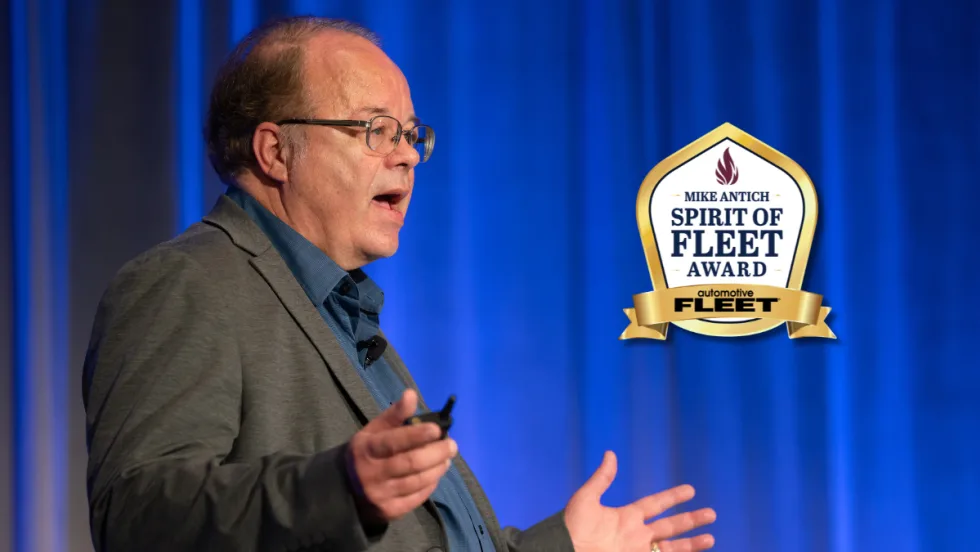
What Does It Mean to Embody the Spirit of Fleet?
Presented alongside Fleet Manager of the Year, Fleet Visionary, and Fleet Hall of Fame at AFLA, the new Mike Antich Spirit of Fleet Award is unique in that it recognizes service to the overall profession. Just like Mike.
Read More →
What Separates Great Fleet Managers From Everyone Else?
What do Visionary candidates with fewer than 10 years of experience have in common with Hall of Fame nominees with a lifetime under their belts?
Read More →
The Next Fleet War Won't Be Won on Specs Alone
The 2026 Stellantis Pro One Fleet Preview was less about vehicles and more about what happens after you buy them.
Read More →
8 Trends: Work Truck Week 2026 Reveals a Fleet Industry in Reset Mode
Walking the show floor this year, the new focus was around “practical innovation” and pragmatic solutions. And oh yeah, a new small van.
Read More →
The Moment AI Became Operational
“AI isn’t assisting us anymore. It’s doing the work,” said CEO Neil Cawse at Geotab Connect 2026. What does this mean for fleet managers?
Read More →
For Mike Antich, it Was Always About the People
He stood tall in the industry in so many ways, but he measured success by the people he served.
Read More →
Solving the Flexible-Lean Fleet Paradox
The lean fleets of yesterday are the fragile fleets of today. Where do we find the balance?
Read More →
We’ve Been Here Before
If every generation of fleet managers thought they had the worst problems, what makes ours any different?
Read More →