





The Only Certainty with the New Tariff Threat Is Uncertainty
John Rossant: Don’t Make a Ten-Year Bet on a Two-Year Policy
At the 2026 Fleet Forward Conference, Rossant brought transportation insights from Europe, China, and the Middle East to a discussion of fleet management's changing role.
November 19, 2026
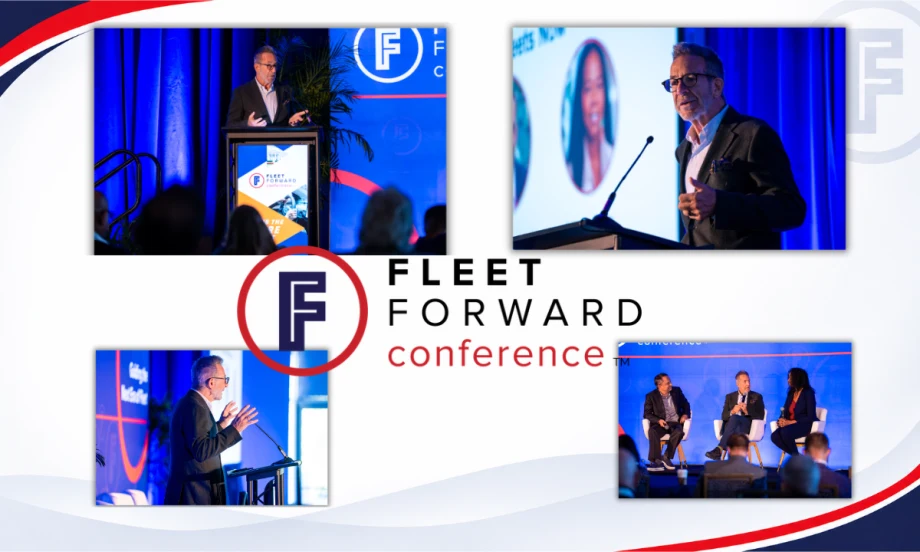
Rossant, a global leader in transportation, energy, and urban mobility, was later joined UCB Pharmaceuticals' Linda Ellis for a discussion of how global trends translate into local fleet decisions.
Credit:
Automotive Fleet
8 min to read
- John Rossant shared transportation insights from Europe, China, and the Middle East at the 2026 Fleet Forward Conference.
- His discussion centered on the evolving role of fleet management amidst global trends.
- Rossant advocated for adaptive strategies rather than committing to long-term plans based on short-term policies.
*Summarized by AI
It's understandable that fleet managers in the U.S. operate in an American-centric bubble. They have enough to worry about when attempting to tax, title, and license vehicles across three states. Imagine operating in Europe, where you can drive 100 miles and cross into three different countries.
Wherever a fleet operates, managers must navigate their own geographies, regulations, business practices, and modus operandi. Yet fleet managers worldwide face many of the same challenges, from shifting vehicle economics and powertrain options to AI and increasingly automated operations.
For U.S. fleet managers, examining how these developments are unfolding elsewhere can provide a new perspective on the changes already underway at home.
That was the premise of the opening keynote John Rossant delivered at the 2026 Fleet Forward Conference (FFC), held outside Washington, D.C. on Oct. 20.
Rossant brings an international perspective to the subject. An award-winning BusinessWeek foreign correspondent, he has spent decades working at the intersection of transportation, technology, energy, and public policy.
He founded the New Cities Foundation, a global nonprofit focused on urban innovation, and is founder and CEO of CoMotion, an event series focused on transforming urban mobility. He led the team that produced the World Economic Forum's annual meeting in Davos, Switzerland, and organized the inaugural e-G8 summit on the future of the internet.
To open his keynote, Rossant acknowledged that he isn't a fleet manager and doesn't face their daily challenges. Instead, he compared his role to that of a weather forecaster, identifying developments in other markets that could affect fleet operations.
His message was not that U.S. fleets are necessarily behind other markets. Rather, many of the same forces affecting fleet management domestically are also playing out internationally, though sometimes through different technologies, business models, and regulatory approaches.
Referring to what might flow to the U.S. market, “The world is your supply chain,” Rossant told attendees.
The keynote is available as a podcast: Reading the Global Signals: What AI and the Energy Transition Mean for Fleets Now | Automotive Fleet
Credit:
Automotive Fleet
China's Booming Electric Truck Market
Rossant served up insights from China, where technology and economics are evolving at breakneck speed. While the electric truck market in the U.S. is still in its infancy, China’s market is booming.
Rossant cited that battery-electric and hybrid trucks accounted for about 28% of new heavy-duty truck registrations in China, compared with roughly 0.3% in the U.S.
And China is approaching electric trucks’ operational challenges differently. Beyond conventional charging, Chinese operators are deploying battery-swapping systems that let trucks swap depleted battery packs for charged ones in minutes.
China has unique advantages in coordinating manufacturers, battery suppliers, and infrastructure providers. But for U.S. operators, it demonstrates what’s possible.
In that vein, China continues to sink billions in investment into electrification, which has helped drive down domestic costs. Rossant argued that these developments are increasingly influencing the global vehicle market, even where trade restrictions limit the direct importation of Chinese vehicles.
Global AI Trends Mirror US
Rossant also discussed how AI is changing how transportation operations are managed, which U.S. fleet managers will acknowledge is the number one theme in fleet management today.
For years, fleets have invested in connected vehicles and software systems that collect enormous amounts of data. The challenge has been turning that “data firehose” into action, and AI is meeting this challenge.
Rossant sees this playing out globally too. “It's software that finally does the second half of the job. It acts for you,” he said.
He pointed to autonomous ride-hailing operations in the Middle East as an example of software coordinating vehicle dispatch, routing, charging, and repositioning in response to changing operating conditions.
Of course, similar capabilities are emerging in U.S. autonomous operations. The broader significance is that around the world, AI is beginning to coordinate multiple aspects of an operation, graduating from optimizing individual tasks in isolation.
This evolution is elevating the fleet manager's role, with more emphasis on overseeing automated systems, managing exceptions, and deciding how much decision-making authority to delegate to technology.
Rossant also highlighted the emergence of vibe coding, in which non-coders use AI to develop their own software tools.
The topic was explored in greater depth during a dedicated FFC2026 session. Rossant echoed the conversations happening in the U.S.: “AI is not going to replace fleet managers,” he said. “Fleet managers who use AI will replace the ones who don’t.”

“AI is not going to replace fleet managers,” Rossant. “Fleet managers who use AI will replace the ones who don’t.”
Credit:
Automotive Fleety
Data and Safety Trends in Europe
Rossant pointed to Europe as a preview of where vehicle safety is heading. Under the EU’s General Safety Regulation, new vehicles sold there must now include automatic emergency braking, lane-keeping assist and a driver drowsiness warning.
The U.S. path is different, he said. The Insurance Institute for Highway Safety is only now beginning to test commercial vans and pickups. As safety moves into the vehicle, he said, the fleet manager’s role moves from teacher to “coach of coaches.”
As AI helps fleets move from reporting to action, Rossant warned that failing to act on the data can be a liability. “Data also testifies.” This is certainly familiar territory for U.S. fleets.
He said Europe has already written product liability rules to cover software, and the EU AI Act is phasing in obligations for AI systems. In the U.S., Rossant expects courts to sort it out case by case, which he called slower and considerably more expensive. Either way, the dashcam video that clears a good driver can also expose an unenforced policy.
He advised writing data retention and coaching policies now, as a planning exercise, rather than while responding to a claim. On the asset side, he urged fleets to write data access into OEM and supplier contracts.
“In the age of AI, whoever owns the data owns the decision,” he said.
With vehicle health data from embedded modems combined with AI to schedule service before a breakdown, downtime, he said, shifts “from an act of God to a line item you can plan for.”
Electrification Economics: From Climate to Cost
Rossant addressed U.S. policy directly, noting that the conference was nine miles from Washington and two weeks before the midterms.
The federal commercial clean vehicle credit, worth up to $40,000 per truck, ended Sept. 30, 2025. The credit for charging equipment ended in June. In February, the EPA rescinded the federal greenhouse gas standards for vehicles. Whatever one thinks of those decisions, “they’re real and they change the math.”
But he argued that another factor has changed the math back. Diesel topped $6 a gallon in September, about $2.50 above a year earlier, as supply through the Strait of Hormuz was disrupted. Nobody voted for that, Rossant noted, and no fleet manager can veto it.
Fuel is roughly a fifth of trucking cost per mile, he said, and every extra dollar per gallon adds about 16 cents a mile for a typical heavy truck. Electricity, by contrast, is almost entirely produced domestically and doesn’t spike when a tanker is disrupted overseas.
That led to an evolving U.S. case for electrification: it’s now about cost and risk, not climate. He compared it to how a treasurer hedges currencies. “A fleet that runs on one fuel has one point of failure,” he said. At $6 diesel, he added, payback comes quickly in last-mile and light-duty work, and hybrids still have a role where they fit.
His advice was to keep options open rather than make bets. Use mixed powertrains, shorter replacement cycles where technology is moving fastest, and electric where duty cycles already pay it back. Policy will swing again, possibly within the life of vehicles ordered this year. “Physics and prices don’t change with elections,” he said. “Plan for the volatility, not the headline.”
“Don't make a ten-year bet on a two-year policy,” he said.

Linda Ellis of UCBemphasized that global objectives must be balanced with local execution, as infrastructure, vehicle availability, leasing structures, and driver needs vary significantly between countries and individual markets.
Credit:
Automotive Fleet
Global Electrification on the Ground
The importance of balancing long-term strategy with operating realities became clear when Linda Ellis, fleet lead for UCB Pharmaceuticals, joined Rossant onstage to continue the discussion.
Ellis oversees fleet operations across the U.S., Canada, Mexico, and Brazil for the Belgium-based biopharmaceutical company.
Like many multinationals, UCB initially pursued an ambitious electrification strategy with the requisite leadership and investment support. But Ellis acknowledged that the company had placed too much emphasis on incentives and other considerations without sufficiently analyzing the underlying fleet data.
“We didn't rely on the data,” she said.
UCB subsequently reassessed its approach, examining vehicle applications and driver requirements to better understand the financial implications.
Today, approximately 40% of its U.S. fleet is fully electric, according to Ellis. In Mexico, the company has adopted an entirely hybrid fleet, reflecting different market conditions and operating requirements.
The company also had to revisit its original goal of achieving full electrification by 2030. “Obviously, we won't make that,” Ellis said.
But the new timeline didn't mean abandoning the transition. Instead, UCB developed a new approach based on the circumstances of its individual markets.
Ellis emphasized that global objectives must be balanced with local execution, as infrastructure, vehicle availability, leasing structures, and driver needs vary significantly between countries and individual markets.
Don’t Get Surprised by the Storm
Rossant closed by returning to his role as a weather forecaster. A forecaster’s job, he said, isn’t to stop the storm but “to make sure you don’t get surprised by it.”
His practical advice was to stop benchmarking only against last year or the fleet down the road. He pointed fleet managers to the hotbeds: Europe on safety, China on trucks, and the Persian Gulf on autonomy. Those are the places, he said, where vendors, parent companies and competitors are already looking.
The caveat came from Ellis, who described how UCB sets strategy globally, then localizes execution, because leasing structures, driver taxation, infrastructure and driver needs differ from market to market. Other markets can’t hand U.S. fleets a template, but they can show what’s coming, and what it costs to be caught off guard.
“You can’t control those signals,” Rossant said, “but you can read them before your competitors do.”
Quick Answers
John Rossant emphasized the importance of aligning long-term strategies with the evolving landscape of fleet management, cautioning against making extended commitments based on short-term policies.
*Summarized by AI
Subscribe to Our Newsletter
More Global Fleet
GeoFencing Adds to Your Truck Security Arsenal
Geofencing is a familiar fleet tool today, but its early adoption marked a major shift in vehicle tracking, route monitoring, and the debate over employee privacy.
Read More →
Holman Takes Full Ownership of ARIZA in Mexico
Holman is bringing its Mexican fleet management operation fully under its own brand after more than 30 years as a joint venture. The change gives multinational fleet customers a single Holman operation across the U.S., Canada, and Mexico.
Read More →
5 Tire Maintenance Tips to Help Prevent Work Truck Downtime
Regular tire checks can do more than extend tread life. These five maintenance practices can help work truck fleets catch problems early, reduce costs, and prevent downtime.
Read More →

Proven Ways to Reduce Work Truck Downtime
The age-old problem of downtime will always be a reality, but with new strategies at hand, fleets have more ways to keep trucks on the road longer.
Read More →

Cameras, Safety and Insurance: From Reactive Claims to Real-Time Prevention (Part 2 of 2)
Part Two: Commercial auto remains one of the most challenging and costly lines of coverage for fleet operators and insurers alike. Continue learning more about how to effectively address these issues from Onur Aksan, Enterprise Business Development Executive, Geotab
Read More →
Cameras, Safety and Insurance: From Reactive Claims to Real-time Prevention
Commercial auto remains one of the most challenging and costly lines of coverage for fleet operators and insurers alike. Learn more about how to effectively address these issues from Onur Aksan, Enterprise Business Development Executive, Geotab.
Read More →
Enterprise Fleet Management Surpasses 900,000 Vehicles in U.S. & Canada
Enterprise Mobility connects with mobility solutions around the globe
Read More →
Automotive Fleet's Guide to Fleet Electrification
Unlock the secrets to a successful transition to electric fleets with Automotive Fleet's comprehensive Fleet Electrification Guide!
Read More →