





Keep Reading! What Fleet Managers Need to Know About EVs, AI, and Optimization in 2026
How China Quietly Reduced Its Dependence on Oil (And What Fleets Should Learn)
China didn’t just bet on EVs. It used them to cut oil dependence at scale. Here’s what that strategy reveals and why smart fleets should be paying attention.
March 24, 2026
China’s push into electric vehicles isn’t just about innovation—it’s a calculated move to cut oil dependence, with millions of EVs quietly reshaping global fuel demand and offering a roadmap for fleets seeking stability.
Credit: Automotive Fleet
4 min to read
There has been a lot of characterizing of China’s electric vehicle program as a Machiavellian way to collect data and personal information on individuals and businesses. If history tells us anything, it is that if you are threatened by a competitor and can’t beat them, then paint them as a villain.
The recent conflict in Iran has shed a spotlight on China’s dependency on crude oil. It appears to be one of the very few, and very much needed, natural resources that China doesn’t produce domestically. China realized this and, in 2009, began executing a roadmap for its New Energy Vehicle (NEV) program.
I understand that China's population is three times that of the U.S., but the question I ask myself is: what if China had taken the same path as the U.S. on electric vehicles? More specifically: If China had the same EV adoption rate as the U.S., and all those vehicles were instead gasoline-powered, how much more fuel would China need today?
Behind that question sits a much bigger one: How much has China already reduced its dependence on fossil fuels by committing early to electrification? This isn’t a theoretical exercise. It’s a measurable shift in global energy demand, and one that fleet operators should be paying very close attention to.
China didn’t experiment with EVs; It industrialized them. For example, today:
31.4 million electric vehicles (NEVs) are on the road
That’s roughly 9% of the total vehicle population
More than half of new vehicle sales are electric
This is not a niche transition. It is a systemic redesign of transportation tied directly to national energy strategy. To understand just how much that strategy has moved the needle, let’s ask a simple question: what if China had been as slow to electrify as the United States?
Step 1 — EV adoption rates (Share of total vehicles on road)
China EV share: ~8.9%
U.S. EV share: ~2.2%
Step 2 — Apply U.S. adoption to China
Total vehicles in China: ~353 million
At 2.2% EV share → ~7.6 million EVs
Step 3 — Compared to reality
Actual EVs in China: 31.4 million
Difference: 31.4M – 7.6M = 23.8 million vehicles
These 23.8 million vehicles represent the different makes of vehicles that, under a U.S.-like adoption curve, would likely still be powered by gasoline.
How does that translate to real demand for fuel? Let’s do the math!
Assume a typical passenger vehicle in China:
10,300 km per year
~7.0 liters per 100 km
That equals:
~720 liters per vehicle per year
Now multiply:
23.8 million vehicles x 720 liters/year = 17.1 billion liters/year
China is avoiding approximately 16–18 billion liters of gasoline consumption every year
simply by having higher EV adoption than the United States.
How EV Adoption Is Reducing Oil Demand in China
To put that into oil terms:
1 barrel = 159 liters
17.1B / 159 approximates to 107 million barrels per year, or 293,000 per day
This means China’s EV adoption is already reducing oil demand by roughly 300,000 barrels per day (gasoline-equivalent). That’s about 8% of China’s gasoline demand and the equivalent of removing the fuel consumption of an entire mid-sized economy.
This is a conservative estimate! This analysis focuses only on passenger vehicles. It does not include electric buses (where China is the global leader), medium- and heavy-duty electric trucks, two- and three-wheel EVs, and rail electrification. It also doesn’t include the fossil-fuel savings from China’s solar energy. In other words, the real reduction in fossil fuel dependency is materially larger.
China’s reduction of its dependency on crude oil didn’t happen by accident.
It aligned:
Industrial policy (battery and EV manufacturing)
Infrastructure (charging networks built ahead of demand)
Energy strategy (pairing EVs with solar and grid expansion)
Market incentives (for both consumers and fleets)
Unlike in the U.S., Europe, and Canada, where electrification was sold as a way to address climate change and reduce emissions, in China the objective is to use electrification as a tool for energy independence. Countries such as China and Japan are renowned for long-term strategic planning, whereas the “western” world focuses on election cycles and promises made.
What China’s EV Strategy Means for Fleet Operators
For fleet operators, this isn’t about geopolitics. It’s about controlling what you can. Gasoline and diesel are globally priced and volatile, while electricity is increasingly generated locally and is predictable.
China’s playbook shows that electrification can reduce exposure to fuel price swings, improve long-term operating cost stability, and shift energy sourcing closer to home.
Why Electrification Has Become a Strategic Fleet Decision
If China had followed the same EV trajectory as the U.S., it would be consuming about 17 billion more liters of gasoline every year. Instead, it made a long-term strategic pivot over 15 years ago, and today, that decision is showing up not just in emissions data but in reduced oil dependency at a national scale.
For North American fleets, the takeaway is simple: electrification is no longer a climate change calling card; it is a strategic lever for fleet budget stability.
Subscribe to Our Newsletter
More Blog Posts

AI Is the Trojan Horse
The greatest risk of AI isn't what it knows. It's what we stop doing ourselves.
Read More →
Is This Theft Disguised as Training?
If AI is still “training,” why is it already publishing, summarizing, and profiting from the work of creators? In this provocative Insight Lane column, Colin Sutherland challenges the industry’s most convenient narrative—and asks a simple question: when does training become extraction, and why is credit still optional?
Read More →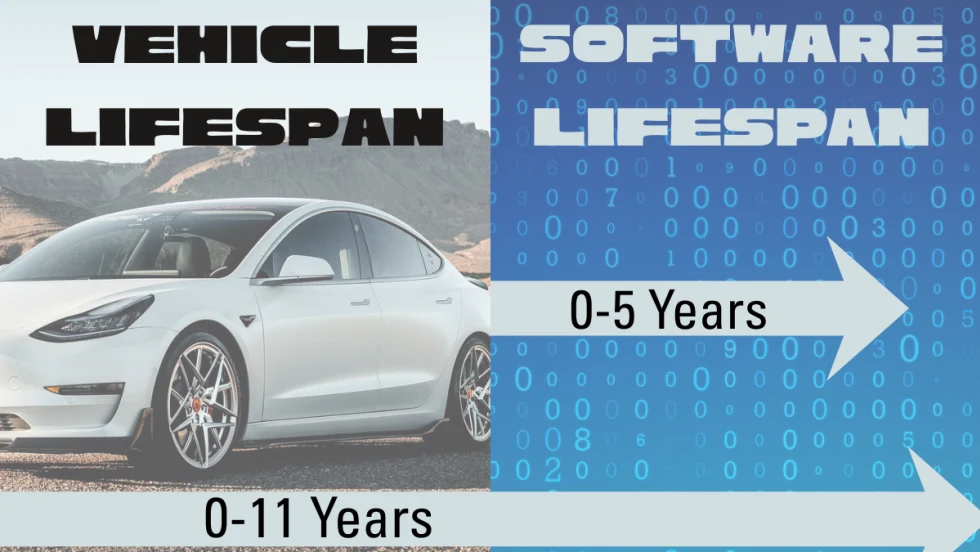
When Cars Stop Updating but Don’t Stop Driving
When the US’s largest EV manufacturer discontinues a model, it gives me pause to consider the software that drives it.
Read More →
The Cart is Pulling the Horse
Here's why software features shouldn’t be allowed to dictate your business goals.
Read More →
The Story of 2025: Outsourcing Accountability
The fleet world has been transformed by technology, so a choice must be made: how do we discern when to use AI and when not to?
Read More →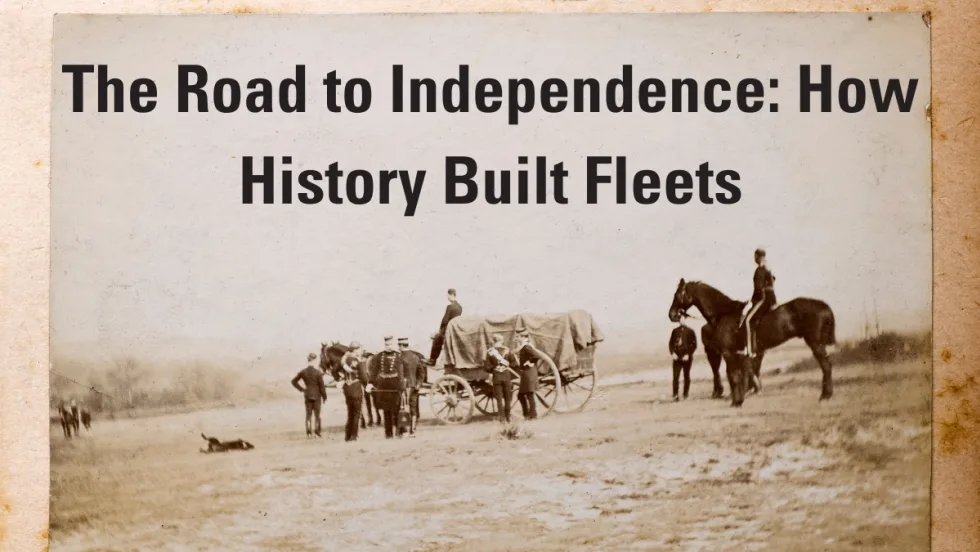
The 250-Year-Old Fleet Manager: Quartermasters & Wagon Masters of the American Revolution
“Fleet manager” wasn’t a title then, but Quartermasters and Wagon Masters lived the job on the road to independence.
Read More →
The New Reality of Disaster Preparedness
When disaster strikes, every second matters. From must-have Grab & Go essentials to lessons the fleet community is sharing right now, this piece explores what real preparedness looks like and why waiting until the last minute is no longer an option.
Read More →