




Hiring Fleet Drivers — When Drivers Hold the Cards [Part 1]
In this new labor market, driver candidates have different motivators and heightened demands. In part one of this two-part series, find out how to start the process and understand new candidates.

![Hiring Fleet Drivers — When Drivers Hold the Cards [Part 1]](https://assets.bobitstudios.com/image/upload/f_auto,q_auto,dpr_auto,c_limit,w_920/20231030-driver-hiring-1_1775895276932_ljbuqu.png)
With the Great Resignation, remote jobs, automation, and now AI, the work environment is changing faster than in any other period in history. Candidates for driving jobs are aware of the new zeitgeist. They understand the explosion of e-commerce and that last-mile driving jobs are a hot commodity.
Photo: Automotive Fleet
The driver shortage was brewing long before the COVID-19 pandemic. While the pandemic may have waned, the driver shortage continues — and has been complicated by new ways employees engage with work.
Toni Tovi knows something about driver recruiting in this new environment. She started Bright Flag Recruiting in 2018 and matured the business through the pandemic. The company hires drivers for last-mile contractors and independent carriers, both CDL and non-CDL, as well as mechanics, operations managers, and other admin support positions.
Before starting Bright Flag, Tovi gained fleet experience firsthand as an investor in four FedEx Ground routes. As a contractor, Tovi immersed herself in the full scope of fleet operations, from vehicle procurement, driver hiring, and onboarding to payroll.
“It was drinking from the firehose on every level,” she said. “I really got immersed in that space.”
In part one of our two-part series, Tovi shares best practices on how fleet operators can better hire drivers in a seminar at the 2023 DeliveryCon conference and expo in Las Vegas.
Begin the Process
Hire an internal recruiter or external firm?
One of the first questions growing organizations ask is whether to create an in-house staff recruiter position or outsource. In this decision, consider the value of your time, Tovi said.
Break down the hours you’ve spent on recruiting and divide that by the fee you’d pay to a recruiting service. Then, take that per-hour rate and compare it to your salary. This calculation often reveals that your time is better spent in other ways, such as scaling the business.
Know the types of recruiting firms.
Tovi said that fleet operators just starting to engage with a driver recruiting firm must understand the types.
Some recruiting firms specialize in temporary drivers or temp-to-hire. Another type is a full-service recruiting agency that finds permanent drivers and other positions, places them for the organization, and charges a fee for each placement.
Operators are assessed fees on a per-hire or month-to-month subscription model that guarantees a certain number of monthly placements. The latter is better suited to meet uneven seasonal demands, Tovi said.
Vet the driver recruitment firm.
The next step is to investigate the firm you’re thinking of hiring. One tried-and-true way is by checking out online reviews.
Be sure to seek out reviews from the hiring company and the drivers they’ve hired. In their reviews, do the drivers say the recruiting firm did its job by creating a warm handoff to the company? Did the firm properly explain what the job entails and the organization's culture so the drivers have full transparency into what they're getting into?
“If a driver offers a rave review of a recruitment firm, that driver is much more likely to last with the company than a firm just trying to fill a seat,” she said. “Having that feedback from the driver is a key component to substantiating the claims that the recruiting firm is selling you.”
Don’t stop with a couple of reviews. Tovi recommended asking for multiple referrals regarding different position types in the different markets the firm serves.
Toni Tovi is the founder and president of Bright Flag Recruiting and speaker at the 2023 DeliveryCon.
Photo: Bright Flag Recruiting/Automotive Fleet
Understand the New Candidates
With the Great Resignation, remote jobs, automation, and now AI, the work environment is changing faster than in any other period in history. Candidates for driving jobs are aware of the new zeitgeist. They understand the explosion of e-commerce and that last-mile driving jobs are a hot commodity.
Know the new demands.
They’re also aware of corporate perks like free gourmet lunches, espresso bars, and napping pods through social media. And while they wouldn’t expect those at a driving job, they still wonder what extras the employer will do for them.
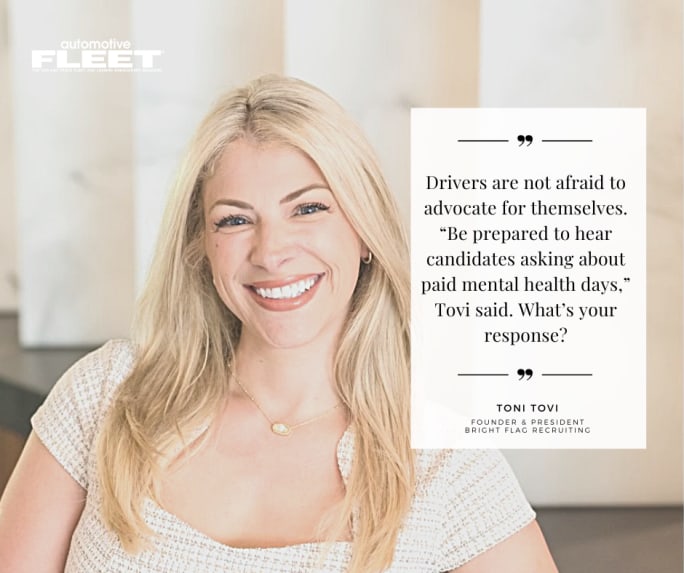
And they’re not afraid to advocate for themselves. “Be prepared to hear candidates asking about paid mental health days,” Tovi said. What’s your response?
Address pay disparity.
Potential hires will be cognizant of pay scales in the overall market, particularly with recent news of union-driven wage hikes at UPS.
Tovi said to explain to candidates that they can’t walk off the street and fall into a $45-an-hour gig — they need tenure with that organization.
Tovi sets the stage with the candidate by saying they can work toward the higher paying goal by using this immediate driving job as a stepping stone. “And then in two to five years, you can go and apply for that well-paying union job, and we're happy to be the conduit to that,” she said.
Know what motivates them.
Employers must continually take the pulse of potential hires to understand what motivates them. They want to know the culture of your organization before they decide to join, Tovi said.
They also want more of a relationship with their peers. Do you have social gatherings, barbecues, or a night out at Top Golf?
Understand how far you’ll go to address these motivators.
In part two of this two-part series, learn more about how to refine your candidate searches and how to improve retainment efforts.
More Operations

What Will Shape the Next Era of Fleet Management?
EVs, AI, and autonomous vehicles are reshaping fleet management. Discover what’s ahead—and how fleet leaders can prepare for the next era.
Read More →
How Fleets Can Recruit and Train Veterans for Technician Roles
Here's how the technician shortage has affected uptime for fleets, and what to do about it.
Read More →
Avis Budget Group Deploys Neology Toll Management Technology Across Major Brands
Neology’s neoFleet platform will manage toll transactions and toll-authority operations for vehicles across Avis, Budget, Payless, Budget Truck and Zipcar.
Read More →

Fleet Personal-Use Charges Edge Higher in 2026
Nearly eight in 10 surveyed fleets allow personal use of company vehicles, while just over half of respondents report charging employees for the privilege.
Read More →
The Future of Fleet + What’s Changing Right Now | AF News Recap
Could developments overseas offer a preview of what’s coming for U.S. fleets? This week, we’re looking at the future of AI, autonomy, and electrification, plus Ford Pro’s new certified pre-owned program, smarter vehicle offboarding, and a new way for fleets to manage toll expenses.
Read More →
How to Handle Vehicle Offboarding
What do fleet managers need to do when a driver leaves?
Read More →
Fleet Manager’s Ultimate Playbook: Navigating the New Standard in OEM Connectivity
Rising operating costs, driver safety concerns, and unplanned downtime are putting unprecedented pressure on modern fleets. Discover how fleet managers use embedded OEM connectivity and real-time vehicle data to cut TCO, prevent downtime, and protect drivers without aftermarket telematics hardware.
Read More →
U.S. Bank Adds Verra Mobility Toll Management to Voyager Fleet Platform
The integration allows U.S. Bank Voyager fleet customers to manage toll payments and violations alongside fuel, EV charging and maintenance expenses.
Read More →
ADAS Prevents Crashes. But Repairs Cost More | AF News Recap
ADAS-equipped vehicles may crash less often, but they can cost more when they do. This week, we’re breaking down what that tradeoff means for fleets, plus Subaru’s first Forester Wilderness Hybrid, Nissan’s new e-POWER Rogue, and why Calstart has become Catalyst Mobility.
Read More →
Moventum Fleet Management Names Mark Iorillo Head of Sales
Iorillo brings nearly 20 years of fleet management and sales experience to the role, including previous positions at Element Fleet Management, CEI, Donlen and Ryder.
Read More →