




Prices for Replacement Tires Stabilize in CY-2014
Replacement tires are the third-largest fleet expense category. In recent years, there have been year-over-year price increases for replacement tires. A key reason for current, stable tire pricing is less volatility in commodity costs.

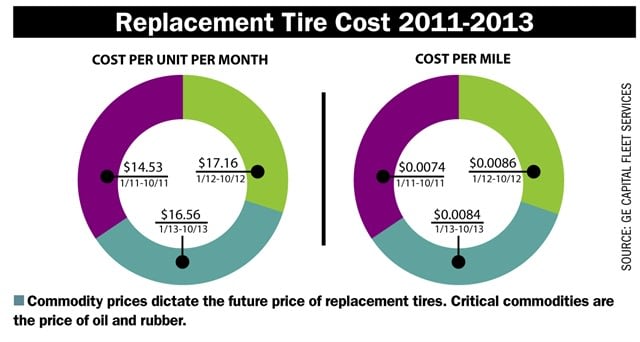
Replacement tire pricing in 2014 was flat compared to 2013. This was welcome news by fleets, which have been buffeted since 2002 with a dizzying spiral of ongoing price increases.
A key reason for the stabilization in replacement tire prices is less volatility for the commodities used to manufacture tires, namely carbon black, oil, rubber, and steel.
“Lower material costs are the main reason behind the decrease in tire prices. We continue to see the trend of clients paying close attention to the cents per mile of the tire, rather than the initial purchase price of the tire, often choosing to go with higher-cost tires to achieve better overall return on investment,” said Bob Sandler, senior vice president, customer experience & enterprise consulting at Element Fleet Management.
While manufacturing costs have stabilized, some tire models are being replaced by higher-priced models.
“There have been instances of tire models being discontinued and replaced by higher priced tires in a comparable design and size. One positive development is that, while we continue to see larger wheel diameters, there is a greater availability of these replacement tires than years ago,” said Eric Strom, maintenance & safety product manager at GE Capital Fleet Services.
In the past, the trend toward increased tire diameters helped put upward pressure on replacement tire prices. For many years, the trend has been to larger 17- and 18-inch wheel sizes, resulting in higher replacement costs. (The larger the tire, the more material it takes to make the tire, thus, the more it costs.)
However, this shift to larger diameter tires has already occurred in many vehicle model lines and the current prices are, so to speak, already baked into the pie, especially when making year-over-year comparisons.
Another silver lining is the ongoing improvement in tire quality, which has resulted in longer wear life. Tire life has been extended by 10 percent during the past 10 years, helping offset some price increases. However, driver behavior is a key factor in determining real-world tire tread life.
“Driver behavior plays a key role in a fleet’s tire spend. Drivers who consistently have severe decelerations in their vehicle are much more likely to have shorter lifespans on brake and tire components. Some customers have seen up to a 20,000-mile difference in tire replacement timing due solely to driver behavior,” said Tom Sloan, manager, telematics products at Donlen.
Another variable impacting tire tread wear is proper tire rotation; however, fleet management companies have automated the reminder process for drivers to schedule appointments to rotate tires.
“Using automated tools to remind drivers to perform frequent tire rotations has helped some fleets extend tire life and lower cost accordingly,” said John Bauer, manager, fleet analytics at Wheels Inc.
Fleet Replacement Tire Trends
There are a number of other trends playing out in the fleet replacement tire market. One is the re-emergence of new, run-flat tires.
“The re-emergence of new, run-flat tires has reduced vehicle weight, but many replacement run-flat tires are higher priced and it may be challenging to find a replacement run-flat tire,” said Strom of GE Capital Fleet Services.
Another trend being followed is the wear pattern of all-wheel drive tires.
“With all-wheel-drive vehicles becoming more popular with OEMs, tires now need to be replaced as complete sets in order to avoid problems with the powertrain,” said Robert Cascarano, manager, fleet management services at Donlen.
One fuel consumption mitigation strategy being examined by both OEMs and fleets is the use of low-rolling resistance tires.
“The use of low-rolling resistance tires can offset some of the higher purchase price by saving fuel. In addition, there is the introduction of some lower-cost alternatives for unique applications,” said Mike Crumlett, manager, North America truck services at Emkay.
There has been a perennial issue with the on-again, off-again shortage of snow tires, directly influenced by the severity of winter conditions.
“The harsh winter of 2013-2014 brought an increase in demand for snow tires when fleet administrators and drivers were stranded. A severe spike in demand, coupled with static supply, led to inflated costs. Worse yet, lack of supply left many drivers without snow tires and forced them to try other, more costly alternatives,” said Tony Blezien, vice president, operations at LeasePlan USA.
Looking Ahead
Replacement tire prices are anticipated to remain stable into the 2015 calendar-year.
“Through many conversations with tire manufacturers, tire costs are forecasted to remain stable through 2014 and into 2015. This is assuming no unforeseen negative impacts to tire raw materials, such as carbon black, rubber, and oil,” said David Jankiewicz, director maintenance and repair management at LeasePlan USA.
Much of this forecast is contingent on commodity prices and vehicle replacement policies.
“We expect oil prices to continue to be stable and even slide lower and this may help mitigate some tire price increases. Another key factor includes the average age of the fleet as timely cycling can prevent some second-set of replacement tires,” said Chad Christensen, strategic consultant at GE Capital Fleet Services.
The wildcard in replacement tire pricing is future oil prices, which are impossible to predict.
“We anticipate tire pricing to hold steady and don’t foresee prices going up, unless oil prices dramatically increase unexpectedly,” said Sandler of Element Fleet Management.
One unknown is the replacement tire pricing and availability for the new generation of all-new Euro-style vans that are entering the fleet market.
“We are carefully watching the new commercial cargo vans due to anticipated challenges in finding replacement tires for specific sizes and load range,” said Christensen.
Related:
Operating Costs Flat for Second Consecutive Year
Commercial Fleet Maintenance Costs Remain Flat in CY-2014
Analysis of Fleet Fuel Spend Trends in CY-2014
Forecast of Operating Costs for CY-2015
Forecast of Operating Costs for Medium-Duty Trucks for CY-2015
More Maintenance

Fleet Manager’s Ultimate Playbook: Navigating the New Standard in OEM Connectivity
Rising operating costs, driver safety concerns, and unplanned downtime are putting unprecedented pressure on modern fleets. Discover how fleet managers use embedded OEM connectivity and real-time vehicle data to cut TCO, prevent downtime, and protect drivers without aftermarket telematics hardware.
Read More →
How Can Fleet Managers Tell Which Repairs Require Closer Review?
Fleetio’s Brianna Perry demonstrates how Service Advisor evaluates maintenance requests, identifies pricing anomalies, and provides the context fleet managers need to focus their attention on potential problems.
Read More →
Why Roadside Assistance Belongs in a Fleet Risk Strategy
Roadside assistance is more than a tow. See how the right partner can protect drivers, uncover fleet trends, and strengthen your risk strategy.
Read More →
Hidden in Plain Sight: Fleet Compliance Risks
Fleet compliance isn't just about having policies — it's about consistently enforcing them. This practical guide reveals six hidden compliance risks common in public sector and shared fleet operations and outlines proven strategies to improve visibility, accountability, and audit readiness
Read More →
How Maintenance Costs Compare Across 27 Fleet Vehicles
Vincentric’s three-year, 60,000-mile projections reveal wide differences for both scheduled and unscheduled maintenance among selected vehicle categories. Projected maintenance visits also play a factor.
Read More →
The EV Breakdown Nobody's Talking About: Why Most Electric Vehicle Roadside Calls Aren't Mechanical Failures
Here's why EV breakdowns are widely misunderstood.
Read More →
How Stellantis Plans to Get Ahead of Fleet Downtime
Keeping fleet vehicles on the road has become as important as buying them. Darren Bradshaw of Mopar North America explains how connected vehicle data, AI, and proactive service strategies are helping Stellantis reduce downtime and move closer to predictive maintenance.
Read More →
Merchants Fleet Expands Maintenance Network with Pep Boys
Merchants Fleet has expanded its relationship with Pep Boys, increasing the service provider's role within its national maintenance network. The move is intended to enhance maintenance coordination and support commercial fleets through Pep Boys' nationwide footprint.
Read More →
The Two Biggest Summer Downtime Threats for Fleets
A conversation with a maintenance expert reveals the two most common summer maintenance pains and how to prevent them.
Read More →
From Marine Corps Motor Pool to Managing 460 Fleet Vehicles
Cesar Ayala of O’Connell Landscape Maintenance shares how he transitioned from the Marine Corps to managing a 460-vehicle fleet—and the real-world challenges of maintenance, compliance, and driver management in California.
Read More →