





RELATED: How Home Delivery Fleets are Changing How Food is Delivered
21 Questions to Ask When Spec'ing Refrigerated Truck Bodies
Critical elements in determining medium-duty refrigerator body specifications include maintaining optimal cargo area temperature and designing a cost-effective, energy-efficient vehicle.
September 5, 2010
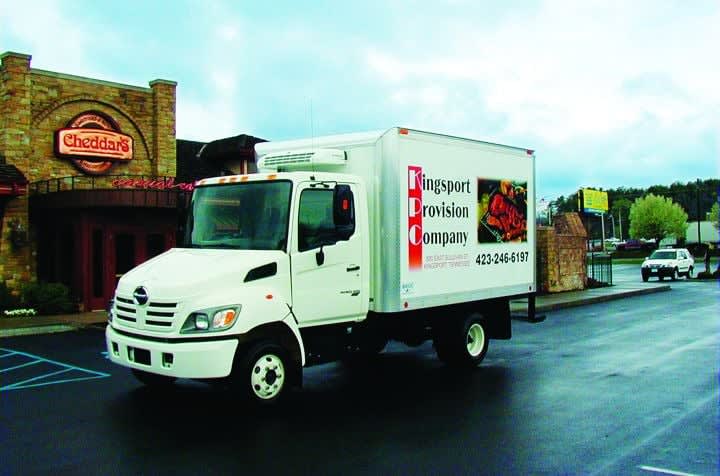
When spec’ing a refrigerated truck body, knowing product dimensions, weights, and capacity is necessary.
10 min to read
When spec'ing refrigerated bodies for medium-duty trucks, there's a lot at stake to get it right. If the truck fails to maintain optimal temperature inside the cargo area, perishable products may spoil before delivery, making customers unhappy. Additionally, if the body and refrigeration unit are not designed and built with maximum energy efficiency in mind, the risk of paying much more than necessary to operate the truck is greater.
How should the right refrigerated body for your medium-duty application be spec'ed? The following 21 questions provide a step-by-step process.
Truck Objectives
1. What type of product will the truck haul?
Whether it's fruits and vegetables, fresh seafood, ice cream, or frozen meats, the answer to this question dictates the fundamental specifications needed for a refrigerated truck.
2. How will the product be packaged?
Will the cargo be packed in pallets, milk crates, boxes, or bags? Cargo container shape, size, and type will help determine how much interior space is needed to carry a full load.
In addition, packaging impacts the amount of refrigeration required to maintain the right product temperature.
"If the product is shrink-wrapped, you can get away with a little less coldness than when it's enclosed in a box," advised Bill Byron, senior truck specialist, medium- and heavy-duty trucks for Donlen Corporation, a fleet management company based in Northbrook, Ill.
3. What body dimensions are needed?
For example, if you're transporting boxes of frozen meats, how much space, including length, width, and height, does each box take? How many boxes are needed on a given load? Will other types of products be carried in the box at the same time? If so, what dimensions per unit? Once the dimensions per unit are nailed down, how many units will be hauled at maximum load? Answers to these questions will determine the minimum box dimensions needed.
Box lengths for medium-duty trucks typically range from 9 feet to as long as 28 feet.
Considering box height, will the truck be driven into parking garages or other areas where clearance may be an issue? Also, the higher the box stands above the cab, the greater the wind drag, which affects fuel economy. In this case, some fleets may choose to lower the box height or add an aerodynamic wind faring to reduce drag.
4. What is the total cargo weight the truck will haul?
If carrying product in pallets, how much does each pallet weigh? How many pallets will be hauled in a maximum load? If transporting multiple types of products, compile a list of all items in the load and note estimated weights next to each item on the list to ensure all bases are covered.
If carrying heavy equipment on the truck, such as a forklift, consult the equipment manufacturer for details on shipping weights for those pieces of equipment.
Chassis Selection
Once the size of the body and payload capacity are defined, it's time to select the right chassis to marry with the body.
5. What chassis GVWR best fits necessary payload requirements?
Gross vehicle weight rating (GVWR) is the maximum amount of total weight determined by the manufacturer a truck is able to carry - and start and stop safely. The total includes the weight of the truck and its entire payload (body, equipment, fuel, driver, and cargo). Consult with the body manufacturer and/or chassis dealer to determine the GVWR chassis required to handle payload requirements.
6. What chassis length is needed to support body requirements?
Most body manufacturers think of chassis length in terms of cab-to-axle (CA). For example, a 12-foot box typically requires an 84-inch CA; 14-foot takes 108-inch CA; 16-foot, 120-inch CA; and so forth. Once the body length is confirmed, it is possible to determine which CA chassis is required.
7. What tire size should Be spec'ed for a chassis?
Tire size affects load height. For example, using a forklift usually requires a dock-high truck - typically a Class 6 (19,500-26,000-lb. GVWR) or larger truck with 22.5-inch wheels and tires. Choose the tire size that offers the best load height for the application.
Refrigeration & Insulation Requirements
After chassis selection, address specs that impact temperature control.
8. What is the required temperature to maintain inside the body?
How cold does the body need to be consistently kept? Must the temperature stay between 0 to 30 degrees Fahrenheit? Colder? The answer depends on the products planned to haul.
9. Will products require maintaining different temperatures within the body?
If so, make sure the body is designed for multiple-temperature zones. Options include moveable or permanent interior partitions that enable fleets to transport fresh, cold, and frozen foods - all at the same time, in the same truck.
10. How much insulation should be spec'ed?
Insulation options range from three to five inches. Insulation should be spec'ed for the front wall, sidewalls, roof, and doors. Consult the body manufacturer on what best fits your situation.
"The maximum amount of insulation, the better," recommended Chip Honse, sales manager for Hercules Manufacturing Company, a Henderson, Ky.-based custom truck and van body manufacturer. "Look at the roof as an example. It's the highest area of heat gain. When you add just one inch of insulation, you reduce heat gain by 17% in that area alone."
11. What refrigeration unit capacity is needed?
This part of the spec'ing process is critical. Capacity is defined by how many BTUs (British Thermal Units) are required to keep the entire box at the desired temperature. If unsure of the capacity needed, ask the body manufacturer for guidance. The decision is based on the required temperature and the dimensions of the cargo area that must be kept cool.
12. Must the refrigeration unit remain running while the truck is turned off?
This question determines whether an engine-driven or self-contained refrigeration unit is selected.
Also, will the product be removed from the truck every night or kept it inside the truck body? With an electric stand-by option, the refrigeration unit can be connected to a power outlet for overnight storage, eliminating the need to unload cargo.
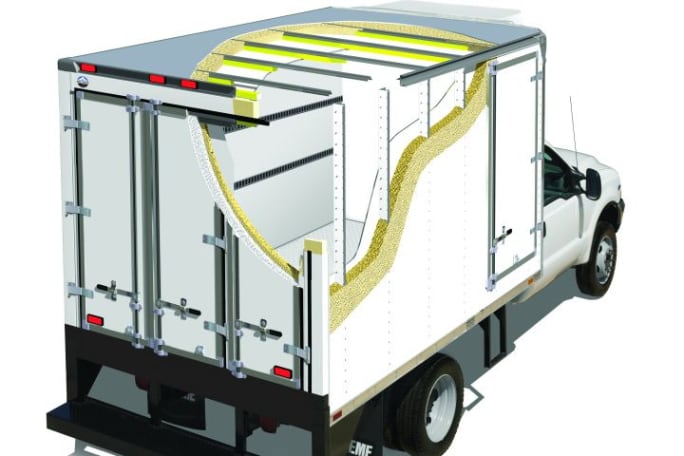
E-track, a steel row of vertical slots recessed into a truck boxes wall, can be added to a refrigerated body to assist with cargo tie-down.
Load, Haul & Delivery Considerations
It's one thing to spec a truck body with the right size and refrigeration unit, but if a crew can't load, secure, and unload cargo as efficiently as possible, increased delivery times will occur and employees will become frustrated. Use the following questions to identify the specs needed to secure cargo and optimize crew productivity.
13. How will cargo be held?
Options to consider include:
Tie rings. These metal rings are recessed into the wall and/or floor to allow cargo tie-down. The key is determining how many rings are required and their location. For example, should the rings be the same distance apart or concentrated in a certain section of the box?
E-Track. This steel row of vertical slots is recessed into the wall and placed the same height from the floor on both sides of the box. Ratchet straps hook into the slots to secure cargo as tightly as possible. E-track can be added to the box front corresponding to the height of tracks on the left and right sides. Consult the truck body manufacturer to help determine how many rows of e-track you need and where to place them.
F-Track. This track works similarly to e-track. However, instead of being mounted on the walls for horizontal tie downs, f-track is installed in parallel locations on the box floor and ceiling for vertical tie downs. F-track allows partitioning the truck box space from floor to ceiling.
14. Is a liftgate required?
While liftgates range from $1,500 to more than $5,000, depending on weight capacity and type, they are a good fit for loading heavy cargo items into the truck with minimum effort and physical strain on employees, enhancing safety and productivity. Determine which of the following common liftgate types best fits your application:
Tuckaway gate. As the name suggests, this liftgate tucks out of the way, under the rear of the box, offering easy access to cargo when not using the gate. However, if items that require more than three feet in depth must be lifted, the tuckaway gate may not offer a large enough platform to safely lift the cargo.
Railgate. Attached to the rear pillars of the box, this gate offers extra platform size for larger cargo and heavier-weight capacities. The downside is the gate must be lowered any time the box interior must be accessed, which can consume time unnecessarily.
15. Will a forklift be used?
If a forklift will be used to load cargo onto the truck, make sure a forklift package is spec'ed. This package reinforces the floor with added cross members, a threshold plate, and reinforced rear-end plate.
16. Will a walk-up ramp be used?
A walk-up ramp is usually adequate to carry cargo on hand trucks. The disadvantage is plenty of clearance space is required at the rear of the truck to allow room for the ramp. In tight loading and unloading areas, this configuration would not be a good fit.
17. Roll-up or swing-open rear door?
"Typically for refrigerated trucks, a center swing-open rear door is more secure and easier to insulate than the overhead rear door," Byron of Donlen advised. "With the overhead roll-up door, you lose top-end space when loading the truck, and it's not really cost-effective. The roll-up door limits the amount of insulation you can spec for the door and requires special cuts in the insulation, with each panel on the door, to allow for the folds."
Honse of Hercules Manufacturing agreed. "When you get into the deep-frozen ice cream bodies, you see very few roll-up rear doors," he said. "They don't seal well and the thickest insulation available for those doors is 2 ½ inches. In food services or produce applications, roll-up rear doors are more commonplace. They are very convenient for the driver and delivery crew, but are also the least insulated doors available, so the refrigeration unit must work harder to compensate."
Swing doors present a downside for inner-city delivery situations, in which tight outside clearance limits the space to swing open the doors.
18. Will cargo be unloaded from the side door?
"The side door is often overlooked by the customer until the truck is built," said Byron of Donlen. "Then the delivery crew has a hard time making a delivery at tight inner-city locations because they only have a reardoor application."
Consider the following options with side doors.
Swing doors. Single or double swing-out doors are the most common options. The door opening ranges from 36-48 inches. Just as with the swing-open rear doors, make sure sufficient clearance is available outside the truck to open the doors. The advantage of swing doors is maximum height clearance inside the box.
Roll-up side door. The roll-up side door facilitates deliveries in tight spaces. However, this door type sacrifices 6-8 inches of height clearance inside the box near the door. Also, as with roll-up rear doors, roll-up side doors don't allow for as much insulation as swing doors.
How will drivers step up into the box if a side door is selected? Typical options include a recessed step well, pull-out step, and stirrup step. Ask the body manufacturer to determine which step best fits the application and budget.
Other Considerations
Ask the following questions to ensure all bases are covered:
19. Which exterior wall material is best?
Common options include aluminum and fiberglass reinforced plywood (FRP). Byron recommended aluminum.
"The aluminum reflects coldness back into the body, whereas with FRP, there's the possibility of condensation reaching the plywood and rotting out the sidewall," Byron of Donlen explained.
20. Which roof option is best for the application?
In general, two types of roofs are available:
Standard aluminum roof - the lowest-cost option and suitable for most applications.
Translucent roof - constructed of fiberglass material, the translucent roof allows sunlight to show through the top of the box, offering better visibility inside the box. The downside, however, is heat. Where an aluminum roof reflects the sunlight away from the box, the translucent roof allows it to pass through, increasing interior temperatures.
"Go with an aluminum roof," Byron advised. "You're trying to create that refrigerator effect by reflecting coldness back into the body, and the aluminum roof will do that."
21. Is special interior lighting required?
Most refrigerated bodies come standard with an interior dome light. Available options include floodlights, spotlights, and fluorescent lights, depending on how much visibility you need inside and outside the box, especially during night deliveries.
As a fleet's next refrigerated truck is spec'ed, the process can be simplified by answering the previous 21 questions. Answers will equip fleet managers with the required details to order the refrigerated body and medium-duty chassis that best fit the application.
Topics:Truck BodiesMedium-Duty TrucksSpec'ingRefrigerated TruckReefersLiftgatesFood & Beverage FleetsVehicle ResearchOperations
Originally posted on Work Truck Online
Subscribe to Our Newsletter
More Vehicle Research

Hall of Fame Inductee: John Dmochowsky
The longtime Mondelēz International fleet executive joins the Automotive Fleet Hall of Fame.
Read More →
Hall of Fame Inductee: Lee Miller
After more than four decades at Boehringer Ingelheim, Lee Miller leaves a legacy built on fleet expertise.
Read More →
Hall of Fame Inductee: Mark F. Petersen
From managing fleets of thousands of vehicles to advancing safety and mentoring fellow professionals, Mark F. Petersen made his mark across both the corporate and supplier sides of fleet.
Read More →
When Charger Downtime Becomes a Fleet Availability Problem
As EV deployments move beyond pilot programs, charger reliability can directly affect vehicle readiness, driver productivity and route scheduling.
Read More →
2027 Nissan Rogue Hybrid Adds e-POWER, Standard AWD
The new Rogue Hybrid uses Nissan’s e-POWER system with dual electric motors, offers an estimated 40 mpg and starts at $35,490.
Read More →
2027 Subaru Forester Adds First Wilderness Hybrid
The 2027 Forester lineup starts at $29,995 and adds a Wilderness Hybrid with 194 combined horsepower and 9.3 inches of ground clearance.
Read More →
EV Realty Names Henrik Holland President as Charging Platform Expands
The former Prologis Mobility and Shell executive will help expand EV Realty’s truck charging business and move its power-first infrastructure model into autonomous vehicle depots and other fleet sectors.
Read More →
Mercedes-Benz Introduces Electric GLC With Up to 350 Miles of Range
The GLC 400 4MATIC Electric features an 800-volt architecture, 330-kW DC fast charging and a 94-kWh battery, along with Mercedes-Benz's new MB.OS operating system.
Read More →
Fleet Has a Talent Pipeline Problem, not a Talent Problem
Where will the next generation of fleet leaders come from, and what does the industry need to do differently to find them?
Read More →
Fleet Hacks: What Are You Still Doing Manually?
From daily recaps to repeatable workflows, fleet professionals share how AI can cut through busywork while keeping human judgment at the center.
Read More →