




2014 Fleet Industry Report Card: Senior Management
Read these perspectives from fleet managers about how senior management needs to listen to fleet managers concern about fleet managers reporting to procurement.

Photo courtesy of iStockPhoto.com.

Photo courtesy of iStockPhoto.com.
Read these perspectives from fleet managers as a sidebar to our 2014 Fleet Industry Report Card about how senior management needs to listen to fleet managers concern about fleet managers reporting to procurement.
"Companies are consolidating fleet under procurement, and making procurement employees the ones in charge of fleet. Fleet managers do much more than just purchase vehicles for the best possible price; that is probably the easiest part of being a fleet manager. I think it's important that companies realize the importance of having a dedicated fleet-minded person in charge of the fleet strategy for a company and someone who wants that responsibility as well. Thankfully, my company does."
The Concept of Doing More with Less is Not Working
"I don't know what other fleet managers' most pressing problems are, but mine is finding enough time to do everything my company requires of me. They keep giving me more work to do, because of how wonderfully qualified I am (or so I've been told), but they don't give me the proper resources to get the job done well.
"I'm afraid to not succeed, because I believe that they won't see that they've burdened me with an impossible task, instead they'll say I can't do the job and find someone else they think can (and who still won't be able to do it all)."
Balance Needed Between Cutting Costs and Maintaining Service Levels
"One challenge is driving down costs without giving up service levels and too much vehicle content. Another is the continual pressure from management that yesterday's savings were never enough. It is about finding that 'sweet' spot between savings and cost reductions and continuing to keep drivers in safe and cost-effective vehicles. Additionally, trying to find the real truth behind FAVR systems and the notion that the FAVR proposal is nothing more than balancing the fleet budget off the backs of these drivers that choose the FAVR system."
Fleet Managers are Becoming Removed from Day-to-Day Fleet Management
"As the FMCs bring more and more computing power to bear in servicing their clients, the tendency may be for fleet managers to pull back on time spent on operations. The distance between actually doing the work of running a fleet and the experiential understanding that comes along with that work, and the time actually needed to manage a fleet, now widens.
"Quite often new responsibilities are added to the role; represented by the growth of the role of fleet and travel managers. As this occurs, first-hand operational knowledge shifts from the fleet manager to the FMC. This knowledge is needed to make strategic and tactical operational decisions for the fleet. In this scenario, the FMC needs to step up and provide guidance for the fleet; something I believe they struggle with today.
"Logical recommendations are made based on reactions to the macro forces on the entire industry, but do not perform as well interpreting the pressures in the market that affect the individual fleets on the micro level. This is not something to which systems can currently provide a solution. More needs to be done."
Revolving Door for Senior Management Makes Fleet Management Difficult
"I personally struggle with the revolving leadership door and reporting to someone new who does not understand fleet, nor do they seem to want to learn about it.
"Although I consistently achieve big cost savings and introduce the latest in technology and new programs — I do not get credit or considered for a promotion even though I am always thinking outside the box and seeking to learn and implement new technology and programs to help our drivers' productivity. Succession planning and doing 'more with less' has become more of a concern as my staff reaches retirement age."
Senior Management Needs to Trust the In-House Fleet Manager
"A challenge is convincing executive-level management of the value provided by an in-house, professional fleet managers and staff. Thinking all fleet management can be outsourced is unenlightened. Trusting the fox to guard the hen house is playing with fire. And, thinking one (or two) folks can manage 2,000 vehicles or more is absurd."
Management Commitment to Improving Driver Safety
"The culture of accepting accidents and injuries as the 'cost of doing business' needs to be made to be seen as something that does not have to be. To change the public zeitgeist is not something I can even begin to know how to do, but it desperately needs to happen."
Related:
More Safety

Fleet Manager’s Ultimate Playbook: Navigating the New Standard in OEM Connectivity
Rising operating costs, driver safety concerns, and unplanned downtime are putting unprecedented pressure on modern fleets. Discover how fleet managers use embedded OEM connectivity and real-time vehicle data to cut TCO, prevent downtime, and protect drivers without aftermarket telematics hardware.
Read More →
From Driver Well-Being to EV Charging | AF News Recap
Mental health belongs in the fleet safety conversation. This week, we’re looking at five ways fleets can support employee well-being before a crisis, plus Holman’s expansion in Mexico, new one-day Fleet Forward passes, and why EV charging demand is outpacing infrastructure growth.
Read More →
Nexar-Nauto Merger Aims to Give Fleets Better Safety Intelligence Through Larger Driving Dataset
Stefan Heck tells Automotive Fleet that combining more than 10 billion miles of driving history with Nexar's AI models will give fleets deeper insights into driver risk and roadway conditions than either company could provide independently.
Read More →
Don't Wait for a Crisis: 5 Ways to Build Mental Health Into Your Fleet Safety Program
For Suicide Prevention Month, fleet and safety leaders have an opportunity to put mental health where it belongs: at the center of workplace safety.
Read More →
How Camera Data Can Strengthen a Fleet’s Insurance Renewal
Insights from a commercial insurance carrier and a broker show how fleets can turn video telematic data, driver coaching, and improved claims results into a stronger case at insurance renewal.
Read More →
The Safest Fleets Aren’t the Ones with the Most Technology
You’ve made the telematics investment. Here’s how to capture the other half of its value and build the safest fleet on the road.
Read More →
Hidden in Plain Sight: Fleet Compliance Risks
Fleet compliance isn't just about having policies — it's about consistently enforcing them. This practical guide reveals six hidden compliance risks common in public sector and shared fleet operations and outlines proven strategies to improve visibility, accountability, and audit readiness
Read More →
NETS Sets 2026 Fleet Safety Benchmark Conference for Indianapolis
The Sept. 15–17 program will feature fleet benchmarking data, case studies, emerging technologies, and implementation strategies while running alongside the NSC Safety Congress & Expo.
Read More →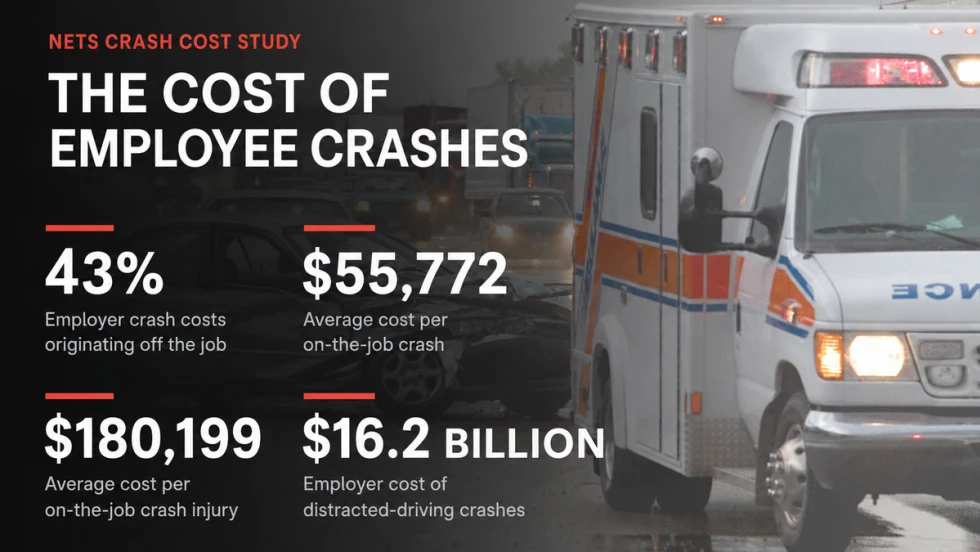
Off-the-Job Crashes Account for 43% of Employers’ $61.7 Billion Crash Burden
NETS quantifies costs dispersed across fleet, risk, HR, and other departments while providing new per-crash benchmarks for employers.
Read More →
Ram Recalls More Than 1.27 Million 1500 Pickups for Seat Belt Anchor Issue
The recall affects certain 2019-2026 Ram 1500 pickups that may have improperly attached second-row seat belt buckle anchors.
Read More →