





Tired of Reading? Give This A Watch: Geotab at 25: Neil Cawse Gets Candid on Growth, Disruption, and the Next Era of Telematics
Fleet Managers’ Roundtable: Tackling Tariffs, Safety, and the Next Generation of Fleet
Four veteran fleet leaders explain how they are navigating rising costs, improving driver safety, and preparing the industry for what’s ahead.
September 16, 2025
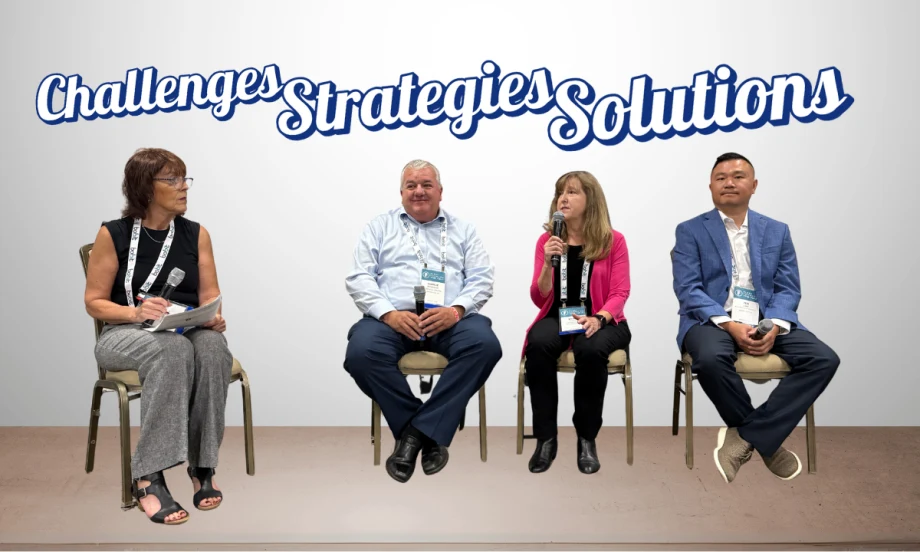
From challenge to solution: how are Nancy Murray (left), Charles Stevenson, Wendy Kupper, and Ted Chan balancing budgets, compliance, sustainability, and driver safety?
Chris Brown/Automotive Fleet
6 min to read
When the Fleet Forward Tour made its final stop for 2025 in Somerset, N.J., on Sept. 9, fleet managers from across the Northeast gathered to exchange strategies and share challenges.
After a ride-and-drive, networking sessions, lunch, and three interactive seminars, the day concluded with a Fleet Managers’ Roundtable. Four veteran fleet managers — Wendy Kupper of Syneos Health, Charlie Stevenson of Essential Utilities, Ted Chan of Schindler, and Nancy Murray of Agfa — discussed how tariffs, safety initiatives, sustainability demands, and workforce changes are affecting fleet operations today.
Tariffs and the Cost of Doing Business
The conversation began with a topic that’s become unavoidable for many industries: tariffs. For Charlie Stevenson, who oversees a 2,300-vehicle utility fleet, the financial impact is already real. “Our biggest tariff impact is on the Buick Envision, where we’re estimating a $4,000 increase,” he said. “On the larger equipment side — dump trucks, utility trucks with cranes — we’re paying almost 35% more than in 2020. We’re also seeing extended lead times.”
By contrast, Wendy Kupper said her fleet has yet to feel direct pain. “We’re negotiating with OEMs for the 2026 model year, and some haven’t released pricing yet,” she explained. “It’s important to stay close to manufacturers because things can change quickly. Right now, our bigger challenge is hybrid availability.”
Ted Chan, whose 3,600-vehicle fleet supports elevator and escalator construction and service across the U.S., said tariffs have been slower to filter down to fleet budgets. “When tariffs were first announced, I thought costs would rise immediately. That didn’t exactly happen. Instead, it’s getting baked into overall TCO,” he said.
He mentioned the Ford Maverick, built in Mexico, as an example where a price shift may occur, even though every vehicle has globally sourced parts. “For now, it’s business as usual.”
Budget Pressures Meet Sustainability Goals
The panel then shifted to the constant push-and-pull of balancing budgets with sustainability initiatives. Kupper said hybrids remain the most practical step for her fleet, while EVs are still in pilot stage.
“We’re putting more hybrids into the fleet to help offset fuel costs,” she said. “We’re also running an EV pilot with executives, but widespread adoption isn’t practical yet. We are waiting to see what happens with new technologies and a longer battery range. Our drivers cover long distances, and infrastructure just isn’t there.”
Nancy Murray is balancing cost and sustainability through order discipline and tighter specs: “I have to order early. I have been looking at higher trim levels, so I’m not adding as many options.”
She, too, is realizing the benefits of hybrids, which emit fewer pollutants, reduce fuel costs, and raise the fleet’s mpg. This cycle, she expects 85% of her fleet to be all hybrid.
Chan emphasized that corporate sustainability goals continue to shape his decision-making. “We’re a European company with a net-zero 2040 target, and that hasn’t changed,” he said. “This year I have a 6% CO₂ reduction goal, and we’re halfway there.”
Chan said there are already 200 EVs in the fleet, but adoption has slowed somewhat. Beyond electrification, Schindler is leveraging telematics, which can identify non-business use. “Cutting weekend driving alone reduced emissions by 9%,” he said.
For Stevenson, the budget squeeze is particularly sharp as a utility provider. “We’re required to protect ratepayers, so everything goes out to bid — from parts to OEM contracts,” he explained, adding that fuel has been the biggest cost driver.
Regarding electrification, Stevenson is also aware of the challenges posed by model availability, infrastructure, and exorbitant initial costs. He thought in 2020 that the fleet would have 250 EVs by 2026. “Today we have four.”
Realizing Safety Improvements, from Tech to Culture
Safety was one of the most striking areas of progress. Chan reported that Schindler has seen a 70% reduction in accidents year-over-year. “Telematics and cameras help, but I’m most proud of the culture shift,” he said. “That’s what makes it sustainable.”
Stevenson said his utility has tied safety performance directly to driver accountability. The organization uses a driver scorecard tied to annual MVRs and accident history, and high-risk drivers get targeted training. “We’ve driven responsible vehicle accidents down by 36%,” he said.
Kupper described a transformation in how her company approaches driver risk and how the fleet’s accident rate dropped from 40% to 14% YTD within five years. “The difference is top-down support,” she said. “Executives now receive driver risk reports monthly.
The Syneos fleet team also utilizes committee reviews when drivers reach a points threshold, involving HR, legal, and senior leaders, which ensures accountability and shared responsibility.
Mitigating Rising Maintenance and Repair Costs
With the technician shortage, rising parts costs, and vehicles carrying more technology than ever before, repair costs are skyrocketing. Stevenson said his fleet has focused on extending PM intervals through oil sampling and telematics monitoring. “Every shop visit is both hard and soft cost, so reducing downtime is a real lever,” he said.
On maintenance for lower‑mileage units, Murray keeps to the rule of 7,500-mile oil changes and safety checks, but with a guardrail: “We’ll also put in that six-month clause… I still want it checked… within six months.”
Kupper said rising labor and parts costs have shifted her repair-versus-totaled thresholds. “We’re seeing more vehicles totaled after accidents, especially with sensor-based safety systems. Damage to areas of the vehicle that used to be cosmetic repairs now have features that are expensive to repair so now become totals,” she noted.
Chan added that efficiency is one of his strongest tools to lower repair costs. “A $2,000 repair years ago is now double or triple,” he said. “To offset costs, we reduced our fleet by 150 vehicles this year with no business impact. That’s real efficiency.”
This led to a nuanced discussion of cost savings versus cost avoidance. Stevenson put it plainly: “If a $1,200 mirror is replaced with a $200 part that is sourced differently, that’s cost avoidance. But my company expects both — hard budget savings and smart avoidance.”
Insurance, Tires, and Subrogation Realities
Beyond repairs, fleets are also wrestling with rising tire prices and the complexities of insurance recoveries.
Chan and Kupper rely on their FMCs for maintenance decisions. Chan states that they encourage the use of mid-tier tire brands to balance cost and safety. Stevenson said his team is adding tire storage at a new shop to better manage supply and cost.
On subrogation, all three agreed that strict driver reporting is essential. “We require police reports for every accident,” said Kupper. “Without documentation, it’s he-said-she-said, and recoveries are harder.”
Chan said his FMC tracks claims, but that a 70% drop in accidents has lightened the load.
Balancing AI While Sourcing New Fleet Talent
Looking ahead, panelists struck a balance between optimism about technology and concern about industry talent. Stevenson worried about the pipeline of new professionals. “I don’t see enough young people entering the industry. Hiring a mechanic or even a fleet admin is harder than it’s ever been. We need to make fleet more appealing as a career.”
Looking ahead, Murray wants to widen the pipeline: “I’m looking forward to seeing new talent come in… it’s an industry you seem to fall into and not really go out and say, I’m going to be a fleet manager.”
Subscribe to Our Newsletter
More Operations

How Fleets Can Recruit and Train Veterans for Technician Roles
Here's how the technician shortage has affected uptime for fleets, and what to do about it.
Read More →
Avis Budget Group Deploys Neology Toll Management Technology Across Major Brands
Neology’s neoFleet platform will manage toll transactions and toll-authority operations for vehicles across Avis, Budget, Payless, Budget Truck and Zipcar.
Read More →
Fleet Personal-Use Charges Edge Higher in 2026
Nearly eight in 10 surveyed fleets allow personal use of company vehicles, while just over half of respondents report charging employees for the privilege.
Read More →
The Future of Fleet + What’s Changing Right Now | AF News Recap
Could developments overseas offer a preview of what’s coming for U.S. fleets? This week, we’re looking at the future of AI, autonomy, and electrification, plus Ford Pro’s new certified pre-owned program, smarter vehicle offboarding, and a new way for fleets to manage toll expenses.
Read More →
How to Handle Vehicle Offboarding
What do fleet managers need to do when a driver leaves?
Read More →
Sponsored•October 1, 2026
Fleet Manager’s Ultimate Playbook: Navigating the New Standard in OEM Connectivity
Rising operating costs, driver safety concerns, and unplanned downtime are putting unprecedented pressure on modern fleets. Discover how fleet managers use embedded OEM connectivity and real-time vehicle data to cut TCO, prevent downtime, and protect drivers without aftermarket telematics hardware.
Read More →
U.S. Bank Adds Verra Mobility Toll Management to Voyager Fleet Platform
The integration allows U.S. Bank Voyager fleet customers to manage toll payments and violations alongside fuel, EV charging and maintenance expenses.
Read More →
ADAS Prevents Crashes. But Repairs Cost More | AF News Recap
ADAS-equipped vehicles may crash less often, but they can cost more when they do. This week, we’re breaking down what that tradeoff means for fleets, plus Subaru’s first Forester Wilderness Hybrid, Nissan’s new e-POWER Rogue, and why Calstart has become Catalyst Mobility.
Read More →
Moventum Fleet Management Names Mark Iorillo Head of Sales
Iorillo brings nearly 20 years of fleet management and sales experience to the role, including previous positions at Element Fleet Management, CEI, Donlen and Ryder.
Read More →
Fleet Has a Talent Pipeline Problem. What Comes Next? | AF News Recap
Where will fleet’s next generation of leaders come from? This week, we’re looking at the industry’s talent pipeline, what certification can add to a fleet career, how to build an award-worthy track record, and the return of Automotive Fleet’s Personal Use Survey.
Read More →