




Want More? Adjusting Fleet Practices to Address High-Risk Driving
Lytx 'State of the Data' Report Reveals Risks, Coaching Opportunities for Fleets
The report is powered by 40 billion miles of new driving data from 2023 and can guide commercial fleet managers in factors to address in driver safety training programs.

Christy Grimes・Former Senior Editor
Speeding, distraction, not wearing a seat belt, and following too closely continue to top the list of risky behaviors in 2023.
Photo: Lytx
5 min to read
Lytx's 2024 'State of the Data' report provides insights into the top 10 behaviors contributing to risk, the riskiest cities for driving, the time of day with the highest risk for fleet drivers, and more.
“Road travel surged to record highs in 2023, and with more vehicles come more risks, as well as increased logistical complexity,” Lytx CEO and Chairman Brandon Nixon said. “It’s crystal clear that the need for safety and efficiency amid increasingly congested roadways has never been stronger. Despite an overall rise in road risk, our data indicates that companies that have implemented fleet safety programs are seeing the results across a number of success metrics – from lower claims costs and more efficient fuel use to improved collision avoidance.”
The report is powered by 40 billion miles of new driving data from 2023 and can guide commercial fleet managers in factors to address in driver safety training programs.
What Contributes to Roadway Risk?
Roadway risk captured by Lytx marched up 9.5% in 2023 from the previous year as traffic volume on U.S. roads swelled to a record 3.26 trillion miles, according to the Federal Highway Administration.
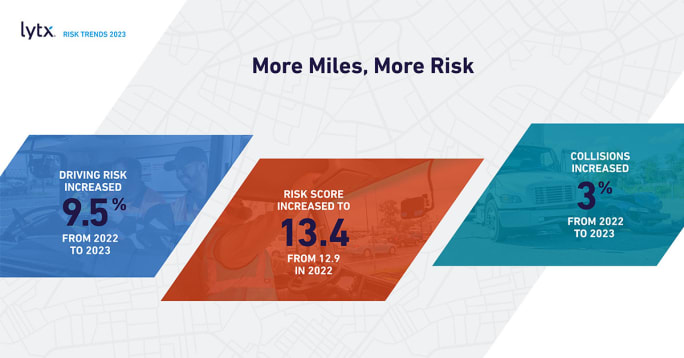
Lytx identified more than 18 million risky driving incidents in 2023.
Photo: Lytx
Correspondingly, Lytx identified more than 18 million risky driving incidents in 2023. Using the proprietary Lytx Risk Score, which calculates behavior averages across a variety of industries using learnings from 261 billion miles of driving data from Lytx’s global database, the report found:
Captured driving risk per vehicle increased 9.5%, from 2022 to 2023
Captured Lytx Risk Score per vehicle increased to 13.4 in 2023, from 12.9 in 2022
Collisions per vehicle increased 3%, from 2022 to 2023
The top 10 behaviors contributing to risk in the U.S. include:
Following distance (1-2 seconds)
Handheld device
No seat belt
Posted speed violation
Following distance (less than 1 second)
Incomplete stop
Food or drink
Failed to stop
Inattentive
Late response
Speeding, distraction, not wearing a seat belt, and following too closely continue to top the list of risky behaviors in 2023.
New to the top 10 list this year is incomplete stop. As roads become more congested, what once seemed like minor, habitual infractions are now resulting in more frequent —and severe — incidents.
What's Riskier: Mornings or Afternoons?
Among the report’s findings is a significant difference in risk between morning and afternoon commute hours. Despite similar congestion patterns, afternoon commute hours — 4:00 p.m. to 7:00 p.m. — were three times riskier than morning commute times — 5:00 a.m. to 8:00 a.m.
“The data around commute hours was one of the more interesting and surprising insights to emerge from this year’s analysis,” Lytx Client Intelligence Director Erin Baucum said. “This type of finding is extremely valuable for us as we build and refine our safety tools and programs, as well as for fleets to take into account as they plan their routes.”
The report also identified the riskiest day of the week to drive. In 2023, the highest collisions per vehicle in the U.S. occurred on Wednesdays, with Thursdays trailing closely behind. Alternatively, Sunday was the safest day of the week to drive, with Saturday as the second safest day.
What Are the Riskiest Cities and States for Driving?
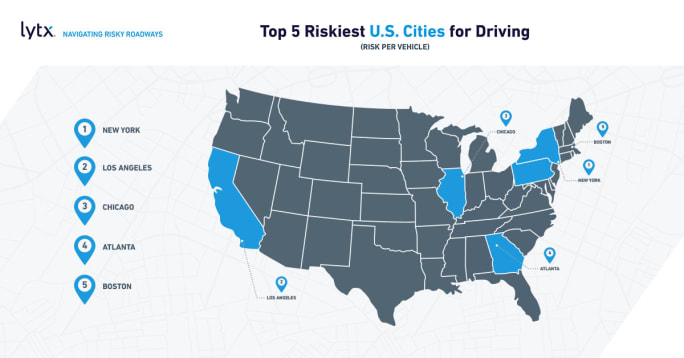
For the third year in a row, in 2023, New York held the No. 1 spot as the nation’s riskiest driving city and was twice as risky as the next-riskiest city (Los Angeles).
Photo: Lytx
The chart below shows the top five riskiest U.S. cities for driving when calculated by risk per vehicle. The left column shows how the cities ranked in 2023, and the right column shows how they ranked in 2022.
2023 Ranking | 2022 Ranking |
| 1. New York City |
| 2. Philadelphia |
| 3. Los Angeles |
| 4. Chicago |
| 5. Dallas/Fort Worth |
For the third year in a row, in 2023, New York held the No. 1 spot as the nation’s riskiest driving city and was twice as risky as the next-riskiest city, which was Los Angeles for 2023.
Atlanta, which dropped to No. 7 in 2022, returned to the top five as the fourth riskiest city in 2023. Philadelphia, which ranked second in 2022, made the biggest improvement by moving down six spots to No. 8 in 2023.
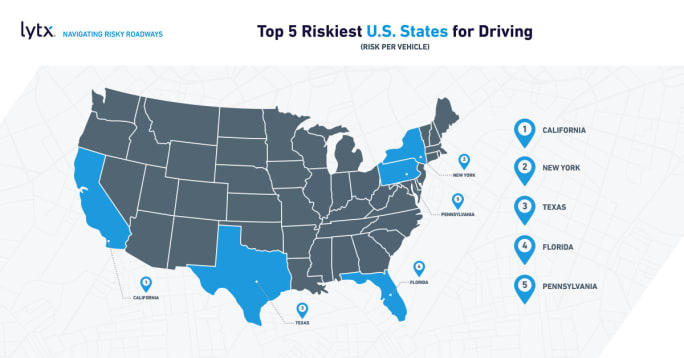
In 2023, California has secured the top position as the nation’s riskiest state for driving for the third time in four years. More
Photo: Lytx
When measured by risk per vehicle, the top five riskiest states did not show much change between 2023 and 2022.
2023 Ranking | 2022 Ranking |
| 1. California |
| 2. Texas |
| 3. New York |
| 4. Florida |
| 5. Pennsylvania |
In 2023, California has secured the top position as the nation’s riskiest state for driving for the third time in four years. More than two times riskier than the fifth-ranked state (Pennsylvania), California continues to have the most-hazardous roads overall, likely due to its large population, numerous metropolitan areas, and high traffic volumes.
Of the five riskiest U.S. public roadways, only one is located in one of the top five riskiest states:
I-678 into JFK International Airport (Jamaica, New York)
I-10 into Phoenix Sky Harbor International Airport (Phoenix)
I-580 into Reno-Tahoe International Airport (Reno, Nevada)
N 3rd St. and E. Monroe St. near the Phoenix Convention Center (Phoenix)
N 3rd St. and E. Nationwide Blvd. near the Columbus Convention Center (Columbus, Ohio)
“Convention centers have joined airports as risky areas for collisions,” Lytx Client Intelligence Senior Analyist Kyle Warlick said. “The combination of congestion, frequent passenger drop-offs and pick-ups, and visitors who may be less familiar with the roads make these areas especially hazardous.”
Collision and Near-Collision Trends
The report revealed that near-collisions were up 97% from 2022 to 2023, and actual collisions were up 3% from 2022 to 2023
Although near collisions per mile were up 97% in 2023, collisions themselves were up only 3%. This suggests that, as roads got more congested, commercial drivers seemed to be getting better at avoiding collisions on a per mile basis through defensive driving skills and/or more attentive driving.
Across the board, all industries saw an increase in near collisions from 2022 to 2023. The biggest increases came from the Automotive (+226%), Concrete (+148%), and Emergency Medical Services (EMS) (+131%) industries.
Collision frequency and severity varied by industry in 2023.
Concrete (+49%) and Utilities (+14%) showed the biggest increases from 2022 to 2023, while Services (-8%) and EMS (-5%) saw the biggest decreases in collision frequency and severity in 2023.
More Safety

Sponsored•October 1, 2026
Fleet Manager’s Ultimate Playbook: Navigating the New Standard in OEM Connectivity
Rising operating costs, driver safety concerns, and unplanned downtime are putting unprecedented pressure on modern fleets. Discover how fleet managers use embedded OEM connectivity and real-time vehicle data to cut TCO, prevent downtime, and protect drivers without aftermarket telematics hardware.
Read More →
From Driver Well-Being to EV Charging | AF News Recap
Mental health belongs in the fleet safety conversation. This week, we’re looking at five ways fleets can support employee well-being before a crisis, plus Holman’s expansion in Mexico, new one-day Fleet Forward passes, and why EV charging demand is outpacing infrastructure growth.
Read More →
Nexar-Nauto Merger Aims to Give Fleets Better Safety Intelligence Through Larger Driving Dataset
Stefan Heck tells Automotive Fleet that combining more than 10 billion miles of driving history with Nexar's AI models will give fleets deeper insights into driver risk and roadway conditions than either company could provide independently.
Read More →
Don't Wait for a Crisis: 5 Ways to Build Mental Health Into Your Fleet Safety Program
For Suicide Prevention Month, fleet and safety leaders have an opportunity to put mental health where it belongs: at the center of workplace safety.
Read More →
How Camera Data Can Strengthen a Fleet’s Insurance Renewal
Insights from a commercial insurance carrier and a broker show how fleets can turn video telematic data, driver coaching, and improved claims results into a stronger case at insurance renewal.
Read More →
The Safest Fleets Aren’t the Ones with the Most Technology
You’ve made the telematics investment. Here’s how to capture the other half of its value and build the safest fleet on the road.
Read More →
Sponsored•August 7, 2026
Hidden in Plain Sight: Fleet Compliance Risks
Fleet compliance isn't just about having policies — it's about consistently enforcing them. This practical guide reveals six hidden compliance risks common in public sector and shared fleet operations and outlines proven strategies to improve visibility, accountability, and audit readiness
Read More →
NETS Sets 2026 Fleet Safety Benchmark Conference for Indianapolis
The Sept. 15–17 program will feature fleet benchmarking data, case studies, emerging technologies, and implementation strategies while running alongside the NSC Safety Congress & Expo.
Read More →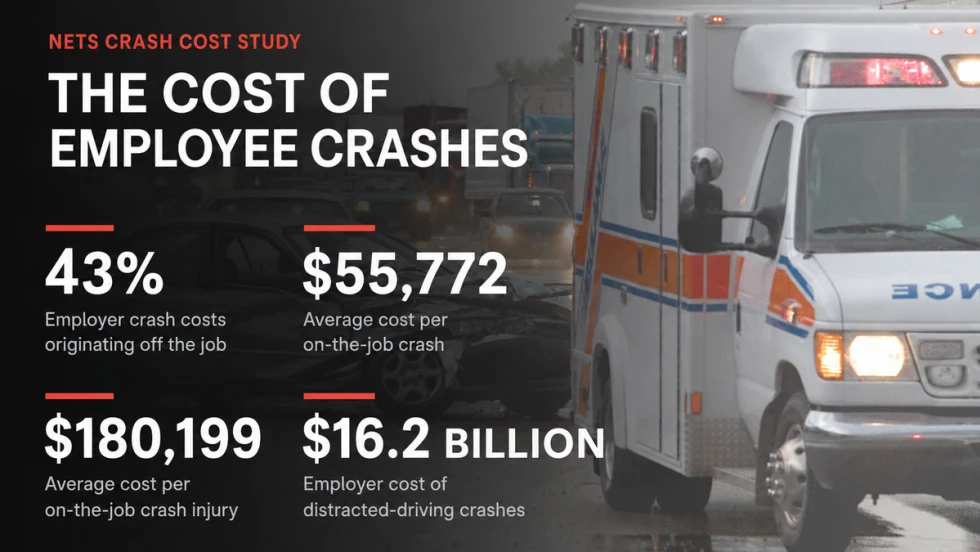
Off-the-Job Crashes Account for 43% of Employers’ $61.7 Billion Crash Burden
NETS quantifies costs dispersed across fleet, risk, HR, and other departments while providing new per-crash benchmarks for employers.
Read More →
Ram Recalls More Than 1.27 Million 1500 Pickups for Seat Belt Anchor Issue
The recall affects certain 2019-2026 Ram 1500 pickups that may have improperly attached second-row seat belt buckle anchors.
Read More →