




Safe Strategies for Different Vehicle Types
A basic guide to help commercial fleet drivers safely navigate roadways around other fleet vehicles like garbage trucks, school buses, and delivery trucks.

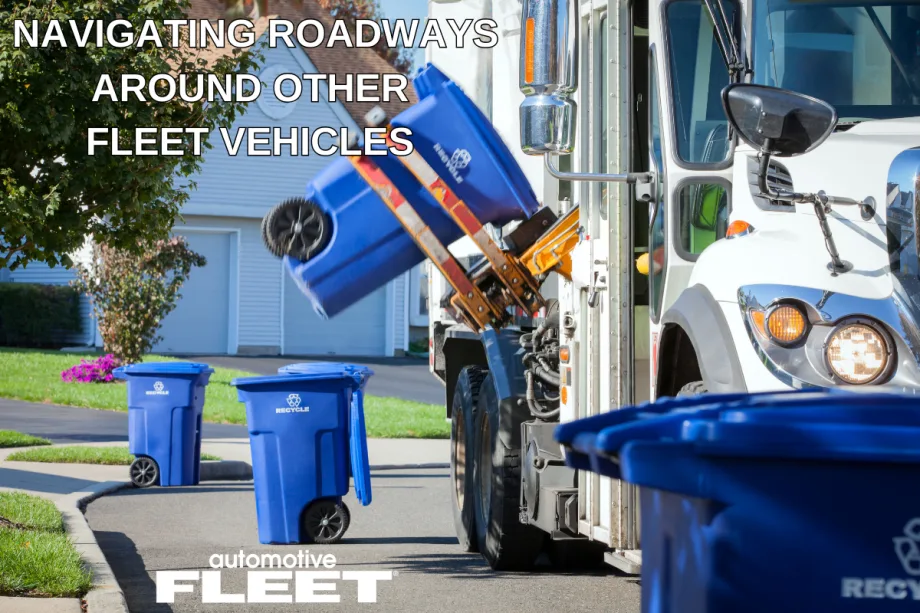
When specialty vehicles are near, fleet drivers should practice safety strategies to both protect themselves and other fleet operators.
Photo: Canva/Automotive Fleet
Certain vehicle types require special attention for safety’s sake. Passenger vehicles like cars, pickup trucks, and vans are likely to make up the bulk of the traffic on the roads your fleet travels on.
But no matter where drivers are driving to, it’s also likely they will encounter specialty vehicles such as refuse trucks, mail carriers, delivery vehicles, school buses, and motorcycles. Each one brings risks that are unique and demand more diligence.
Several common safe driving principles always apply whenever drivers are behind the wheel, whether they are driving near a sedan, a tractor trailer, or a mail carrier.
For instance, maintaining a safe following distance behind any vehicle is essential because it helps prevent rear-end collisions, which is the most common crash type. Likewise, driving within the posted speed limit greatly reduces the risk of a crash and the severity of injuries sustained in a crash, no matter what the driving environment.
But when specialty vehicles are near, additional strategies are needed.
A Change of Landscape
One factor that necessitates more attention to these vehicles is their increasing prevalence. For example, a surge in online shopping means people may spend less time driving to malls and shopping centers.
But it also puts more delivery trucks on the road — not only during year-end holidays, but 365 days a year. With online retailers offering free or inexpensive shipping, the volume of shipments is growing exponentially.
Another growing challenge is the increasing incidence of distracted driving. As more motorists make the unsafe decision to attend to tasks other than driving while behind the wheel, distraction contributes to more and more collisions.
When traveling near vehicles that make frequent stops, or are difficult to see, or in which drivers or passengers are entering and exiting often, the risk of distracted driving — and the dangerous consequences — become even greater.
Here are tips and techniques to reduce the odds of a crash for your drivers.
Watch Out for Mail/Delivery Trucks
Once a mail carrier reaches its assigned area it will make frequent stops — not only on side roads but often on main roads where businesses or homes may be located. On higher-speed roads, the stop-and-go driving of a mail carrier can create more risks than in residential neighborhoods, as motorists are expecting to travel at a higher speed and aren’t prepared to stop.
Delivery trucks like those operated by UPS or FedEx are often on a tight schedule, attempting to make many stops per day. Company policies typically discourage them from backing up (since backing commonly leads to crashes), but that means rather than pull into a driveway they usually pull to the side of the road. If there’s no shoulder or a narrow shoulder, they may block part of the travel lane.
What to do?
Pass carefully. If a mail carrier is making frequent stops, or a delivery vehicle is blocking part of a lane, drivers should not speed past it. There should be an unobstructed view and a clear path before passing. Don’t pass near the crest of a hill, an intersection, or a curve, or when there is a double yellow line.
Stay alert. Keep an eye on the driver’s side door in case he/she exits onto the road instead of on the shoulder side. Scan nearby driveways and walkways to see if the driver is about to step into the road.
Be patient. Allowing emotions like impatience or frustration to control driving is always a dangerous choice. Avoid making impulsive and unsafe maneuvers near vehicles making stops. Instead, remain calm, and a driver needs to themselves that arriving at their next destination safely is the most important goal.
Navigating Driving Near Refuse Trucks
On residential roads and city streets, fleet drivers may find trash and recycling trucks in their path, especially in the morning. Because they make frequent stops, they can frustrate drivers behind them, causing motorists to make unsafe maneuvers.
Workers often stand on the back of the truck, exposed to traffic, then hop on and off quickly as they reach each stop, walking along sidewalks and driveways and across the road to collect trash and recyclables, all increasing the risk of a collision.
Besides the trucks that collect trash at homes and businesses, larger trash haulers travel along local roads and highways to and from landfills and recycling centers.
Due to their cost, trash haulers tend to have longer lifecycles. These oftentimes older vehicles may be more likely to create hazards. If their flaps are worn off, they’re likely to throw off rocks from the road, and if their haul isn’t secured properly it could fly onto the road. If these vehicles have retread tires, the tread can detach and fly into the path of traffic.
What to do?
Stay back. Never crowd a trash truck, especially one making stops. Following too closely increases your risk of striking the truck from behind and puts workers at risk of being hit as they hop on and off the vehicle and move along the road.
Remain patient. It may seem like a driver is losing a lot of time, but it’s likely to take only a few extra minutes to wait for a trash truck to make its stops before a driver can pass. Drivers should allow extra time in their schedule for delays.
Pass with caution. As with any other vehicle, only pass a trash truck when there is a clear path to pass and move back into the lane. Never pass near the crest of a hill, right before a curve, close to an intersection, or where there is a double yellow line (which means it’s illegal to pass).
Watch for signs. If there is a trash hauler with loose items, give it a wide berth. Rather than pass, stay a safe distance behind.
If a driver hears a thumping sound when traveling near any kind of truck, they should recognize this may be a sign of a tread detaching from a tire. A driver should move away from the truck as best they can by changing lanes when it’s safe.
When School Buses Are Near
During the morning and mid-afternoon, it’s likely drivers encounter school buses on their travels. It’s vital that they know the unique risks of driving near them, the relevant motor vehicle laws, and the driving practices that can improve safety for everyone involved.
The laws about when to stop for a stopped school bus depending on the lane you are in vary from state to state. In general, cars on the same side as the school bus must stop, no matter what lane they’re in.
It’s the law for drivers traveling in the opposite direction – often with median separation – that can vary depending on the state you’re in.
Be sure to remind your drivers of these laws each school year. You can never be too careful in areas where children are nearby.
Be Aware of Potential Towing Dangers
When a vehicle is towing a camper, trailer, or boat, and the towed item is swaying or the vehicle is braking erratically, do not pass. Passing can create a wind draft that can make things worse, causing the towed vehicle to cross into the line of traffic.
Drivers may be tempted to pass to get away from the problem, but it is safter to stay behind and slow down to add distance between one vehicle and the other.
Reviewing the risks involved when driving near these vehicles, and the driving principles with a company or organization’s drivers, can help to avoid a collision.
This article was authored and edited according to Automotive Fleet's editorial standards and style. Opinions expressed may not reflect that of Automotive Fleet.
More Safety

Fleet Manager’s Ultimate Playbook: Navigating the New Standard in OEM Connectivity
Rising operating costs, driver safety concerns, and unplanned downtime are putting unprecedented pressure on modern fleets. Discover how fleet managers use embedded OEM connectivity and real-time vehicle data to cut TCO, prevent downtime, and protect drivers without aftermarket telematics hardware.
Read More →
From Driver Well-Being to EV Charging | AF News Recap
Mental health belongs in the fleet safety conversation. This week, we’re looking at five ways fleets can support employee well-being before a crisis, plus Holman’s expansion in Mexico, new one-day Fleet Forward passes, and why EV charging demand is outpacing infrastructure growth.
Read More →
Nexar-Nauto Merger Aims to Give Fleets Better Safety Intelligence Through Larger Driving Dataset
Stefan Heck tells Automotive Fleet that combining more than 10 billion miles of driving history with Nexar's AI models will give fleets deeper insights into driver risk and roadway conditions than either company could provide independently.
Read More →
Don't Wait for a Crisis: 5 Ways to Build Mental Health Into Your Fleet Safety Program
For Suicide Prevention Month, fleet and safety leaders have an opportunity to put mental health where it belongs: at the center of workplace safety.
Read More →
How Camera Data Can Strengthen a Fleet’s Insurance Renewal
Insights from a commercial insurance carrier and a broker show how fleets can turn video telematic data, driver coaching, and improved claims results into a stronger case at insurance renewal.
Read More →
The Safest Fleets Aren’t the Ones with the Most Technology
You’ve made the telematics investment. Here’s how to capture the other half of its value and build the safest fleet on the road.
Read More →
Hidden in Plain Sight: Fleet Compliance Risks
Fleet compliance isn't just about having policies — it's about consistently enforcing them. This practical guide reveals six hidden compliance risks common in public sector and shared fleet operations and outlines proven strategies to improve visibility, accountability, and audit readiness
Read More →
NETS Sets 2026 Fleet Safety Benchmark Conference for Indianapolis
The Sept. 15–17 program will feature fleet benchmarking data, case studies, emerging technologies, and implementation strategies while running alongside the NSC Safety Congress & Expo.
Read More →
Off-the-Job Crashes Account for 43% of Employers’ $61.7 Billion Crash Burden
NETS quantifies costs dispersed across fleet, risk, HR, and other departments while providing new per-crash benchmarks for employers.
Read More →
Ram Recalls More Than 1.27 Million 1500 Pickups for Seat Belt Anchor Issue
The recall affects certain 2019-2026 Ram 1500 pickups that may have improperly attached second-row seat belt buckle anchors.
Read More →