




Drive Safe: Hot Weather Driving Tips
Memorial Day Crash Numbers Expected to Hit Highest Level Since 2008
Experts estimate a record-breaking travel volume for the holiday weekend and increased traffic fatalities.

Christy Grimes・Former Senior Editor

Only 12% of fatal holiday crashes occur on an interstate highway, while 43% occur in rural areas and 49% involve a vehicle leaving the roadway.
Photo: Automotive Fleet
3 min to read
The Memorial Day weekend holiday can be deadly for drivers, and it kicks off what has become known as the '100 Deadly Days' — with Memorial Day through Labor Day resulting in an uptick in roadway deaths, particularly among teens. Despite the holiday weekend, many commercial fleet drivers will be on the road for work.
Memorial Day Travel Expected to Set A New Record
AAA forecasts that 45.1 million people will travel at least 50 miles from home over the Memorial Day holiday period, from Thursday, May 22, to Monday, May 26. This travel forecast breaks the previous Memorial Day weekend record of 44 million people set in 2005.
Of the expected 45.1 million travelers, 39.4 million will be travelling by car. That’s an additional one million travelers compared to last year.
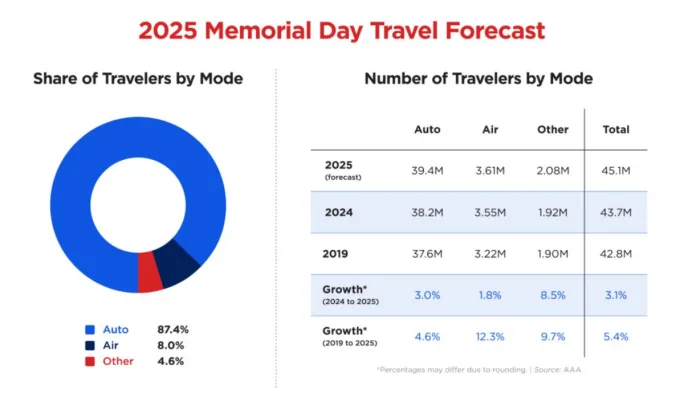
AAA 2025 Memorial Day Travel Forecast
Photo: AAA
The National Safety Council (NSC) estimates 443 people may die in preventable traffic crashes during the 2025 Memorial Day holiday period. This number notes a 6% increase from 2024’s estimate.
The NSC shared some tips for a safer holiday weekend:
Drive defensively: Buckle up, designate a sober driver, get enough sleep and avoid distractions.
Prepare your vehicle: Check tires, oil, and repair any open recalls at ChecktoProtect.org.
Avoid impairment: Remember, both alcohol and drugs, including prescription medications, can impair driving ability.
Monitor speed: Drive at or below posted limits and adjust for weather and traffic conditions.
Stay focused: Put phones away and minimize distractions while driving.
Check back seats: Always look before locking your vehicle to ensure no children or pets remain inside.
Support safety initiatives: Visit nsc.org/roadtozero to join efforts to eliminate roadway fatalities.Here are more insights from Jerry's data analysis:
What's the Deadliest Day to Drive?
The data revealed that Saturday proved the deadliest day on the roads during Memorial Day weekend, followed by Sunday.
The single deadliest hour is 11 p.m. to midnight on Saturday, followed by midnight Saturday to 1 a.m. Sunday, and 9-10 p.m. on Sunday. The safest times to drive include Saturday morning after 6 a.m. and Sunday and Monday mornings after 8 a.m.
What Is the Cause of Most Crashes?
Nearly one third of all Memorial Day holiday crashes involve speeding, while another 30% involve at least one driver with a positive blood-alcohol test.
Moreover, nearly three-fourths of fatal crashes that involve speeding involve at least one driver who had been drinking.
Where Do Most of the Crashes Occur?
It may come as a surprise that only 12% of fatal holiday crashes occur on an interstate highway, while 43% occur in rural areas and 49% involve a vehicle leaving the roadway.
Among U.S. cities, Houston and Dallas recorded the most fatal crashes during the Memorial Day holiday period. Texas reported the most fatal crashes, with 218 fatal crashes during the holiday period between 2018-2022.
The three most populus states — Texas, California, and Florida — all see twice as many fatal crashes as any other state.
On a per capita basis, Delaware reported the most fatal crashes of any state, as well as the most involving speeding and the most involving drugs. Montana, South Dakota, and Nebraska topped the list of states with the most per capita fatal crashes involving drinking.
NHTSA announced a heightened law enforcement presence will be on U.S. roadways through June 2 as part of the Click It or Ticket campaign. The annual seat belt safety campaign runs concurrent with the Memorial Day holiday.
Here are some safety tips from NHTSA to share with your drivers to keep them safe:
If you are planning to drink, plan ahead for a sober ride home.
If you are using any impairing drugs, including marijuana, don’t drive, arrange for a safe ride home. Impaired driving is illegal, regardless of the source of impairment.
If you see an impaired driver on the road, safely pull over and call 911.
Editor’s note: This article was originally published in May 2024 and has been updated for continued relevance.
More Safety

Sponsored•October 1, 2026
Fleet Manager’s Ultimate Playbook: Navigating the New Standard in OEM Connectivity
Rising operating costs, driver safety concerns, and unplanned downtime are putting unprecedented pressure on modern fleets. Discover how fleet managers use embedded OEM connectivity and real-time vehicle data to cut TCO, prevent downtime, and protect drivers without aftermarket telematics hardware.
Read More →
From Driver Well-Being to EV Charging | AF News Recap
Mental health belongs in the fleet safety conversation. This week, we’re looking at five ways fleets can support employee well-being before a crisis, plus Holman’s expansion in Mexico, new one-day Fleet Forward passes, and why EV charging demand is outpacing infrastructure growth.
Read More →
Nexar-Nauto Merger Aims to Give Fleets Better Safety Intelligence Through Larger Driving Dataset
Stefan Heck tells Automotive Fleet that combining more than 10 billion miles of driving history with Nexar's AI models will give fleets deeper insights into driver risk and roadway conditions than either company could provide independently.
Read More →
Don't Wait for a Crisis: 5 Ways to Build Mental Health Into Your Fleet Safety Program
For Suicide Prevention Month, fleet and safety leaders have an opportunity to put mental health where it belongs: at the center of workplace safety.
Read More →
How Camera Data Can Strengthen a Fleet’s Insurance Renewal
Insights from a commercial insurance carrier and a broker show how fleets can turn video telematic data, driver coaching, and improved claims results into a stronger case at insurance renewal.
Read More →
The Safest Fleets Aren’t the Ones with the Most Technology
You’ve made the telematics investment. Here’s how to capture the other half of its value and build the safest fleet on the road.
Read More →
Sponsored•August 7, 2026
Hidden in Plain Sight: Fleet Compliance Risks
Fleet compliance isn't just about having policies — it's about consistently enforcing them. This practical guide reveals six hidden compliance risks common in public sector and shared fleet operations and outlines proven strategies to improve visibility, accountability, and audit readiness
Read More →
NETS Sets 2026 Fleet Safety Benchmark Conference for Indianapolis
The Sept. 15–17 program will feature fleet benchmarking data, case studies, emerging technologies, and implementation strategies while running alongside the NSC Safety Congress & Expo.
Read More →
Off-the-Job Crashes Account for 43% of Employers’ $61.7 Billion Crash Burden
NETS quantifies costs dispersed across fleet, risk, HR, and other departments while providing new per-crash benchmarks for employers.
Read More →
Ram Recalls More Than 1.27 Million 1500 Pickups for Seat Belt Anchor Issue
The recall affects certain 2019-2026 Ram 1500 pickups that may have improperly attached second-row seat belt buckle anchors.
Read More →