




One Large SUV Excels in IIHS Tests While Others Fall Flat
See which SUV scored highest in IIHS crash tests and which scored poorly.

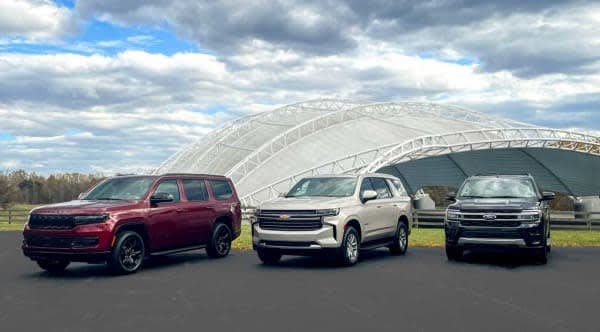
The Jeep Wagoneer (left) performed better in IIHS testing than the Chevrolet Tahoe (center) and Ford Expedition (right).
Photo: IIHS
New ratings from the Insurance Institute for Highway Safety (IIHS) show some large SUVs used by commercial fleets are safer than others, based on their crash test performance.
The Jeep Wagoneer stood out, qualifying for a 2024 Top Safety Pick award, unlike two other large SUV counterparts, the Chevrolet Tahoe and Ford Expedition, which fell short due to poor performance in the small overlap front crash test and other tests.
More than 90% of new models have sailed through this evaluation with good ratings since 2021, according to an IIHS news release.
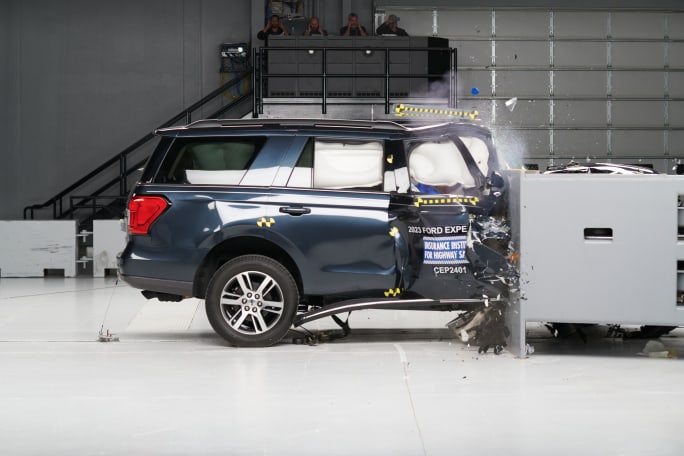
The Ford Expedition earned a marginal rating in the small overlap front test, which is designed to replicate what happens when the front corner of a vehicle collides with another vehicle or object.
Photo: IIHS
"The huge mass of these large SUVs provides some additional protection in crashes with smaller vehicles, though that also means they present more danger to other road users," IIHS President David Harkey said. "The flip side of their large size is that there is a lot more force to manage when they crash into a fixed obstacle like a tree or bridge abutment or the barrier we use in our front crash tests."
Analyzing Front Seat Safety
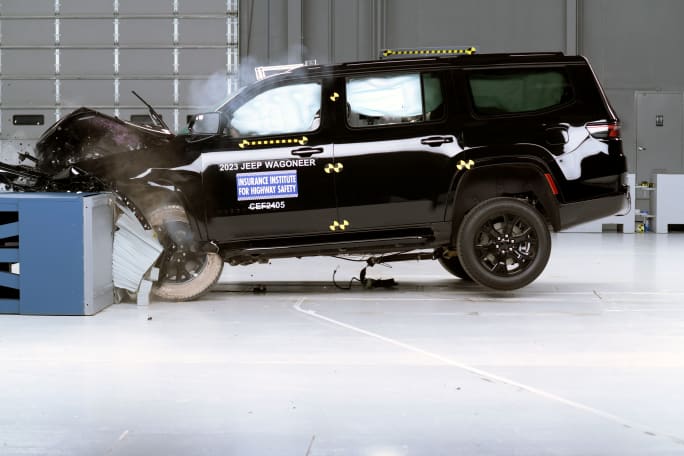
The Jeep Wagoneer earned a marginal rating in the moderate overlap front test, which now includes a dummy in the second row, due to its failure to protect the rear passenger well. This is what kept the Wagoneer from earning the Top Safety Pick+.
Photo: IIHS
The Wagoneer performed better than the Tahoe and Expedition, maintaining better survival space for the driver and front passenger and showing lower risks of injury in tests.
All three vehicles did well in the updated side test, with slight performance deficiencies. The Wagoneer showed an intrusion in the footwell, resulting in a modest injury risk to the driver's left foot and ankle.
The Tahoe received an acceptable rating in the driver-side test, with adequate survival space and effective airbags and restraints. However, there was significant footwell intrusion, posing a risk of lower leg injuries. In the passenger-side test, extensive footwell intrusion led to a high risk of right foot injury and a moderate risk of injury to the left leg.
In tests on both sides, the Expedition's structure failed, resulting in damage to the steering column and A-pillar. Severe footwell intrusion posed a high injury risk to the driver's legs.
All three vehicles scored well in the original moderate overlap front evaluation, which focuses on the front seat's protection. Still, the driver dummy's head hit the steering wheel through the airbag in the Wagoneer, and the driver's side curtain airbag in the Expedition did not deploy during the test.
What About Rear Passenger Protection?
None of the SUVs provided satisfactory protection for rear passengers, with the Tahoe showing a high risk of head or neck injuries in the backseat. The lackluster rating prevented the Wagoneer from earning the higher-tier Top Safety Pick+ award.
In the updated tests, none of the vehicles performed well in protecting second-row passengers from chest injuries due to high seat belt forces.
Only the marginal-rated Expedition has second-row belt pretensioners, which can mitigate belt forces, but its injury metrics were no better than those seen in the other two SUVs. The Expedition's side curtain airbag for the rear passenger also failed to deploy, but that wasn't enough to change its overall rating.
The Tahoe received poor second-row ratings, with data from the rear dummy indicating a high risk of head, neck, and chest injuries. The Tahoe's second-row lap belt shifted from the pelvis to the dummy's abdomen, raising the likelihood of abdominal injuries.
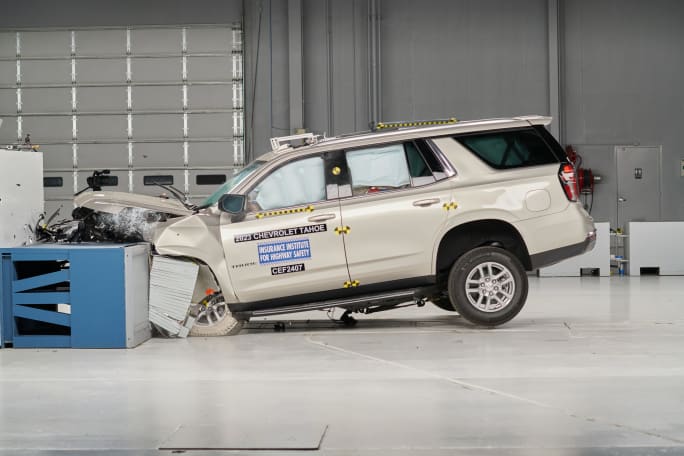
The Chevrolet Tahoe received a poor rating on the updated moderate overlap front test. Measurements taken from the rear dummy showed a high risk of head, neck, or chest injuries.
Photo: IIHS
"These discouraging results show that some popular vehicles still lag behind in meeting the most advanced safety standards," Raul Arbelaez, vice president of the Institute's Vehicle Research Center, said. "The good news is that the top performer in this class proves that automakers can readily address these problems."
Pedestrian Crash Avoidance
The Wagoneer and Expedition received a good rating in pedestrian crash avoidance with standard front crash prevention systems. Both vehicles avoided collisions with the pedestrian dummy in most daytime and nighttime test scenarios.
The Tahoe only received a marginal rating on pedestrian safety tests. While its standard system performs well in daylight, it falters in low-light conditions.
The Wagoneer's headlights on all trims were rated acceptable or good, while the Expedition's headlights only earned a marginal rating. They struggle to illuminate the road well enough on curves, and the low beams produce too much glare for oncoming drivers.
The poor-rated headlights supplied with all trims of the Tahoe may be a contributing factor in the lower pedestrian crash results.
Along with creating excessive glare for oncoming drivers, the Tahoe's low beams don't light up the right side of straightaways well. In the IIHS test, the pedestrian dummy crosses the test track from right to left.
Good headlights and effective pedestrian crash avoidance systems are essential for larger vehicles since their greater height and weight make them more dangerous than smaller cars for pedestrians and other road users.
Buckle Up: Seat Belt Reminder Ratings
The Expedition's seat belt reminders earned a good rating, while the Tahoe's are acceptable because there is no reminder for the second-row seating positions.
The Wagoneer earned a marginal rating because its unbelted occupant alert doesn't come on fast enough and lacks a second-row belt reminder.
Both the Wagoneer and Tahoe earned good ratings for the ease of use of their LATCH systems, which are intended to make it easier to install a child seat properly. The Expedition earned an acceptable rating.
The overall mixed results underline a pressing need for improvements in vehicle safety standards.
IIHS released its 2024 Top Safety Pick+ and Top Safety Pick winning models in February 2024. More have been added to the charts. Click here to see the full list.
More Safety

Fleet Manager’s Ultimate Playbook: Navigating the New Standard in OEM Connectivity
Rising operating costs, driver safety concerns, and unplanned downtime are putting unprecedented pressure on modern fleets. Discover how fleet managers use embedded OEM connectivity and real-time vehicle data to cut TCO, prevent downtime, and protect drivers without aftermarket telematics hardware.
Read More →
From Driver Well-Being to EV Charging | AF News Recap
Mental health belongs in the fleet safety conversation. This week, we’re looking at five ways fleets can support employee well-being before a crisis, plus Holman’s expansion in Mexico, new one-day Fleet Forward passes, and why EV charging demand is outpacing infrastructure growth.
Read More →
Nexar-Nauto Merger Aims to Give Fleets Better Safety Intelligence Through Larger Driving Dataset
Stefan Heck tells Automotive Fleet that combining more than 10 billion miles of driving history with Nexar's AI models will give fleets deeper insights into driver risk and roadway conditions than either company could provide independently.
Read More →
Don't Wait for a Crisis: 5 Ways to Build Mental Health Into Your Fleet Safety Program
For Suicide Prevention Month, fleet and safety leaders have an opportunity to put mental health where it belongs: at the center of workplace safety.
Read More →
How Camera Data Can Strengthen a Fleet’s Insurance Renewal
Insights from a commercial insurance carrier and a broker show how fleets can turn video telematic data, driver coaching, and improved claims results into a stronger case at insurance renewal.
Read More →
The Safest Fleets Aren’t the Ones with the Most Technology
You’ve made the telematics investment. Here’s how to capture the other half of its value and build the safest fleet on the road.
Read More →
Hidden in Plain Sight: Fleet Compliance Risks
Fleet compliance isn't just about having policies — it's about consistently enforcing them. This practical guide reveals six hidden compliance risks common in public sector and shared fleet operations and outlines proven strategies to improve visibility, accountability, and audit readiness
Read More →
NETS Sets 2026 Fleet Safety Benchmark Conference for Indianapolis
The Sept. 15–17 program will feature fleet benchmarking data, case studies, emerging technologies, and implementation strategies while running alongside the NSC Safety Congress & Expo.
Read More →
Off-the-Job Crashes Account for 43% of Employers’ $61.7 Billion Crash Burden
NETS quantifies costs dispersed across fleet, risk, HR, and other departments while providing new per-crash benchmarks for employers.
Read More →
Ram Recalls More Than 1.27 Million 1500 Pickups for Seat Belt Anchor Issue
The recall affects certain 2019-2026 Ram 1500 pickups that may have improperly attached second-row seat belt buckle anchors.
Read More →