





Related: AAA Study Reveals Safety Concerns During Heavy Traffic
AAA Testing Finds Gaps in Intersection AEB Crash Prevention
Testing of four 2026 model-year vehicles found that automatic emergency braking prevented collisions in standardized intersection scenarios, but three vehicles failed to avoid crashes when another vehicle turned into their path.
November 13, 2026
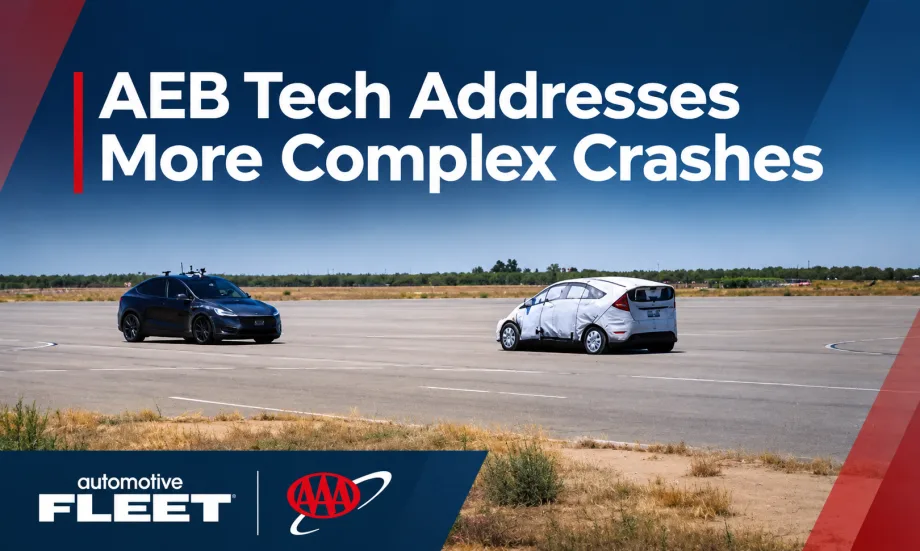
AAA testing found that three of four 2026 model-year vehicles equipped with intersection automatic emergency braking failed to prevent collisions when another vehicle turned into their path, despite all four successfully avoiding crashes in standardized left-turn tests.
Credit:
Automotive Fleet / AAA
4 min to read
- AAA conducted tests on four 2026 model-year vehicles to assess their automatic emergency braking performance at intersections.
- The tests found that while the AEB systems could prevent collisions in standardized scenarios, they struggled with vehicles turning into their path.
- Three out of the four vehicles tested failed to avoid crashes when an oncoming vehicle turned unexpectedly.
*Summarized by AI
New research from AAA found that automatic emergency braking (AEB) systems designed to prevent intersection crashes perform consistently in standardized testing but may not respond effectively to other common collision scenarios.
AAA tested four 2026 model-year vehicles equipped with standard intersection AEB technology. All four avoided collisions during standardized left-turn tests. However, three of the four vehicles failed to prevent collisions when another vehicle turned into their path from a side road.
The findings raise questions about how fleet managers should evaluate advanced driver-assistance systems (ADAS) when selecting vehicles and developing driver safety programs.
"Intersections are some of the most dangerous places on the road," said Greg Brannon, AAA's director of automotive engineering and research. "AEB is making progress in the limited intersection scenarios it is tested to handle. Unfortunately, performance outside those scenarios is spotty."
How AAA Tested Intersection AEB Systems
AAA partnered with the Automobile Club of Southern California's Automotive Research Center to evaluate four 2026 model-year vehicles equipped with intersection AEB as standard equipment.
Researchers conducted 74 closed-course test runs under controlled daytime conditions, using a robotic soft vehicle to simulate another vehicle.
Testing included four intersection scenarios:
- Turn-into-path: A vehicle traveling at 30 mph encountered another vehicle turning right into its path from a perpendicular road at 5 mph.
- Standardized left turn: A test vehicle turned left at 9.3 mph across oncoming traffic traveling at 18.6 mph, following Euro NCAP testing procedures.
- Left turn without a turn signal: Researchers repeated the standardized left-turn test without activating the turn signal.
- Left turn with manual steering: A driver manually steered through the left turn with the turn signal activated, replacing robotic steering.
Where Did Intersection AEB Systems Fall Short?
AAA found that collision avoidance varied depending on the scenario.
Test Scenario | Results |
|---|---|
Turn-into-path | One vehicle avoided all collisions; three struck the target in every run. |
Standardized left turn | All four vehicles avoided collisions in every run. |
Left turn without turn signal | One vehicle failed to warn or brake and struck the target in every run. |
Left turn with manual steering | All four vehicles warned, braked and avoided collisions in every run. |
The largest performance gap occurred during the turn-into-path scenario, when another vehicle entered the test vehicle's path from a side road.
Three of the four tested vehicles struck the target during every run, while one successfully avoided all collisions.
Researchers also found that removing the turn signal affected one vehicle's response during the left-turn scenario. That vehicle provided neither a forward collision warning nor automatic braking.
However, replacing robotic steering with manual steering did not affect collision avoidance in the standardized left-turn scenario. All four vehicles warned the driver, applied the brakes and avoided collisions.
Current AEB Testing Standards Leave Gaps
Historically, U.S. vehicle-to-vehicle AEB testing has focused primarily on rear-end collisions.
In 2020, Euro NCAP introduced intersection testing protocols that included left turns across oncoming traffic.
The National Highway Traffic Safety Administration developed a draft Intersection Safety Assist testing procedure in 2019 for research purposes, but a final standard has not been implemented.
According to AAA, existing protocols do not fully evaluate how intersection AEB systems respond to common U.S. crash configurations.
In previous research conducted in 2022, AAA evaluated four vehicles equipped with standard AEB systems that did not include manufacturer-identified intersection AEB functionality.
Those systems failed to provide collision warnings or automatic braking during any test runs involving two intersection crash scenarios.
What Do the Findings Mean for Fleet Safety?
For fleet managers evaluating vehicle safety technology, the findings highlight the importance of understanding what specific AEB systems are designed to detect and prevent.
Although the tested vehicles performed consistently during standardized left-turn scenarios, results varied when another vehicle entered the roadway from a perpendicular direction.
AAA recommends that automakers, researchers, regulators and safety organizations expand intersection AEB testing to include additional crash scenarios and real-world driving conditions.
The organization also advises drivers to treat intersection AEB as an additional safety feature rather than a replacement for attentive driving.
When entering intersections, AAA recommends that drivers consider "covering the brake" by positioning their right foot just above the brake pedal, with their heel on the floor, while remaining prepared to brake or steer if necessary.
For fleet safety programs, the results provide an opportunity to reinforce driver training around ADAS limitations, particularly in intersection scenarios where automatic braking may not activate.
AAA Testing Methodology
AAA conducted 74 closed-course test runs under controlled daytime conditions.
Five runs were planned for each vehicle and configuration. If a vehicle failed to provide either a forward collision warning or automatic braking during the first three runs, researchers stopped testing that configuration to reduce the risk of vehicle damage.
The findings reflect the performance of four 2026 model-year vehicles under the conditions tested and do not necessarily represent the capabilities of all intersection AEB systems.
More Safety
Which Fleet Types Have the Highest Severe Speeding Rates?
New research from SambaSafety finds significant differences in speeding rates across fleet industries, even as nearly 90% of surveyed fleets report using telematics.
Read More →
When a Cyberattack Hits Your Fleet: What Happens Next?
“You have two opportunities to test your plans: when you choose or when the threat actor chooses.” A cybersecurity expert reveals what fleet managers need to know before a cyberattack puts their operations at risk — and why the decisions made in the first moments can shape the entire recovery.
Read More →
Tips for Driving Safely on Halloween Night
This video features a reminder from the Connecticut Department of Transportation (DOT) and the Connecticut Police Chiefs Association, urging drivers to prioritize safety this Halloween.
Read More →
IIHS Crash Avoidance Tests Reveal Safety Gaps in Cargo Vans and Work Trucks
New IIHS crash avoidance ratings show uneven performance among cargo vans and heavy-duty pickups, with most struggling to avoid vehicle-to-vehicle collisions.
Read More →
What’s Next for Fleet? Safety, AI & Industry Recognition | AF News Recap
Could your company's culture be encouraging distracted driving? This week, we're exploring how workplace expectations affect driver safety, what AI, EVs, and autonomous vehicles could mean for the future of fleet management, and how fleet professionals can strengthen their award nominations.
Read More →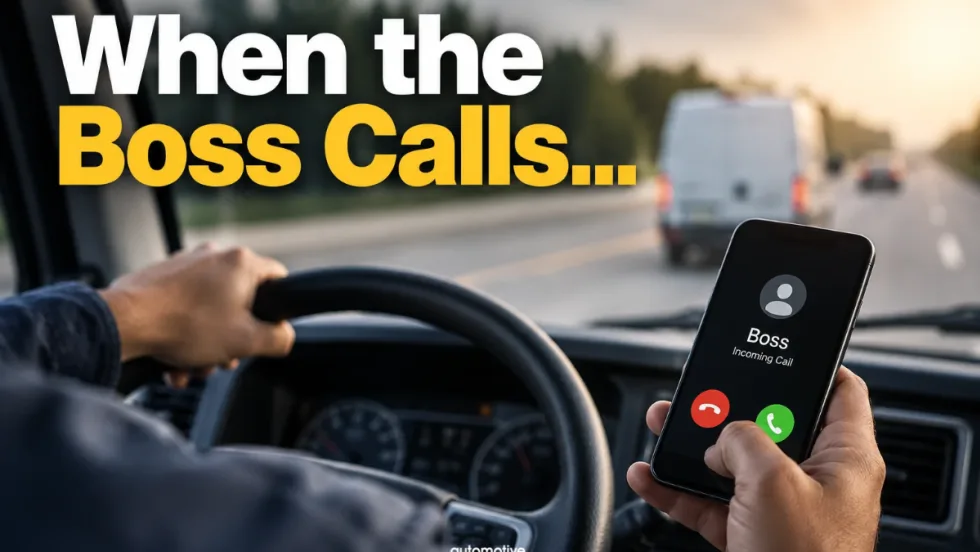
Does Your Fleet's Culture Encourage Distracted Driving?
What happens when the people responsible for enforcing safety rules are the ones setting the wrong example? The answer may reveal why some of the biggest risks to fleet drivers have little to do with what's written in the employee handbook.
Read More →
Sponsored•October 1, 2026
Fleet Manager’s Ultimate Playbook: Navigating the New Standard in OEM Connectivity
Rising operating costs, driver safety concerns, and unplanned downtime are putting unprecedented pressure on modern fleets. Discover how fleet managers use embedded OEM connectivity and real-time vehicle data to cut TCO, prevent downtime, and protect drivers without aftermarket telematics hardware.
Read More →
From Driver Well-Being to EV Charging | AF News Recap
Mental health belongs in the fleet safety conversation. This week, we’re looking at five ways fleets can support employee well-being before a crisis, plus Holman’s expansion in Mexico, new one-day Fleet Forward passes, and why EV charging demand is outpacing infrastructure growth.
Read More →
Nexar-Nauto Merger Aims to Give Fleets Better Safety Intelligence Through Larger Driving Dataset
Stefan Heck tells Automotive Fleet that combining more than 10 billion miles of driving history with Nexar's AI models will give fleets deeper insights into driver risk and roadway conditions than either company could provide independently.
Read More →
Don't Wait for a Crisis: 5 Ways to Build Mental Health Into Your Fleet Safety Program
For Suicide Prevention Month, fleet and safety leaders have an opportunity to put mental health where it belongs: at the center of workplace safety.
Read More →