




IIHS Crash Avoidance Tests Reveal Safety Gaps in Cargo Vans and Work Trucks
New IIHS crash avoidance ratings show uneven performance among cargo vans and heavy-duty pickups, with most struggling to avoid vehicle-to-vehicle collisions.
October 22, 2026

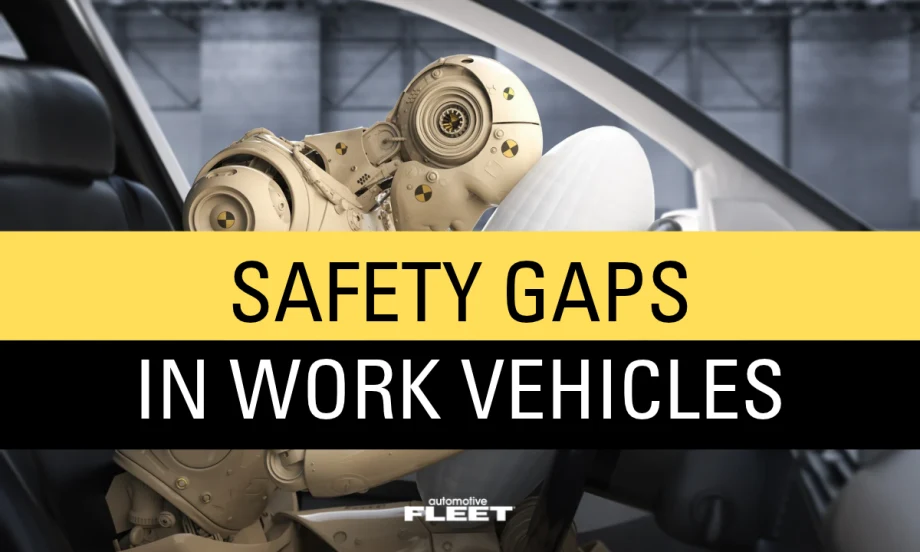
The IIHS findings raise questions about how well crash-avoidance technology protects vulnerable road users, highlighting the importance of evaluating safety performance when selecting vehicles for commercial fleets.
Credit:
Automtive Fleet
4 min to read
- The IIHS conducted crash-avoidance tests revealing varying safety performance in commercial vehicles.
- Several popular cargo vans and heavy-duty pickups displayed inefficiency in avoiding collisions.
- The tests highlighted safety gaps in collision avoidance with other vehicles and pedestrians.
*Summarized by AI
New evaluations from the Insurance Institute for Highway Safety (IIHS) show that cargo vans and Class 3 pickup trucks lag behind passenger vehicles in front-crash prevention.
Initial assessments found that commercial vehicles tested for vehicle-to-vehicle and pedestrian crash avoidance often received marginal or poor ratings.
The findings could affect commercial fleets as they evaluate vehicle safety features and make purchasing decisions, particularly as automatic emergency braking (AEB) and other driver assistance systems become more common.
Commercial Vehicles Face New Safety Evaluations
Initial testing focused on cargo vans and Class 3 pickup trucks with gross vehicle weight ratings between 10,001 and 14,000 pounds.
Unlike the Institute's earlier commercial vehicle driver protection assessments, the new crash avoidance tests use the same protocols and four-tier rating system applied to passenger vehicles: good, acceptable, marginal, and poor.
The vehicle-to-vehicle evaluation measures the effectiveness of forward collision warning and AEB systems in scenarios involving passenger vehicles and motorcycles. IIHS also evaluates forward collision warnings using a semitrailer target.
“IIHS evaluates automatic emergency braking in unloaded conditions or, in some cases, incomplete builds. Although heavy loads and upfits may affect performance, the immediate priority is expanding availability and demand,” explained David Kidd, vice president of Vehicle Research at IIHS. “Our ratings recognize manufacturers that equip commercial vehicles with effective, high-performing crash avoidance features.”
Pedestrian crash prevention testing examines how well vehicles detect and respond to adults and children in daytime and nighttime scenarios.
Cargo Vans Show Mixed Crash Prevention Performance
Among the cargo vans evaluated, the Mercedes-Benz Sprinter 2500 was the only model to receive a good rating for vehicle-to-vehicle front crash prevention.
The Chevrolet Express 2500 and GMC Savana 2500 received poor ratings in both categories because neither offers AEB. Both models offer optional forward collision warning systems.
“Safety is an operational requirement. An on-the-job crash costs employers more than $55,000 on average, and far more when someone is injured or killed. Our ratings show fleet managers which cargo vans and heavy-duty pickups offer the strongest protection against crashes with pedestrians and other vehicles,” added Kidd.
Motorcycle detection was a particular challenge across the vehicles tested. Several systems failed to issue warnings or reduce speed in most motorcycle test scenarios.
Other vehicles could reduce speed or avoid collisions but received lower ratings because their warning systems did not give drivers enough advance notice.
Pedestrian Detection Performance Varies
Commercial vehicles generally performed better in pedestrian crash avoidance testing, although several models struggled under specific conditions.
Researchers indicated that the height of the vehicles' front ends and the positioning of detection sensors near the rearview mirror may contribute to the problem.
Nighttime performance also presented challenges. Several marginal- and poor-rated systems failed to reduce speed sufficiently when approaching an adult pedestrian, with some performing worse under low-beam headlights than high beams.
How Commercial Vehicles Performed
The following ratings reflect the models and model years evaluated by IIHS.
Vehicle | Vehicle-to-Vehicle | Pedestrian |
Cargo Vans | ||
Chevrolet BrightDrop 400 (2025–26) | Acceptable | Good |
Chevrolet Express 2500 (2025–27) | Poor | Poor |
Ford Transit T250 (2025) | Poor | Marginal |
GMC Savana 2500 (2025–27) | Poor | Poor |
Mercedes-Benz Sprinter 2500 (2025) | Good | Acceptable |
Ram ProMaster 2500 (2025–27) | Poor | Marginal |
Rivian RCV-Delivery 500 (2025) | Marginal | Good |
Class 3 Pickups | ||
Chevrolet Silverado 3500HD (2025–26) | Poor | Marginal |
Ford F-350 (2025) | Poor | Acceptable |
GMC Sierra 3500 (2025–26) | Poor | Marginal |
Ram 3500 (2025–27) | Marginal | Acceptable |
Beyond Safety Ratings
Beyond publishing vehicle ratings, IIHS is developing additional resources to help fleet managers evaluate the financial implications of choosing safer vehicles.
During his safety keynote presentation at the 2026 Fleet Forward Conference, David Harkey, president of IIHS, discussed plans for a return-on-investment calculator that would help fleets assess how vehicle safety investments could affect operating costs, liability, and risk.

During the Fleet Forward Conference, David Harkey of IIHS highlighted a successful automatic emergency braking demonstration involving a Class 7 or 8 truck traveling at 30 mph.
Credit:
Automotive Fleet
IIHS is also developing insurance claims comparisons that would allow fleet managers to examine average claim frequency and severity within a vehicle class and compare individual models.
"We are filling a gap that we see right now in safety in the commercial vehicle space," noted Harkey, emphasizing a move beyond safety ratings to assess purchasing needs for fleet managers.
What the Findings Mean for Commercial Fleets
The evaluations highlight differences in crash avoidance technology across commercial vehicle models, even among vehicles serving similar operational purposes.
For fleet managers, the results provide another consideration when comparing vehicles for acquisition or replacement. AEB availability alone does not necessarily indicate how effectively a system will perform across different collision scenarios.
The findings also highlight the limitations of certain systems in detecting motorcycles and pedestrians, particularly children. IIHS plans to continue evaluating Class 3 commercial vehicles through 2027, adding assessments of headlights and rear automatic emergency braking.
Testing will eventually expand to larger Class 4–6 trucks, providing additional safety performance information for commercial fleet operators managing heavier vehicles.
Subscribe to Our Newsletter
More Safety
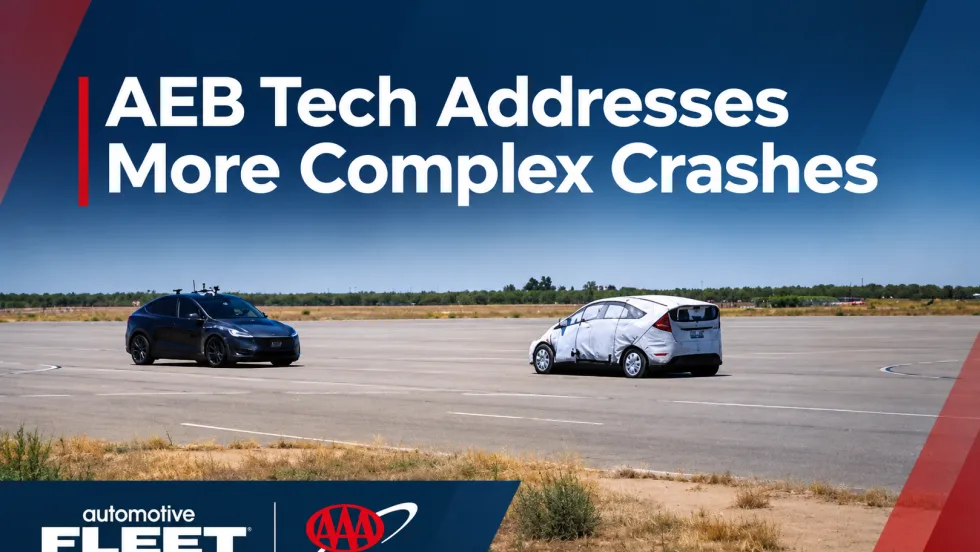
AAA Testing Finds Gaps in Intersection AEB Crash Prevention
Testing of four 2026 model-year vehicles found that automatic emergency braking prevented collisions in standardized intersection scenarios, but three vehicles failed to avoid crashes when another vehicle turned into their path.
Read More →
Which Fleet Types Have the Highest Severe Speeding Rates?
New research from SambaSafety finds significant differences in speeding rates across fleet industries, even as nearly 90% of surveyed fleets report using telematics.
Read More →
When a Cyberattack Hits Your Fleet: What Happens Next?
“You have two opportunities to test your plans: when you choose or when the threat actor chooses.” A cybersecurity expert reveals what fleet managers need to know before a cyberattack puts their operations at risk — and why the decisions made in the first moments can shape the entire recovery.
Read More →
Tips for Driving Safely on Halloween Night
This video features a reminder from the Connecticut Department of Transportation (DOT) and the Connecticut Police Chiefs Association, urging drivers to prioritize safety this Halloween.
Read More →
What’s Next for Fleet? Safety, AI & Industry Recognition | AF News Recap
Could your company's culture be encouraging distracted driving? This week, we're exploring how workplace expectations affect driver safety, what AI, EVs, and autonomous vehicles could mean for the future of fleet management, and how fleet professionals can strengthen their award nominations.
Read More →
Does Your Fleet's Culture Encourage Distracted Driving?
What happens when the people responsible for enforcing safety rules are the ones setting the wrong example? The answer may reveal why some of the biggest risks to fleet drivers have little to do with what's written in the employee handbook.
Read More →
Sponsored•October 1, 2026
Fleet Manager’s Ultimate Playbook: Navigating the New Standard in OEM Connectivity
Rising operating costs, driver safety concerns, and unplanned downtime are putting unprecedented pressure on modern fleets. Discover how fleet managers use embedded OEM connectivity and real-time vehicle data to cut TCO, prevent downtime, and protect drivers without aftermarket telematics hardware.
Read More →
From Driver Well-Being to EV Charging | AF News Recap
Mental health belongs in the fleet safety conversation. This week, we’re looking at five ways fleets can support employee well-being before a crisis, plus Holman’s expansion in Mexico, new one-day Fleet Forward passes, and why EV charging demand is outpacing infrastructure growth.
Read More →
Nexar-Nauto Merger Aims to Give Fleets Better Safety Intelligence Through Larger Driving Dataset
Stefan Heck tells Automotive Fleet that combining more than 10 billion miles of driving history with Nexar's AI models will give fleets deeper insights into driver risk and roadway conditions than either company could provide independently.
Read More →
Don't Wait for a Crisis: 5 Ways to Build Mental Health Into Your Fleet Safety Program
For Suicide Prevention Month, fleet and safety leaders have an opportunity to put mental health where it belongs: at the center of workplace safety.
Read More →