





Want More? 7 Steps for a Successful Zero-Emission Vehicle Strategy
Honda Unveils 2025 CR-V e:FCEV Plug-in Hydrogen Fuel Cell EV
The CR-V e:FCEV combines an all-new U.S.-made fuel cell system along with plug-in charging capability designed to provide up to 29 miles of EV driving around town with the flexibility of fast hydrogen refueling for longer trips.
February 28, 2024
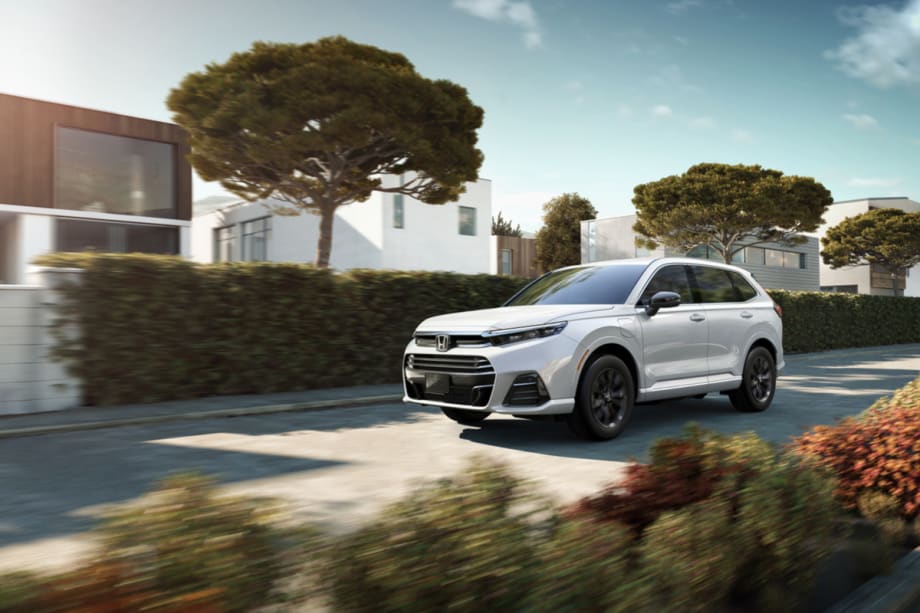
The 2025 Honda CR-V e:FCEV will be available for customer leasing in California beginning later this year. It qualifies for single-occupant California HOV lane access to reduce commute times for fleet drivers.
Photo: Honda
6 min to read
Honda has revealed the first built-in-America production plug-in hydrogen fuel cell electric vehicle, the 2025 Honda CR-V e:FCEV.
The compact crossover received a 270-mile EPA driving range rating, the automaker noted in a news release. The CR-V e:FCEV combines an all-new U.S.-made fuel cell system along with plug-in charging capability designed to provide up to 29 miles of EV driving around town with the flexibility of fast hydrogen refueling for longer trips.
The 2025 Honda CR-V e:FCEV will be available for customer leasing in California beginning later this year. It qualifies for single-occupant California HOV lane access to reduce commute times for fleet drivers.
“Leveraging Honda fuel cell technology expertise continues to play a critical role in our global goal to achieve carbon neutrality for all products and corporate activities by 2050,” said Mamadou Diallo, senior vice president of Auto Sales, American Honda Motor Co. “Honda has laid out an electrification strategy leading to 100% zero-emission automobile sales by 2040, including the introduction of both battery-electric and fuel cell electric vehicles like this new CR-V e:FCEV model.”
Combining the Power EV and Hydrogen Fuel Cell Technology
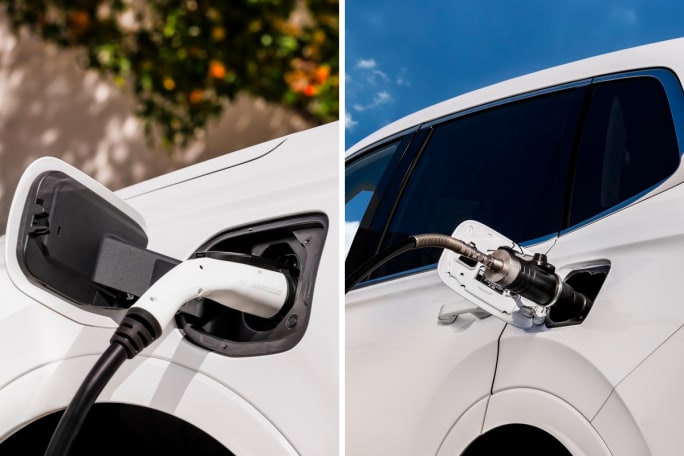
The Honda CR-V e:FCEV combines a fuel cell system with plug-in charging capability (left) to deliver EV driving around town and fast hydrogen refueling (right) for longer trips.
Photo: Honda
Standard features include HondaLink with expanded capabilities including hydrogen station information in addition to charging and power supply data.
The included Honda Power Supply Connector utilizes a 110-volt power outlet that can deliver up to 1,500 watts of power, turning CR-V e:FCEV into a clean power source capable of running small home appliances, portable air conditioners, power tools, camping equipment, and more.
The CR-V e:FCEV has an estimated power output of 92.2 kW.
Honda Making Moves in the Hydrogen Fuel Cell Space
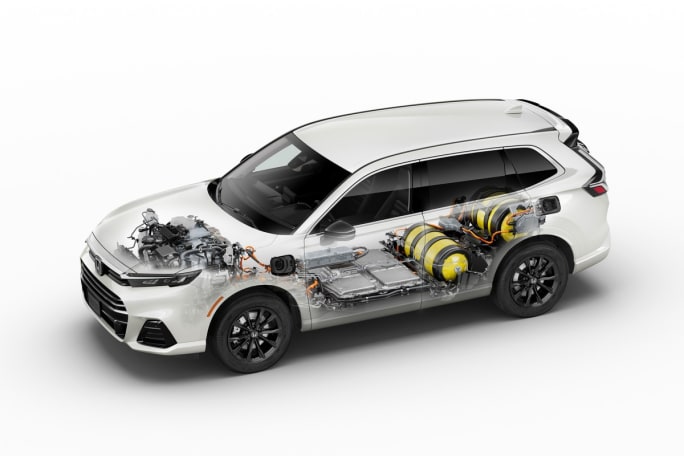
The 2025 CR-V e:FCEV has a front-mounted single-motor producing 174 hp and 229 lb.-ft. of torque delivers quick acceleration and maximum efficiency.
Photo: Honda
According to Honda, its market experience with hydrogen fuel cell vehicles began with introduction of the Honda FCX in December 2002, the world's first zero-emission fuel cell electric vehicle (FCEV) to receive certification for everyday use from both the U.S. Environmental Protection Agency (EPA) and the California Air Resources Board (CARB), as well as the first FCEV leased to individual customers.
The 5-passenger crossover is the first application of the second-generation Honda Fuel Cell Module, which is produced at Fuel Cell System Manufacturing in Michigan, offering improved durability, higher efficiency, increased refinement and lower cost compared to Honda’s previous generation fuel cell system.
The CR-V e:FCEV is built at Honda’s Performance Manufacturing Center in Marysville, Ohio, and is the only fuel cell electric passenger vehicle made in America.
Co-developed with General Motors, the next-generation Honda Fuel Cell Module leverages the knowledge, know-how, and economies of scale of both companies and will reduce the cost by two-thirds compared to the cost of the fuel cell system in the Honda Clarity Fuel Cell.
This cost reduction was achieved by various measures including the adoption of innovative materials for electrodes, advancement of a cell sealing structure, simplification of the supporting equipment and the improvement of productivity, the automaker noted.
Moreover, the durability of the system has doubled by the application of corrosion-resistant materials and controlled suppression of deterioration, and low temperature performance was also improved significantly.
Honda will offer CR-V e:FCEV as a single Touring model with standard features including:
2nd-generation Fuel Cell Module
270 mile zero-emission EPA driving range rating
Plug-in Level II charging capability designed to provide an up to 29 miles of battery electric range (EPA estimated)
10.2-in. digital instrumentation
9-inch HD touchscreen
Wireless Apple CarPlay & Android Auto compatibility
Wireless phone charging (Qi)
Four selectable drive modes, including Snow and Sport
Honda Sensing system
Keeping with the Design of the CR-V
Distinctly styled from CR-V turbo and hybrid models, the exterior design of the Honda CR-V e:FCEV features new body panels forward of the A-pillar, unique designs for the liftgate, rear fascia and large 18-in., 10-spoke black wheels.
The crossover has a new low upright grille design and long hood. Its signature vertical taillights make the zero-emissions variant recognizable as a CR-V from the rear.
To maximize driving range, aerodynamic performance has been further optimized with a full floor undercover and unique front spoiler and strake.
Inside, the Honda CR-V features a large cabin space and cargo capacity. Designed with comfort in mind, the vehicle has power adjustable heated front seats, heated steering wheel, dual zone climate control, hands-free access power tailgate, parking sensors, and sustainable materials including bio-based leather seat upholstery.
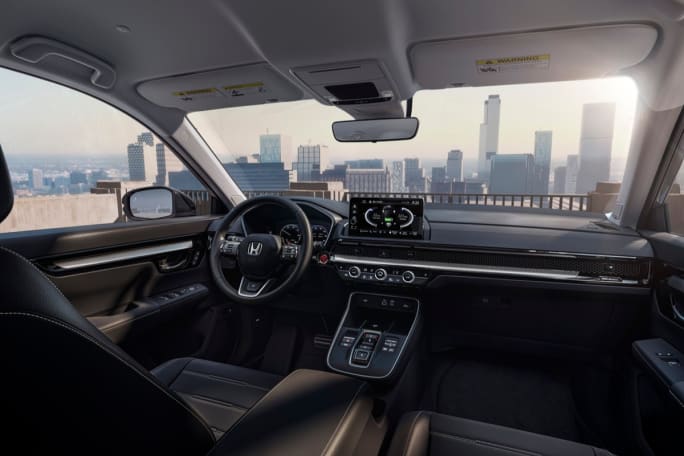
The interior has power adjustable heated front seats, heated steering wheel, dual zone climate control, hands-free access power tailgate, parking sensors, and sustainable materials including bio-based leather seat upholstery.
Photo: Honda
The new CR-V e:FCEV comes standard with the same safety technologies as other CR-Vs, including Advanced Compatibility Engineering (ACE) architecture and the Honda Sensing suite of safety and driver-assistive technologies.
Power and Dynamics
The 2025 CR-V e:FCEV has a front-mounted single-motor producing 174 hp and 229 lb.-ft. of torque delivers quick acceleration and maximum efficiency.
The CR-V e:FCEV structure and suspension will deliver the same sporty driving experience and refinement as other CR-V models.
Compared to CR-V turbo and hybrid models, rear lateral rigidity is increased 10%, rear torsional rigidity has improved 9% and its MacPherson strut front suspension and multilink rear suspension have been completely retuned with specific springs, amplitude-sensitive dampers, and stabilizer bars front and rear to optimize responsiveness while maintaining a smooth ride.
Drivers can customize the driving experience with four selectable drive modes: Normal, Eco, Sport, and Snow.
Furthering the Hydrogen Business
Working toward meeting the growing needs of fleets and states with carbon-neutral goals, Honda will not only continue electrifying its products but also plans to take a proactive approach to increase the use of hydrogen as an energy carrier in an effort to expand its hydrogen business.
Honda has identified four core domains for the initial utilization of its new fuel cell system:
FCEVs
Commercial fuel cell vehicles
Stationary power stations
Construction machinery
Working Toward Sustainability at Honda
While initial FCSM production will be used in support of Honda internal initiatives and FCEV sales, the automaker noted it is also exploring external fuel cell business opportunities with a goal to begin external deliveries of the fuel cell system modules in the near future.
The company envisions initial sales of 2,000 units per year and then expanding sales in stages.
Honda began demonstration testing of a stationary fuel cell power station on its Torrance, California, campus in March 2023, marking the company’s first step toward future commercialization of zero-emission backup power generation.
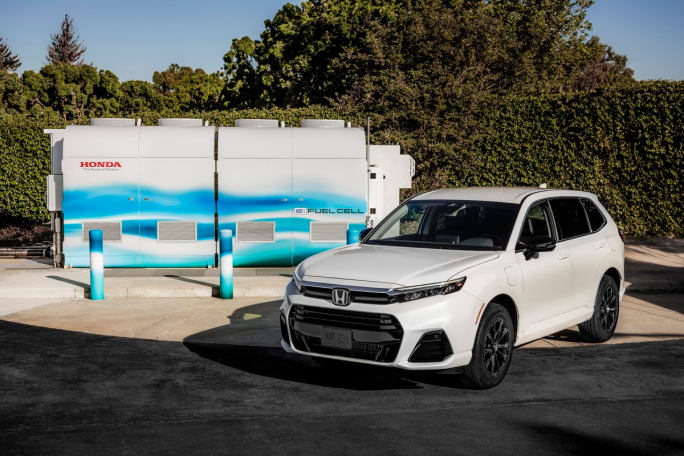
Honda began demonstration testing of a stationary fuel cell power station on its Torrance, California, campus in March 2023.
Photo: Honda
The fuel cell power station supplies clean and quiet emergency backup power to Honda’s data center. In December 2023, Honda also announced a similar joint project in Japan where Honda will establish a stationary fuel cell station to power a Mitsubishi data center.
Future stationary fuel cell (FC) units intended for commercialization will utilize the new Honda FC system. In the coming years, Honda will begin applying stationary FC power station technologies now under development – featuring a next-generation FC system with further cost reduction and improved performance – to Honda facilities and data centers globally.
Heavy-Duty Fuel-Cell Trucks
In the area of commercial vehicles, the GIGA FUEL CELL, a zero-emissions fuel cell-powered heavy-duty truck currently being co-developed by Isuzu Motors Limited and Honda Motor Co., Ltd. was shown for the first time at the Japan Mobility Show 2023.
In addition to conducting joint research on fuel cell heavy-duty trucks, the two companies began demonstration testing of a prototype model on public roads in Japan in December 2023, and plan to introduce the production model to market in 2027 by fully leveraging the technology, experience and knowledge gained through the joint research.
Moreover, Honda is preparing a proof-of-concept Class 8 hydrogen fuel cell truck in the U.S. and is in talks with potential customers.
Powering Construction Equipment
Honda also intends to apply its fuel cell system to construction equipment such as excavators and wheel loaders, contributing to the realization of carbon neutrality for construction machinery.
Honda is conducting advanced research and development of hydrogen technologies while envisioning use in outer space, another potential area where hydrogen technologies such as a fuel cell system and high differential pressure water electrolysis technologies can be utilized.
In addition to water and food, people need oxygen, as well as hydrogen for fuel and electricity for various activities supporting life in space.
More Vehicle Research
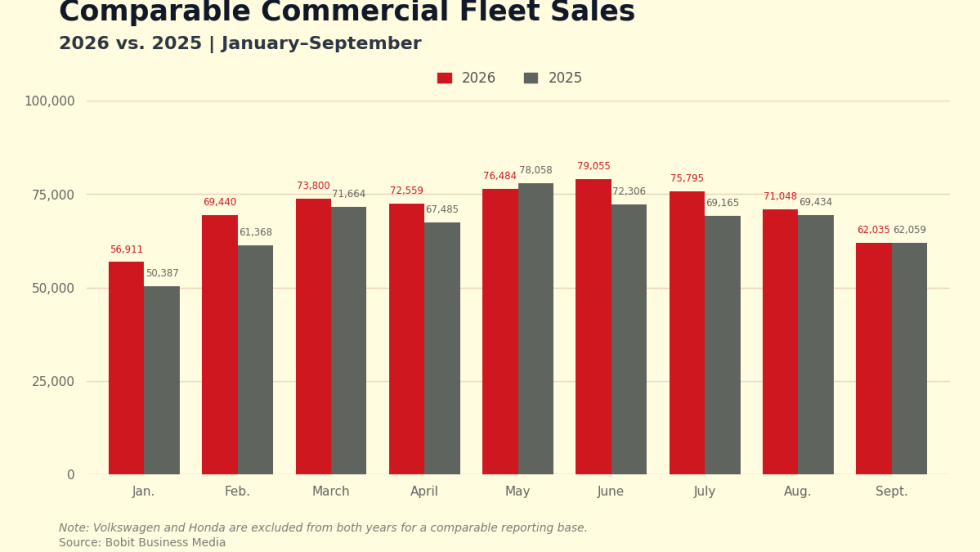
Commercial Fleet Sales Rise 5.8% Through September 2026
September commercial fleet sales were essentially unchanged from a year earlier, slowing year-to-date growth while keeping volume ahead of 2025.
Read More →
Hall of Fame Inductee: John Dmochowsky
The longtime Mondelēz International fleet executive joins the Automotive Fleet Hall of Fame.
Read More →
Hall of Fame Inductee: Lee Miller
After more than four decades at Boehringer Ingelheim, Lee Miller leaves a legacy built on fleet expertise.
Read More →
Hall of Fame Inductee: Mark F. Petersen
From managing fleets of thousands of vehicles to advancing safety and mentoring fellow professionals, Mark F. Petersen made his mark across both the corporate and supplier sides of fleet.
Read More →
When Charger Downtime Becomes a Fleet Availability Problem
As EV deployments move beyond pilot programs, charger reliability can directly affect vehicle readiness, driver productivity and route scheduling.
Read More →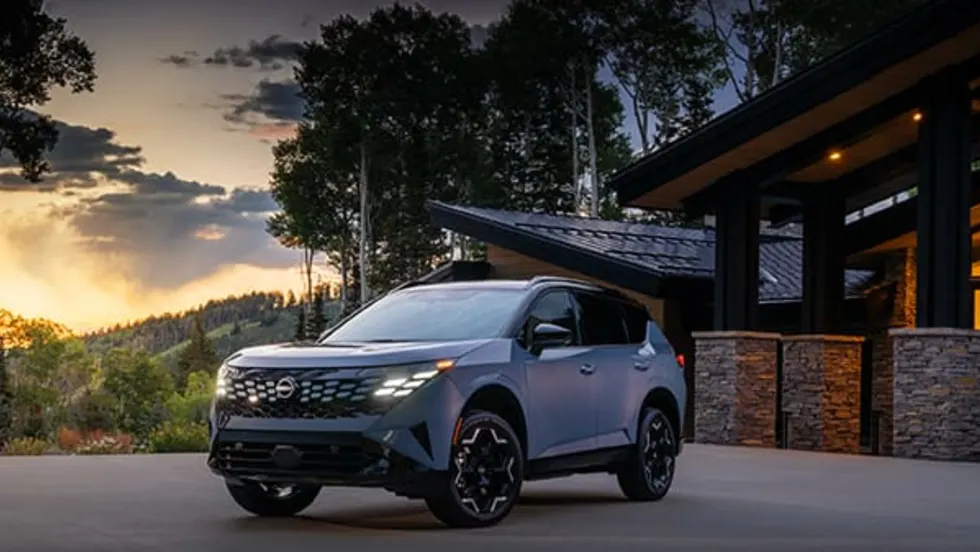
2027 Nissan Rogue Hybrid Adds e-POWER, Standard AWD
The new Rogue Hybrid uses Nissan’s e-POWER system with dual electric motors, offers an estimated 40 mpg and starts at $35,490.
Read More →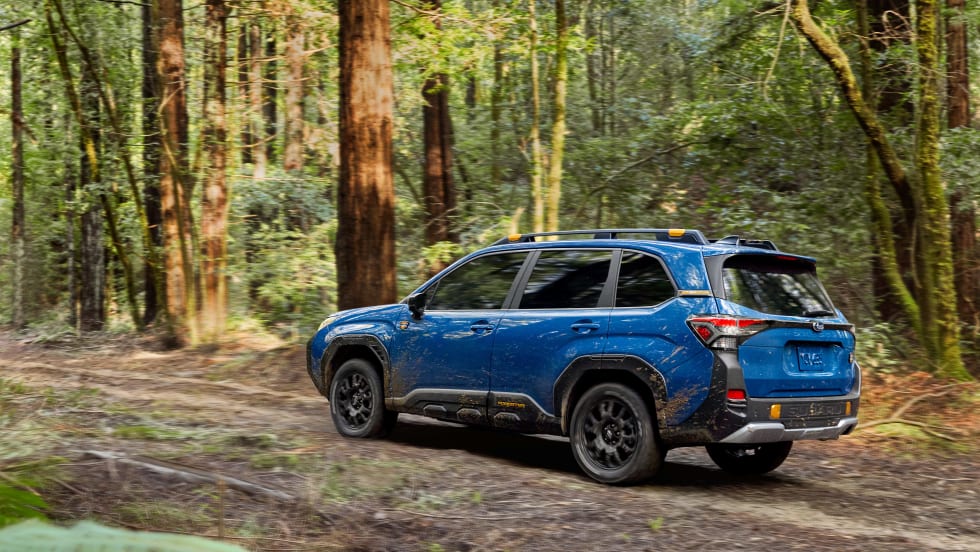
2027 Subaru Forester Adds First Wilderness Hybrid
The 2027 Forester lineup starts at $29,995 and adds a Wilderness Hybrid with 194 combined horsepower and 9.3 inches of ground clearance.
Read More →
EV Realty Names Henrik Holland President as Charging Platform Expands
The former Prologis Mobility and Shell executive will help expand EV Realty’s truck charging business and move its power-first infrastructure model into autonomous vehicle depots and other fleet sectors.
Read More →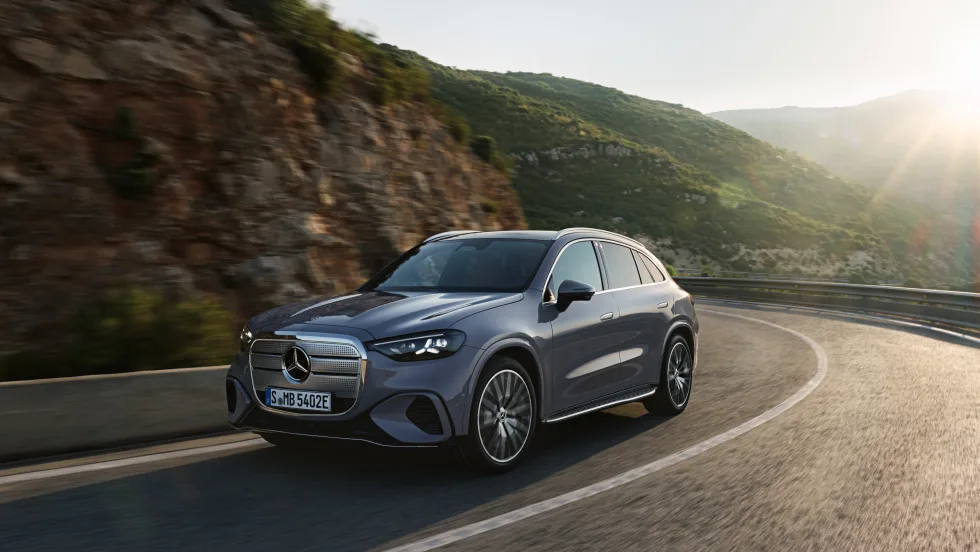
Mercedes-Benz Introduces Electric GLC With Up to 350 Miles of Range
The GLC 400 4MATIC Electric features an 800-volt architecture, 330-kW DC fast charging and a 94-kWh battery, along with Mercedes-Benz's new MB.OS operating system.
Read More →
Fleet Has a Talent Pipeline Problem, not a Talent Problem
Where will the next generation of fleet leaders come from, and what does the industry need to do differently to find them?
Read More →