





Keep Reading! 11 Fleet Managers Describe Challenges, Opportunities for 2026
When Cars Stop Updating but Don’t Stop Driving
When the US’s largest EV manufacturer discontinues a model, it gives me pause to consider the software that drives it.
February 9, 2026
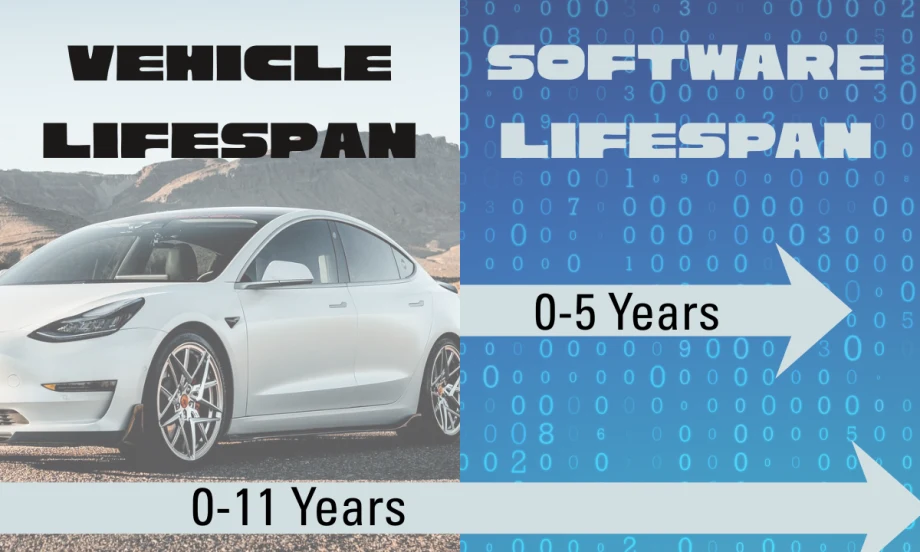
Vehicles may last a decade or more, but the software that defines them often has a much shorter life span.
Credit: Automotive Fleet
5 min to read
For years, OEMs have touted vehicles as “computers on wheels.” And today, all OEMs are so dependent on software that their vehicles can’t operate without it. This is especially pertinent to the largest electric vehicle manufacturer in the U.S., which recently announced plans to discontinue two of its popular models. But this isn’t the only story here. It’s the clearest case study of a much bigger question the industry hasn’t answered yet: what does “support” mean when the vehicle is software-defined?
Remember how Tesla addressed concerns about the battery's height above the road if debris hit the underside and caused a fire? It pushed an over-the-air (OTA) update to adjust the air suspension to increase ground clearance at highway speeds.
Moving forward, what are Tesla’s obligations to S and X owners?
How Software Makers Manage Support
When Microsoft or Apple discontinues an operating system, they have a policy on how long they will support customers.
Once a Microsoft operating system reaches the end of support, customers no longer receive technical assistance, software updates, or security fixes. Support for Windows 10, which was introduced in 2015, ended in October 2025. Apple typically provides security updates for the latest three major releases of its operating system. When a new macOS version is released, the previous version typically stops receiving security updates. This can be in as little as five years.
Five to 10 years of service is pretty good in the software world, as the life of a laptop or mobile device isn’t usually longer than five years these days.
But vehicles have an average lifespan of 11 years; what happens when a car manufacturer discontinues a model?
Vehicle OEM Obligations for Software Support
Here’s what I believe should be the OEM logic as it relates to obligations under warranty, and it’s something most of us haven’t really grasped:
Core vehicle operation: indefinite for the life of the vehicle
Safety defects: lifetime recall obligation
Emissions software: mandated warranty period
Feature updates: warranty period only
Infotainment & apps: discretionary due to changes by third parties
Cloud services: discretionary with notice
Under U.S. law, an OEM’s clear legal duty is tied to warranties that cover defects in materials and software that affect operation. Software bugs that impair functionality must be fixed. OTA updates are often the mechanism for compliance, not the obligation itself. Once the warranty ends, there is no general duty to continue feature updates or to improve or modernize the software.
Safety and emissions rules create limited post-warranty duties. If a software defect creates a safety risk, the OEM must issue a recall and provide an OTA or dealer-installed fix. They must do so regardless of vehicle age or warranty status. The obligation is lifetime only for that defect, not ongoing support.
With respect to emissions compliance, OEMs must maintain emissions-related software functionality and honor federally mandated emissions warranties (often eight to 15 years for specific components). Emissions compliance does not mean full support, and of course, it certainly doesn’t apply to an electric vehicle model.
There is no U.S. law requiring “lifetime software support,” unlike parts-availability rules (which do exist in some states and countries). The U.S. does not require continuous OTA updates, OS upgrades, app compatibility, cloud-service continuation, infotainment, or UI updates.
Once a model is discontinued, the OEM may freeze software at its last stable version. Buyer beware: servers may eventually be shut down (with notice), and features that depend on connectivity may degrade or stop. This is why discontinued models sometimes lose navigation updates, apps, or other streaming features.
Moving forward, we must continually ask: What software support obligations do automakers actually owe vehicle owners under U.S. law?
Legal Requirements for Software Support
So, what about cars whose owners’ satisfaction is defined by the software user experience? This is where it gets interesting.
For all vehicles, the legal standard for software support is that the vehicle must continue to operate safely and substantially as sold. That means core driving functionality must remain intact, and safety systems must function properly.
While the OEM cannot intentionally brick a vehicle post-sale, the OEM can stop feature evolution, end cloud services (if disclosed), sunset apps and integrations, and limit updates to critical fixes only. This is why modern OEM terms now explicitly say “Connected services may change or be discontinued at any time.”
There is an interesting contrast in Europe. The EU is moving faster than the US to protect vehicle owners. In parts of Europe, “digital elements” in goods must be supported for a “reasonable period.” Software updates tied to product functionality are increasingly subject to regulation.
What is the legal standard for software support once a vehicle is sold?
Why This Matters for Fleet, Remarketing, and Resale
For fleet managers, remarketers, and government buyers, software longevity is quickly becoming a line-item risk, not a tech curiosity.
Residual values increasingly depend on software viability. Buyers assume “modern car = ongoing updates.” Sure, this may not affect fleet managers who exclusively keep their fleets up to date and within warranty; however, it may well affect your residual values.
Expect this to become a major disclosure issue in wholesale and government fleets over the next five to 10 years. Join me at the Conference of Automotive Remarketing in Cleveland, April 15-16, where we will discuss this topic and other critical areas affecting residual values—and how we can collectively address them.
In the meantime, we’ll keep an eye on Tesla’s statements on how it will support updates to Model X and Model S.
The industry has figured out how to sell vehicles as software platforms. Now it has to decide how long it’s willing to stand behind them.
Subscribe to Our Newsletter
More Blog Posts

AI Is the Trojan Horse
The greatest risk of AI isn't what it knows. It's what we stop doing ourselves.
Read More →
Is This Theft Disguised as Training?
If AI is still “training,” why is it already publishing, summarizing, and profiting from the work of creators? In this provocative Insight Lane column, Colin Sutherland challenges the industry’s most convenient narrative—and asks a simple question: when does training become extraction, and why is credit still optional?
Read More →
How China Quietly Reduced Its Dependence on Oil (And What Fleets Should Learn)
China didn’t just bet on EVs. It used them to cut oil dependence at scale. Here’s what that strategy reveals and why smart fleets should be paying attention.
Read More →
The Cart is Pulling the Horse
Here's why software features shouldn’t be allowed to dictate your business goals.
Read More →
The Story of 2025: Outsourcing Accountability
The fleet world has been transformed by technology, so a choice must be made: how do we discern when to use AI and when not to?
Read More →
The 250-Year-Old Fleet Manager: Quartermasters & Wagon Masters of the American Revolution
“Fleet manager” wasn’t a title then, but Quartermasters and Wagon Masters lived the job on the road to independence.
Read More →
The New Reality of Disaster Preparedness
When disaster strikes, every second matters. From must-have Grab & Go essentials to lessons the fleet community is sharing right now, this piece explores what real preparedness looks like and why waiting until the last minute is no longer an option.
Read More →