




What's Best Handled by an FMC, and What's Better Done Directly?
Fleet managers continue to rely on FMCs for essential services but are taking a closer look at where working directly with suppliers can improve efficiency and responsiveness.

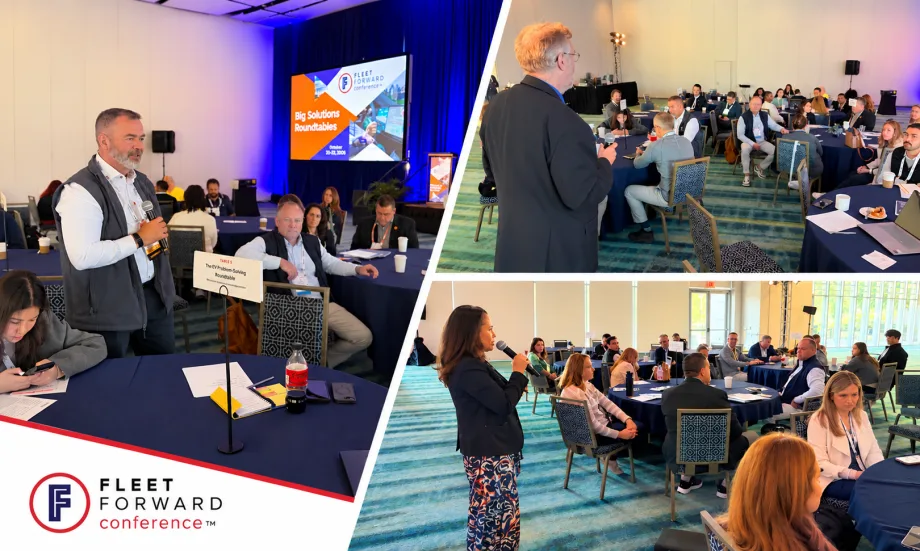
Attendees to the 2026 Fleet Forward Conference exchange ideas during the Big Solutions Roundtables. One discussion explored which services fleets prefer to keep with their FMCs and which may benefit from direct supplier relationships.
Automotive Fleet
- Fleet managers still depend on FMCs for essential services, highlighting their central role in fleet operations.
- There is a growing trend among fleet managers to assess direct engagements with suppliers to enhance efficiency.
- Evaluating direct supplier relationships might offer improved responsiveness for fleet managers.
*Summarized by AI
Fleet management companies (FMCs) remain essential partners for many commercial fleets. But fleet managers are increasingly asking whether every service needs to be handled through the same provider.
That was a central theme of a roundtable discussion Diana Holland, founder and managing director of Cavis, facilitated at the 2026 Fleet Forward Conference.
Across three rotations of fleet managers, participants discussed the strengths of their FMC partnerships, the services they sometimes prefer to manage directly, and the trade-offs involved in working with specialized providers.
Where FMCs Deliver the Most Value
Participants generally agreed that FMCs continue to provide significant value in access to capital and financing, factory ordering, and fuel management.
These services benefit from the FMC's scale, established processes, and buying power. Participants expressed little interest in moving them elsewhere. Other services generated more debate.
Stock vehicle acquisition was one example. Fleet managers with established dealership relationships said they could sometimes locate vehicles faster by working directly with dealers rather than going through their FMC.
Title and registration services were another frequent source of frustration. Participants described delays and paperwork challenges, although some acknowledged that their own drivers and internal processes contributed to the problem.
Toll management also came under scrutiny, particularly when administrative fees appeared disproportionate to the underlying toll. One example raised during the discussion involved a $5 fee on a $1.50 toll.
Remarketing and accident management were additional areas where participants saw potential advantages in working with specialized providers.
Maintenance management was less clear-cut. Some fleets preferred handling it themselves, while others believed their FMC provided better service than they could achieve independently.
Speed and Specialization Drive Decisions
Across the discussion, speed emerged as a recurring reason for reconsidering bundled services.
But Holland's notes highlighted another important consideration: The right sourcing decision depends heavily on the experience and resources of the person managing the fleet.
A fleet manager with strong dealer relationships and vehicle acquisition experience may be well positioned to handle stock purchases directly. Someone without that network may be better served by an FMC.
Participants also discussed the importance of measuring supplier performance. Vendor scorecards and regular meetings can help fleet managers identify service problems, resolve outstanding issues, and hold providers accountable.
One participant described using weekly meetings and a tracking system to manage outstanding issues with his FMC.
Unbundling Comes with Its Own Costs
Moving services outside an FMC doesn't automatically make fleet operations more efficient.
Additional providers mean more contracts, invoices, integrations, and relationships to manage. Fleet managers also become responsible for coordinating services that previously operated within a single organization.
Participants noted that independent providers may offer shorter contracts and greater flexibility than traditional bundled agreements.
The discussion also touched on how artificial intelligence could eventually make it easier to work across multiple supplier platforms. Rather than relying on a single system, AI agents might retrieve information and coordinate tasks across different providers.
For now, that remains an emerging possibility rather than an established operating model.
The larger takeaway from the roundtable wasn't that fleets should move away from their FMCs. It was that the partnership can be strengthened by periodically reassessing which services are best delivered through an FMC and which may benefit from a more specialized approach.
For fleet managers, the question is how to leverage an FMC's scale and expertise while maintaining the flexibility to meet their organization's specific operational needs.
Quick Answers
An FMC, or Fleet Management Company, provides services to manage a fleet of vehicles, including maintenance coordination, vehicle acquisition, financing, and fuel management.
*Summarized by AI
More Operations

Fleet Meets: Erin Gilchrist
Meet Erin Gilchrist, the inaugural Mike Antich Spirit of Fleet Award winner, as she shares insights on leadership, mentorship, the power of industry connections, and why people remain at the heart of fleet's future.
Read More →
How 2026 Fleet Visionary Jamie McKay Manages 2,400 Vehicles Across 37 States
How do you keep 2,400 vehicles running across 37 states? Fleet Visionary Award winner Jamie McKay shares how collaboration, flexibility, and a few simple strategies help her tackle fleet management challenges at Aptive Pest Control.
Read More →
Managing Fleet Costs in an Era of Permanent Volatility
Fleet operating costs have risen more than 20% since 2020, raising a key question: When does extending a vehicle's service life stop making financial sense?
Read More →

The Next Evolution of Fleet Management: Autonomous Operations
This opening keynote session at the Fleet Forward Conference highlights the future of autonomous driving for fleets.
Read More →
How to Reduce the Total Cost of Risk From Catalytic Converter Theft
A stolen catalytic converter can cost fleets far more in downtime and lost productivity than in repairs. A total-cost-of-risk approach can help fleet managers quantify their exposure and prioritize theft prevention.
Read More →
Personal-Use Charges Rise as Vehicle Values Fall | AF News Recap
Personal-use charges are climbing, wholesale used-vehicle values are declining, and commercial fleet sales growth is slowing. This week, we're breaking down the latest fleet data, plus how Element Fleet Management is helping Waymo prepare for its first Canadian robotaxi market.
Read More →
Here's When You Should Make an Exception to Fleet Policy
Fleet policies are designed to create consistency, but not every driver or situation fits neatly within standard rules.
Read More →
AI-Native or AI-Acquired: What Should Fleet Managers Look for in an AI Platform?
Six questions can help fleet managers look beyond AI marketing claims to evaluate integration, data access, and real-world operational performance.
Read More →
A buyer's guide to fleet management software in 2027
Buying fleet management software in 2027 means looking beyond features and price. As fleet operations, technology and expectations evolve, this guide explores what today’s fleet professionals should consider when choosing a system that can deliver value now and adapt to what comes next.
Read More →
What Will Shape the Next Era of Fleet Management?
EVs, AI, and autonomous vehicles are reshaping fleet management. Discover what’s ahead—and how fleet leaders can prepare for the next era.
Read More →