





Read On: How to Lay the Groundwork Before Your Next Fleet RFP
What Do Fleet Managers Say About Their FMCs?
This informal survey offers a snapshot into how fleet managers rate their fleet management companies across services. strategy, and satisfaction.
September 3, 2025
Two-thirds of fleet managers said their FMC platforms are user-friendly and intuitive, and more than 40% would be likely or very likely to recommend their FMC to a peer.
Automotive Fleet
6 min to read
How do fleet managers view the value they receive from their fleet management companies (FMCs)? This anonymous pulse check sets out to capture a directional snapshot of that relationship — where FMCs are seen as delivering value, where frustrations arise, and how those perceptions influence satisfaction and openness to change.
While not intended as a definitive industry benchmark, the findings provide insight into emerging themes that can guide fleets in their FMC relationships and help FMCs focus on the areas that matter most to their customers.
Automotive Fleet collected 55 fleet manager responses via an online form from July 16 to August 15, 2025. Many questions allowed open-ended responses to allow respondents to elaborate beyond the scores.
Respondent Demographics
Organization type: Over half (52%) of respondents came from corporate fleets; 30% identified as commercial fleets, and the rest split between utilities, government, and delivery/logistics.
Fleet size: About one-third manage 1,000 to 5,000 vehicles. 28% manage 100-499; 13% manage 5,000 or more; 13% manage 500-599; and 11% manage fewer than 100.
Vehicle mix: When ranked by count, light-duty pickups and vans topped the list, followed by passenger vehicles and then medium- and heavy-duty vehicles.
FMC usage: 48% use one FMC for all needs; 24% manage some needs with an FMC and others in-house, and 15% split fleet needs between multiple providers.
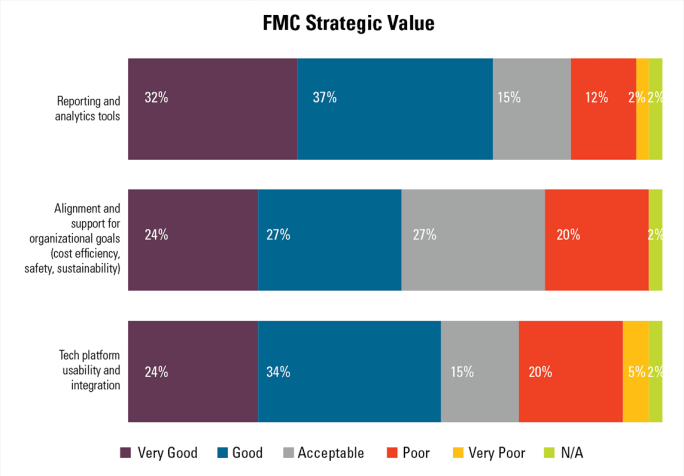
Regarding strategic value, the strongest ratings were given to reporting/analytics tools, while lower satisfaction was noted in tech platform and usability and alignment to organizational goals.
Source: Bobit Business Media Research
Core Services, Funding, and Financing
The six services assessed here are: funding and financing structures, vehicle acquisition, upfitting support, lifecycle cost management, compliance and safety, and vehicle disposal/resale support.
Among these, funding and financing stood out most clearly as a strength: nearly three-quarters rated their FMC positively, including 41% who rated it “very good” and 32% “good.” One respondent said, “Funding is absolutely critical and consistently handled well.”
Other areas reflected more diverse perspectives. Vehicle acquisition earned strong marks from 29%, who rated it “very good,” while another 24% rated it “good.” However, 37% described performance as “acceptable” or worse.
Upfitting support also showed a split, with about 24% rating it “very good” and 15% “good.” Yet 17% rated it “poor" or “very poor.” Lifecycle cost management landed in the middle, with 22% rating it “very good” and 32% rating it “good,” although more than a third (42%) found it merely acceptable or below. Compliance and safety reflected similar middling views, with 20% “very good,” 24% “good,” and over a third rated “acceptable” or worse.
Finally, disposal and resale support were more often described as “acceptable” (39%), with only 17% rating it “very good.” As one manager noted, “Vehicle resale values are not optimized — could do better.” Another said, “End-of-lease process takes too long.”
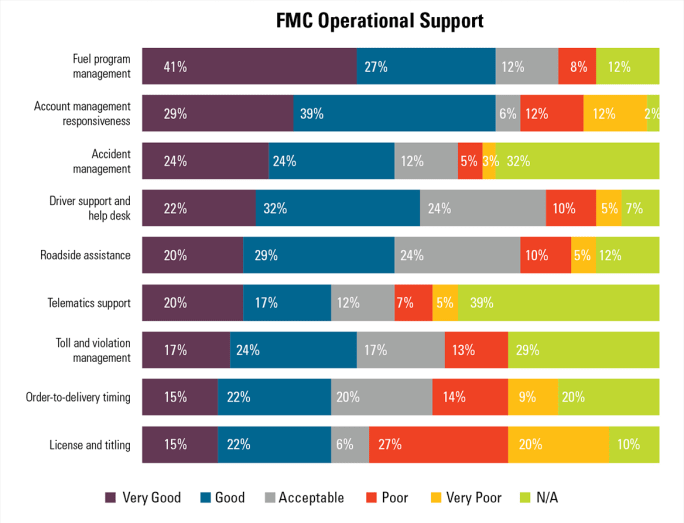
Fleet managers rate FMCs across nine areas of operational support, with fuel program management and account responsiveness receiving the highest marks, while order-to-delivery and license/titling lag.
Source: Bobit Business Media Research
Other Services and Operational Support
The operational support services assessed included fuel program management, account management responsiveness, accident management, driver support and help desk, roadside assistance, telematics support, toll and violation management, order-to-delivery timing, and license and titling.
Fuel program management emerged as a strength, with more than two-thirds of respondents rating it positively —including 41% who rated it “very good.”
Other services reflected more varied experiences across fleets. Account management responsiveness received strong “good” ratings (39%), paired with 29% offering “very good.” Accident management was also recognized, with about half of respondents rating it positively, though many noted it as an area that doesn’t apply to their operations.
Services such as driver support and help desk, and roadside assistance drew mixed assessments. Roughly half rated them “good” or “very good,” while 24% placed them in the “acceptable” range and 15% in the poor or very poor range.
Meanwhile, several support services surfaced as opportunities for FMC to differentiate further. Telematics supports a wide spread of responses — 20% “very good,” 17% “good,” and 12% “acceptable,” though over a third indicated telematics was “not applicable.”
The services receiving the greatest percentage of “poor” and “very poor” marks in this area were toll and violation management (12% poor) and order-to-delivery timing (15% poor, 10% very poor), with license and titling (27% poor, 20% very poor) being the most problematic by far.
License and titling scored the lowest marks of any service assessed in this pulse survey. One fleet manager said bluntly:
“License and title is a mess.” Another added: “Ongoing issues with renewals, still waiting on titles from months ago.”
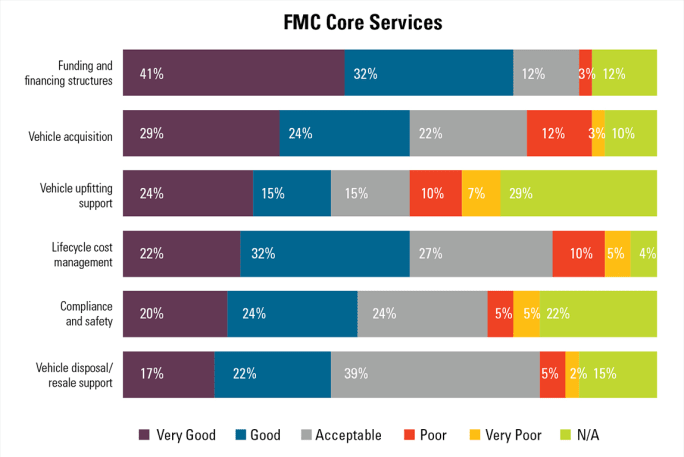
AF's performance snapshot reveals that fleet managers rated funding and financing as FMCs' strongest service, with acquisition, upfitting, and compliance landing in the middle, and disposal and resale support areas needing the most improvement.
Source: Bobit Business Media Research
Strategic Value
Strategic value was assessed in three areas: reporting and analytics tools, alignment and support for organizational goals, and tech platform usability and integration.
Among these, reporting and analytics tools stood out as the strongest performers. More than two-thirds of
respondents rated their FMC “good” or “very good.” One respondent noted: “Their reporting tools are strong and give us what we need.”
Responses varied regarding alignment with organizational goals such as cost efficiency, safety, and sustainability. Over half rated their FMC positively (51% “very good, or “good”), while roughly the same share described the performance as “acceptable” (27%) or “poor” (20%).
One fleet manager noted: “They’re reactive, not proactive. Nothing is done without our asking.”
Tech platform usability and integration landed in between, with nearly six in ten rating their FMC positively (24% “very good,” 34% “good”). At the same time, 20% described their experience as “poor.” One respondent noted: “FMCs forgot we were the customer — they take so long to set up and once you’re in, they all need to heavily step it up.”
Overall Satisfaction and Willingness to Switch
When asked to look back over the past five years, most fleet professionals reported that satisfaction with their FMCs has remained steady.
Nearly two-fifths (38%) said their satisfaction is “about the same,” while close to three in ten saw improvement (13% “much better” and 15% “slightly better”). A quarter felt their experience had declined slightly (25% “slightly worse”), - More than 40% would be likely or very likely to recommend their FMC to a peer.
Looking forward, fleets expressed a measured openness to reconsidering their FMC partnerships. Nearly half (45%) said they would not consider switching providers in the next 12–24 months. However, 38% said they would consider a switch during that timeframe, and another 18% were unsure.
The reasons were illuminated in the comments. One respondent praised their FMC’s team as “always responsive and helpful,” while another pointed to frustration: “They don’t take accountability — just lots of excuses.”
Accountability and Cost Partnership
Across several open-ended questions, a common theme was accountability. Some fleet managers credited their FMCs with readily owning mistakes. “Yes, they accept responsibility and work toward corrective action,” one said. Others felt remedies took too long or missed the mark: “Not really — they slow-walk fixes, and we end up waiting months.”
On cost mitigation, some said FMCs do “absolutely” help reduce costs, while others felt support was inconsistent: “Only when we push them” or “No, in fact they make it more difficult with their processes.”
Varied Experiences and Partnerships
These “pulse check” results reflect a spectrum of fleet manager experiences. Areas like funding and fuel programs earned consistently strong marks, while others, such as licensing, disposal, and strategic alignment, received more mixed reviews. It’s important to note that, just as no two fleets are alike, neither are the FMCs that serve them.
The findings here are not a blanket judgment on the industry, but a reflection on varied experiences across different partnerships.
The data and comments reflect the diversity of providers and the varied needs of the
fleets they serve.
Subscribe to Our Newsletter
More Operations
Here's When You Should Make an Exception to Fleet Policy
Fleet policies are designed to create consistency, but not every driver or situation fits neatly within standard rules.
Read More →
AI-Native or AI-Acquired: What Should Fleet Managers Look for in an AI Platform?
Six questions can help fleet managers look beyond AI marketing claims to evaluate integration, data access, and real-world operational performance.
Read More →
Sponsored•October 14, 2026
A buyer's guide to fleet management software in 2027
Buying fleet management software in 2027 means looking beyond features and price. As fleet operations, technology and expectations evolve, this guide explores what today’s fleet professionals should consider when choosing a system that can deliver value now and adapt to what comes next.
Read More →

What Will Shape the Next Era of Fleet Management?
EVs, AI, and autonomous vehicles are reshaping fleet management. Discover what’s ahead—and how fleet leaders can prepare for the next era.
Read More →
How Fleets Can Recruit and Train Veterans for Technician Roles
Here's how the technician shortage has affected uptime for fleets, and what to do about it.
Read More →
Avis Budget Group Deploys Neology Toll Management Technology Across Major Brands
Neology’s neoFleet platform will manage toll transactions and toll-authority operations for vehicles across Avis, Budget, Payless, Budget Truck and Zipcar.
Read More →
Fleet Personal-Use Charges Edge Higher in 2026
Nearly eight in 10 surveyed fleets allow personal use of company vehicles, while just over half of respondents report charging employees for the privilege.
Read More →
The Future of Fleet + What’s Changing Right Now | AF News Recap
Could developments overseas offer a preview of what’s coming for U.S. fleets? This week, we’re looking at the future of AI, autonomy, and electrification, plus Ford Pro’s new certified pre-owned program, smarter vehicle offboarding, and a new way for fleets to manage toll expenses.
Read More →
How to Handle Vehicle Offboarding
What do fleet managers need to do when a driver leaves?
Read More →
Sponsored•October 1, 2026
Fleet Manager’s Ultimate Playbook: Navigating the New Standard in OEM Connectivity
Rising operating costs, driver safety concerns, and unplanned downtime are putting unprecedented pressure on modern fleets. Discover how fleet managers use embedded OEM connectivity and real-time vehicle data to cut TCO, prevent downtime, and protect drivers without aftermarket telematics hardware.
Read More →