




NHTSA, USDOT Launch Safety Campaigns for 2024 Thanksgiving Week
Thanksgiving travel means crowded roads and celebrations like Blackout Wednesday. Plan ahead to stay safe and avoid impaired driving.

With enough time for preparation, you can ensure safe travels during the holiday. Celebrations start the Wednesday before Thanksgiving, alluding to the new nickname “Blackout Wednesday”.
Photo: Automotive Fleet
Millions will hit our nation’s roads this Thanksgiving week, eager to spend time with family and friends. It’s one of the year’s busiest travel times, so what does this mean for fleet drivers on the clock during the holidays?
For one, it means sharing the road with other motorists in a rush to get to their families for Thanksgiving. However, traveling on the road during the holidays is not always a bad experience for commercial fleets and commuters.
With enough time for preparation, you can ensure safe travels during the holiday. Celebrations start the Wednesday before Thanksgiving, alluding to a recently developed nickname “Blackout Wednesday”, also known as “Drinksgiving”.
The National Highway Traffic Safety Administration (NHTSA) and the U.S. Department of Transportation have created several ad campaigns, fact sheets with talking points, press releases, and formatted social media texts that can be used to promote road safety during the 2024 Thanksgiving week celebrations.
Buzzed Driving Is Drunk Driving
During the Thanksgiving holiday weekend, NHTSA is working diligently to remind drivers that “Buzzed Driving Is Drunk Driving.” Their goal is to assist traffic safety advocates and to educate the public on the dangers and consequences of impaired driving. Read the statistics below and help spread their lifesaving message:
In 2022, 100 drivers were involved in fatal traffic crashes on Thanksgiving Eve (6 p.m. November 23 to 5:59 a.m. November 24) and 184 fatalities during the Thanksgiving holiday period (6 p.m. Wednesday to 5:59 a.m. Monday).
From 2018 to 2022, 479 drivers were involved in fatal traffic crashes on Thanksgiving Eve.
30% (143) of those drivers involved were drunk, with a blood alcohol level of .08 g/ dL or higher.
The 21-34 age group had the highest percentage (38%) of drivers involved in fatal drunk-driving crashes on Thanksgiving Eve from 2018-2022.
Of all drunk drivers involved in fatal traffic crashes that occurred on Thanksgiving Eve from 2018-2022, 109 were males, and 25 were females.
From 2018-2022, over the entire Thanksgiving holiday, there were 833 fatalities in traffic crashes that involved at least one driver or motorcycle rider who was drunk.
Drive Sober or Get Pulled Over
Drunk driving endangers those behind the wheel, their passengers, and others on the road. Law enforcement partners know how to spot an impaired driver and will not hesitate to pull them over.
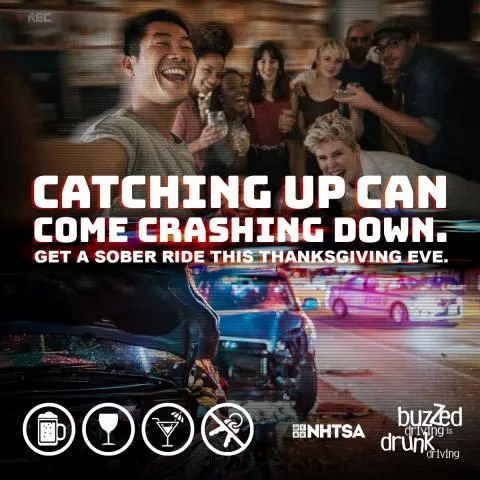
NHTSA provides sample social media posts for anyone to use on social platforms to help spread the word about making better choices when it comes to impaired driving.
Source: NHTSA
If you’re going to drink, plan for a sober ride. Several options are available to impaired drivers to help them get home safely. These include designating a sober driver, scheduling a taxi or rideshare service, or utilizing the sober ride program offered by their community.
The cost of a ride home is a small price to pay compared to the financial and legal consequences of a DUI or DWI, which can amount to thousands of dollars.
While the focus of the NHTSA’s campaign initiatives is to deter impaired driving, officers will also issue citations and make arrests during traffic stops for the following: speed, operating without a license, traffic sign/traffic light violations, seat belt violations, drug arrests, and criminal arrests.
The goal of increased law enforcement efforts during the holiday is not just to arrest impaired drivers. Their mission is to enhance public safety and prevent needless tragedies by discouraging people from making the dangerous decision to get behind the wheel while intoxicated.
If you have a friend who is about to drink and drive, step in. Take the keys away and help them get home safely. Motorists are encouraged to call 911 if they encounter an impaired or unsafe driver on the road.
Drinksgiving and Blackout Wednesday: A Pre-Holiday Phenomenon
Do you know about Drinksgiving? The Wednesday before Thanksgiving is one of the biggest bar nights of the year. It is understandable why this particular day before a holiday is a big night for bars. The majority of Americans have the day off on Thanksgiving.
Many return to their hometowns to visit families, and for college students, it’s often the first time they’re back in town since leaving for campus. The temptation to drink while seeing old friends, attending a reunion, or gathering together is high.
The term Blackout Wednesday comes from the blackouts or memory loss that can result from binge drinking, defined as four or more drinks in succession for women and five or more drinks in succession for men.
How Alcohol Affects Driving Ability
No matter how often you consume alcohol, even one drink can affect your driving ability; still, many drivers don’t understand the impacts that an increasing Blood Alcohol Concentration (BAC) can have. Despite the legal limit in most states being 0.08, research shows that having a BAC at even 0.02 can affect attention and judgment.
The NHTSA outlines the effects as such:
.02 BAC - some loss of judgment, a decline in visual functions (like tracking a moving target), and decreased multitasking ability.
.05 BAC - reduced coordination, difficulty steering, and lowered alertness, causing a reduced emergency response.
.08 BAC - short-term memory loss, poor muscle coordination, impaired perception, and reduced information processing.
.10 BAC - reduced ability to perform basic driving tasks like lane positioning and braking.
.15 BAC - significant vehicle control impairment, inattentiveness, and decreased visual and auditory processing.
The number one safe driving tip for the biggest drinking day of the year is to not get behind the wheel if you have been drinking. Research has shown that a driver with a BAC between .05 and .07 is 6 to 17 times more likely to be killed in a single-vehicle accident than a driver with a .00 BAC.
The 2024 Alcohol-Impaired Driving campaign will take place between Nov. 23-27, 2024. NHTSA encourages you to post leading up to and including Thanksgiving Eve while friends are reuniting and participating in celebrations that may involve alcohol.
Below are some relevant hashtags to use when posting about the campaign:
#BlackoutWednesday
#HappyThanksgiving
#BuzzedDriving
#ImpairedDriving
#Drinksgiving
By working with the NHTSA and their Blackout Wednesday Campaign, we can share their social media playbook, which includes specific content, assets, and instructions to address drivers and encourage them not to drive impaired.
Whether you’re commuting for work during the holiday or celebrating Thanksgiving Eve, Drinksgiving, or Blackout Wednesday, communication efforts during this time of the year may help save lives.
For more information, visit the NHTSA website.
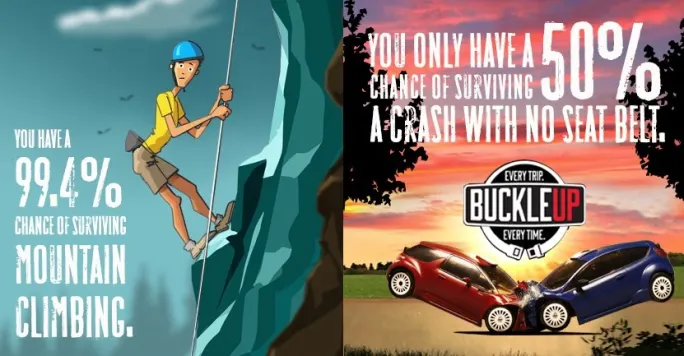
In addition to social posts on impaired driving, NHTSA offers year-round social norming campaigns on topics like seat belt use. Wearing a seat belt can be the difference in preventing a fatal car crash.
Source: NHTSA
Buckle Up. Every Trip. Every Time.
Although holiday celebrations may bring impaired driving and more dangerous roadways, to help combat fatal crashes, the NHTSA has a year-round social norming campaign focusing on seat belt use.
During the 2022 Thanksgiving holiday weekend alone (6 p.m. on Wednesday, November 23, to 5:59 a.m. on Monday, November 28), there were 326 passenger vehicle occupants killed in traffic crashes across the nation, and 43% (141) were unrestrained.
Regardless of whether alcohol or drug-impaired driving was a factor in these crashes, not wearing a seat belt proved to be deadly at any time of the day during the holiday weekend: 47% of those killed in nighttime crashes were unbuckled, and 38% of those killed in daytime crashes also were unbuckled.
Remember, one of the safest choices drivers and passengers can make is to buckle up. Seat belts are the best defense against impaired, aggressive, and distracted drivers.
Editor's Note: This article was originally published in November 2023 and was updated on November 22, 2024, for continued relevancy on alcohol-impaired driving statistics and safe holiday driving habits.
More Safety

Fleet Manager’s Ultimate Playbook: Navigating the New Standard in OEM Connectivity
Rising operating costs, driver safety concerns, and unplanned downtime are putting unprecedented pressure on modern fleets. Discover how fleet managers use embedded OEM connectivity and real-time vehicle data to cut TCO, prevent downtime, and protect drivers without aftermarket telematics hardware.
Read More →
From Driver Well-Being to EV Charging | AF News Recap
Mental health belongs in the fleet safety conversation. This week, we’re looking at five ways fleets can support employee well-being before a crisis, plus Holman’s expansion in Mexico, new one-day Fleet Forward passes, and why EV charging demand is outpacing infrastructure growth.
Read More →
Nexar-Nauto Merger Aims to Give Fleets Better Safety Intelligence Through Larger Driving Dataset
Stefan Heck tells Automotive Fleet that combining more than 10 billion miles of driving history with Nexar's AI models will give fleets deeper insights into driver risk and roadway conditions than either company could provide independently.
Read More →
Don't Wait for a Crisis: 5 Ways to Build Mental Health Into Your Fleet Safety Program
For Suicide Prevention Month, fleet and safety leaders have an opportunity to put mental health where it belongs: at the center of workplace safety.
Read More →
How Camera Data Can Strengthen a Fleet’s Insurance Renewal
Insights from a commercial insurance carrier and a broker show how fleets can turn video telematic data, driver coaching, and improved claims results into a stronger case at insurance renewal.
Read More →
The Safest Fleets Aren’t the Ones with the Most Technology
You’ve made the telematics investment. Here’s how to capture the other half of its value and build the safest fleet on the road.
Read More →
Hidden in Plain Sight: Fleet Compliance Risks
Fleet compliance isn't just about having policies — it's about consistently enforcing them. This practical guide reveals six hidden compliance risks common in public sector and shared fleet operations and outlines proven strategies to improve visibility, accountability, and audit readiness
Read More →
NETS Sets 2026 Fleet Safety Benchmark Conference for Indianapolis
The Sept. 15–17 program will feature fleet benchmarking data, case studies, emerging technologies, and implementation strategies while running alongside the NSC Safety Congress & Expo.
Read More →
Off-the-Job Crashes Account for 43% of Employers’ $61.7 Billion Crash Burden
NETS quantifies costs dispersed across fleet, risk, HR, and other departments while providing new per-crash benchmarks for employers.
Read More →
Ram Recalls More Than 1.27 Million 1500 Pickups for Seat Belt Anchor Issue
The recall affects certain 2019-2026 Ram 1500 pickups that may have improperly attached second-row seat belt buckle anchors.
Read More →