




Inaugural Survey Highlights Fleet Managers’ Top Challenges & Priorities
What keeps fleet managers up at night? They cite budget pressures, safety concerns, and compliance headaches as key issues for 2025.

Conducted between Jan. 7 and Feb. 2, 2025, the Fleet Manager Outlook Survey targeted managers of fleets across multiple industries.
Photo: Automotive Fleet
Welcome to the first-ever Fleet Manager Outlook Survey.
The survey, conducted by Automotive Fleet and Work Truck, gathered insights from 73 respondents who manage corporate and commercial fleets in the U.S.
Conducted between Jan. 7 and Feb. 2, 2025, the survey targeted managers of fleets across multiple industries. The results provide a snapshot of fleet managers’ top priorities, challenges, and emerging trends for the year ahead.
Looking at the overall results, fleet managers cited top concerns around rising fleet costs, increasing fleet safety, and managing evolving sustainability goals.
Respondent Demographics
Respondents’ fleet sizes ranged from one to 10 vehicles to more than 2,500 vehicles, with an average size of 1,050 units.
Survey respondents manage a diverse range of fleet types, with passenger vehicles making up the largest share (34%), followed by light-duty trucks (23%), vans (15%), medium-duty trucks (15%), and heavy-duty trucks (7%).
Though spread across a wide range of industries, construction/mining had 20% of the total share, followed by healthcare (17%) and then a long tail of industries including general freight (9%), manufacturing, utilities, retail, HVAC/plumbing, oil and gas, finance, and others.
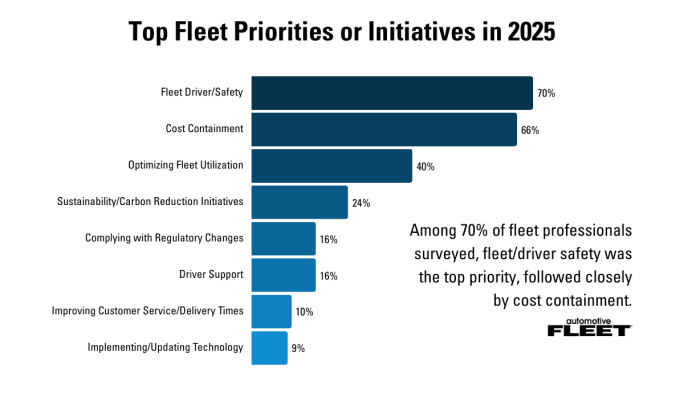
Among 70% of fleet professionals surveyed, fleet/driver safety was the top priority, followed closely by cost containment.
Source: Automotive Fleet
Leading Priorities: Fleet Safety and Cost Containment
What’s on fleet managers’ minds and how do those concerns translate to their to-do lists? When it comes to priorities and challenges, the perennial duo — safety and costs — take precedence.
Fleet and driver safety remains the top priority for 70% of respondents, followed closely by cost containment (66%). Optimizing fleet utilization came in third (40%) followed by sustainability/carbon reduction initiatives (24%).
Regarding top challenges, respondents identified a major aspect of safety — driver compliance with fleet policies (47%) — as number one.
New vehicle pricing (44%) and overall fleet safety (36%) also remain high on the list. Coming in at four and five, parts and maintenance spending (32%) and vehicle downtime (26%) are ongoing concerns, as supply chain disruptions continue to impact fleet operations.
In addition to top priorities, we also asked fleet managers to identify the priorities that are increasing in importance. Those were ordered slightly differently, with new vehicle pricing (43%) as the top increasing priority, followed by fleet safety/reducing crashes (40%) and parts and maintenance spend (33%).
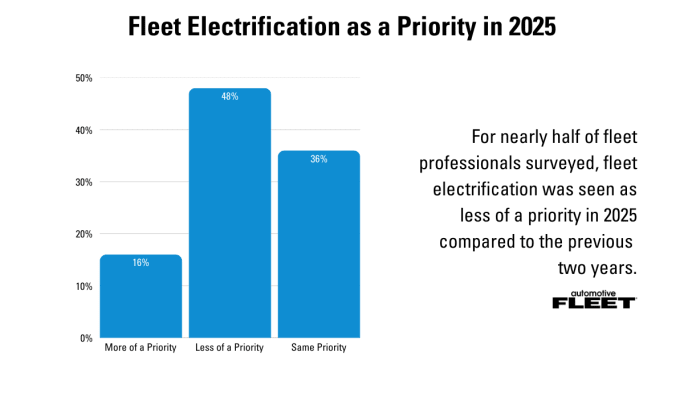
For nearly half of fleet professionals surveyed, fleet electrification was seen as less of a priority in 2025 compared to the previous two years.
Source: Automotive Fleet
Fleet Electrification Slows, Sustainability Efforts Shift
While fleet electrification continues to progress, nearly half (48%) of fleet professionals said electrification will be less of a priority in 2025 than in previous years. Only 16% identified electrification as more of a priority, while 36% said it remained the same.
The results regarding overall sustainability goals are mixed. A plurality (30%) of respondents said they are still actively pursuing sustainability goals within their set timeframe.
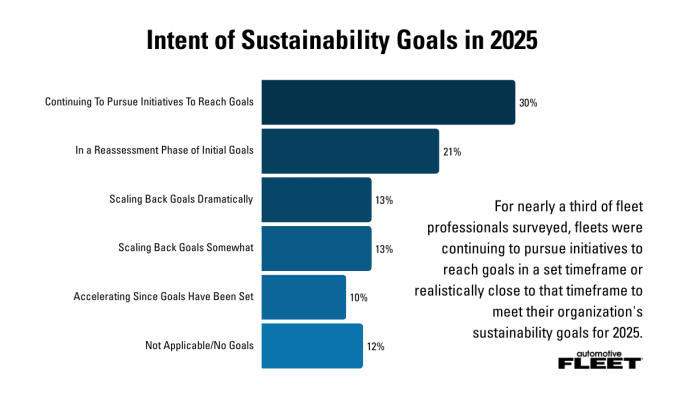
For nearly a third of fleet professionals surveyed, fleets were continuing to pursue initiatives to reach goals in a set timeframe or realistically close to that timeframe to meet their organization's sustainability goals for 2025.
Source: Automotive Fleet
Yet 47% said goals are under review: 21% are reassessing their initial targets (though goals haven’t changed), while 13% intend to scale their sustainability goals dramatically and an equal number (13%) indicated they are scaling back goals somewhat.
Only 10% said they’re accelerating their sustainability goals.
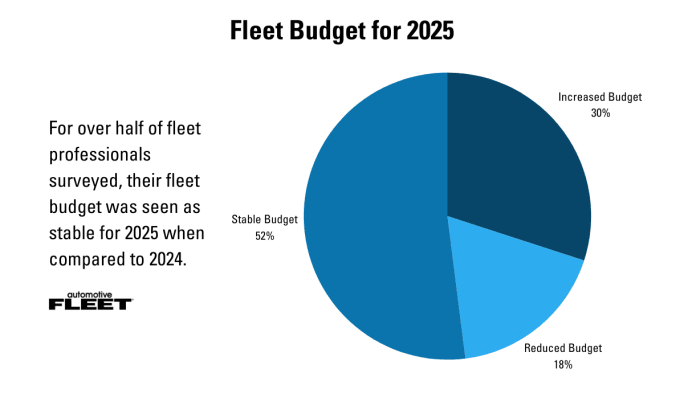
For over half of fleet professionals surveyed, their fleet budget was seen as stable for 2025 when compared to 2024.
Source: Automotive Fleet
Budget Stability & Job Challenges: A Mixed Outlook
Fleet budgets appear relatively stable, with 52% reporting no major changes compared to 2024, while 30% saw an increase and 18% experienced reductions.
Yet, not surprisingly, 62% indicated their job was more challenging than in previous years, and only 6% said it was less challenging.
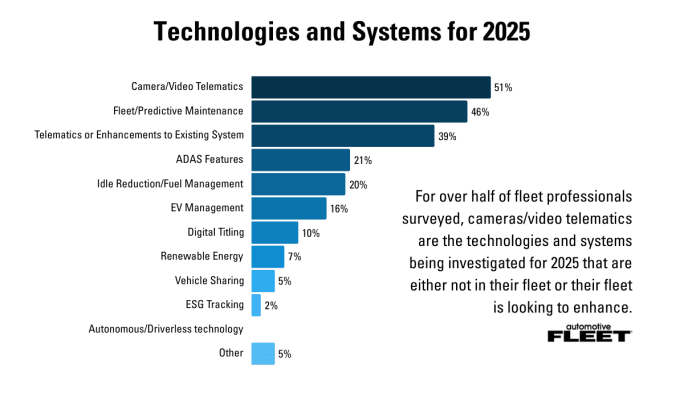
For over half of fleet professionals surveyed, cameras/video telematics are the technologies and systems being investigated for 2025 that are either not in their fleet or their fleet is looking to enhance.
Source: Automotive Fleet
Camera Integration Leads Technology Adoption
When asked about emerging technologies, 51% of fleet managers identified cameras and video telematics as the top tech interest for 2025.
Fleet maintenance, predictive analytics, and telematics enhancements are also being explored to reduce downtime and optimize operations.
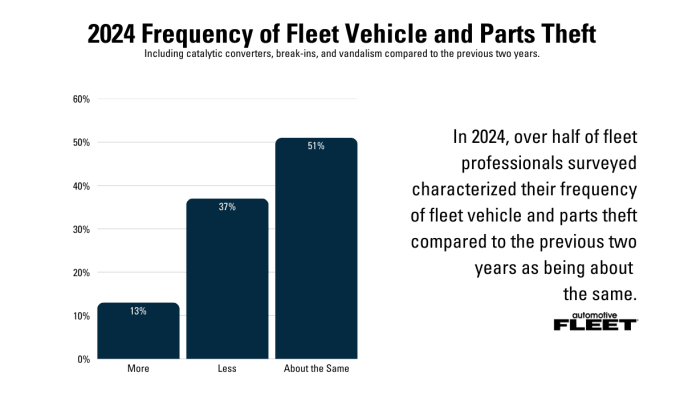
In 2024, over half of fleet professionals surveyed characterized their frequency of fleet vehicle and parts theft compared to the previous two years as being about the same.
Source: Automotive Fleet
Theft Challenges in Check
We also asked about vehicle and parts theft, break-ins, and vandalism.
More than half (51%) responded that theft has not grown in the past two years, while 37% reported fewer incidences and only 13% reported greater incidences.
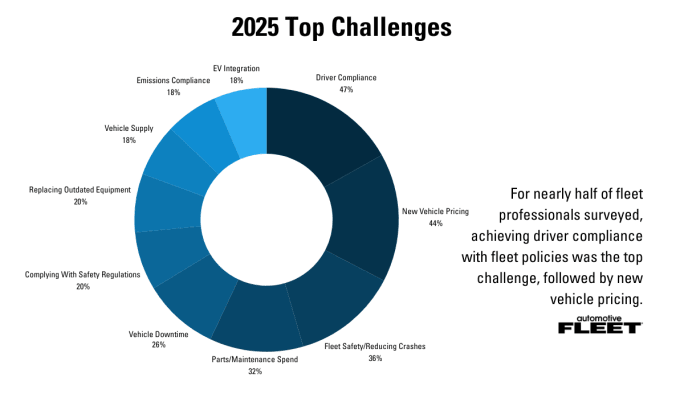
For nearly half of fleet professionals surveyed, achieving driver compliance with fleet policies was the top challenge, followed by new vehicle pricing.
Source: Automotive Fleet
Direct Feedback: What Keeps You Up at Night?
To finish the survey, we asked “What keeps you up at night?” as an open-ended question. Here are their verbatim responses sorted into six areas of concern:
1. Rising Costs and Budget Constraints
Fleet managers are grappling with increasing costs across multiple areas:
“Rising costs of purchasing vehicles along with a softening used car market is squeezing the budgets.”
“Fleet program cost optimization, meaning greater oversight of the variables such as fuel, transport, repairs, etc. Prioritizing reducing waste and using the cost savings to increase safety budget, premium vehicle selections.”
“Budget and emissions regulations.”
2. Safety and Accident Prevention
Fleet safety and liability are top concerns:
“Fear of that call that there was a catastrophic collision.”
“Driver safety and compliance.”
“Large liability verdicts that have little justification in driver or company actions.”
“Accidents and lack of quality drivers.”
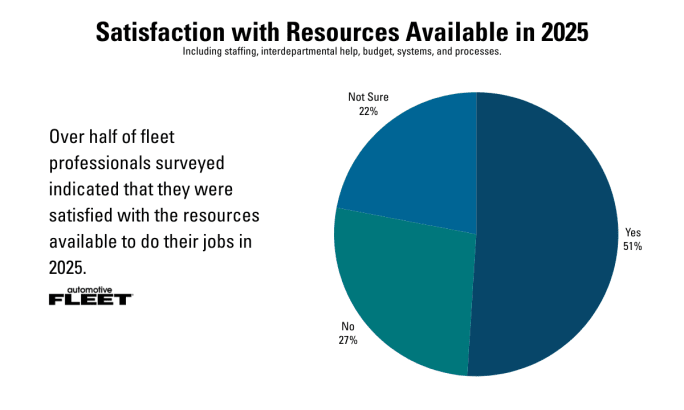
Over half of fleet professionals surveyed indicated that they were satisfied with the resources available to do their jobs in 2025.
Source: Automotive Fleet
3. Compliance and Regulatory Uncertainty
Meeting government-mandated emissions requirements remains a challenge:
“How do we meet state-mandated emission requirements when there is not a vehicle to do so, and I cannot downsize the vehicle?”
“DOT regulations.”
“The forced adoption of EVs in California was a huge concern throughout 2024 because we have a large fleet there and our vehicles go home with our drivers at night. Fortunately, it appears these disruptive anti-business regulations will not be implemented in the near term.”
4. Staffing and Workforce Shortages
Fleet managers struggle with hiring and retaining qualified staff:
“Finding qualified technicians.”
“Keeping my job! So many balls in the air and growing, resources everywhere (my company, FMC, third-party suppliers, etc.) are all overloaded.”
“Hiring more staff.”
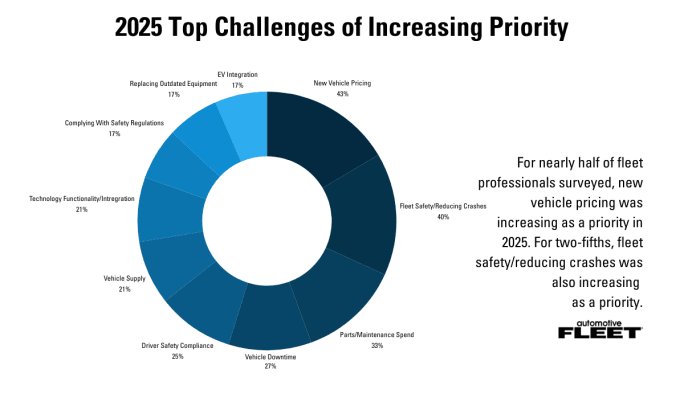
For nearly half of fleet professionals surveyed, new vehicle pricing was increasing as a priority in 2025. For two-fifths, fleet safety/reducing crashes was also increasing as a priority.
Source: Automotive Fleet
5. Supply Chain and Vehicle Availability
While supply chain conditions have improved, unpredictability remains in some areas:
“OEM supply chain issues, OEM cost increases, maintenance & parts cost and labor increases.”
“Timing of when to order new vehicles (OEMs are not consistent), allocation, availability.”
6. Administrative Overload
Some fleet managers feel stretched thin:
“Doing more with less. Not being able to create, initiate, and manage cost-saving in new programs due to administrative functions.”
“Keeping up with tasks and projects along with day-to-day admin tasks. Doing more with less.”
“Unrealistic company expectations.”
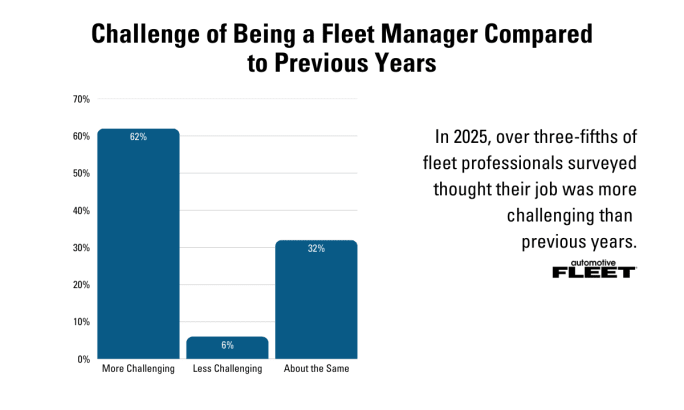
In 2025, over three-fifths of fleet professionals surveyed thought their job was more challenging than previous years.
Source: Automotive Fleet
Ever-Evolving Challenges
Fleet managers face a complex and evolving set of challenges in 2025, with cost pressures, safety, regulatory uncertainty, and staffing shortages dominating their concerns.
The results highlight the need for proactive cost management, improved safety measures, and more strategic workforce planning to mitigate risks and ensure fleet efficiency.
More Operations

How Fleets Can Recruit and Train Veterans for Technician Roles
Here's how the technician shortage has affected uptime for fleets, and what to do about it.
Read More →
Avis Budget Group Deploys Neology Toll Management Technology Across Major Brands
Neology’s neoFleet platform will manage toll transactions and toll-authority operations for vehicles across Avis, Budget, Payless, Budget Truck and Zipcar.
Read More →
Fleet Personal-Use Charges Edge Higher in 2026
Nearly eight in 10 surveyed fleets allow personal use of company vehicles, while just over half of respondents report charging employees for the privilege.
Read More →
The Future of Fleet + What’s Changing Right Now | AF News Recap
Could developments overseas offer a preview of what’s coming for U.S. fleets? This week, we’re looking at the future of AI, autonomy, and electrification, plus Ford Pro’s new certified pre-owned program, smarter vehicle offboarding, and a new way for fleets to manage toll expenses.
Read More →
How to Handle Vehicle Offboarding
What do fleet managers need to do when a driver leaves?
Read More →
Fleet Manager’s Ultimate Playbook: Navigating the New Standard in OEM Connectivity
Rising operating costs, driver safety concerns, and unplanned downtime are putting unprecedented pressure on modern fleets. Discover how fleet managers use embedded OEM connectivity and real-time vehicle data to cut TCO, prevent downtime, and protect drivers without aftermarket telematics hardware.
Read More →
U.S. Bank Adds Verra Mobility Toll Management to Voyager Fleet Platform
The integration allows U.S. Bank Voyager fleet customers to manage toll payments and violations alongside fuel, EV charging and maintenance expenses.
Read More →
ADAS Prevents Crashes. But Repairs Cost More | AF News Recap
ADAS-equipped vehicles may crash less often, but they can cost more when they do. This week, we’re breaking down what that tradeoff means for fleets, plus Subaru’s first Forester Wilderness Hybrid, Nissan’s new e-POWER Rogue, and why Calstart has become Catalyst Mobility.
Read More →
Moventum Fleet Management Names Mark Iorillo Head of Sales
Iorillo brings nearly 20 years of fleet management and sales experience to the role, including previous positions at Element Fleet Management, CEI, Donlen and Ryder.
Read More →
Fleet Has a Talent Pipeline Problem. What Comes Next? | AF News Recap
Where will fleet’s next generation of leaders come from? This week, we’re looking at the industry’s talent pipeline, what certification can add to a fleet career, how to build an award-worthy track record, and the return of Automotive Fleet’s Personal Use Survey.
Read More →