




See More: Navigating the Future: A Guide to Creating a Fleet Manager Succession Plan
Why Won't My Drivers Do What I Need Them to Do?
To avoid common mistakes that don’t promote changes in behavior, managers must understand that change is needed at every level, not just with the drivers.
by Matthew Betz
May 6, 2024
Drivers are often required to attend compliance training, but that training has rarely inspired positive change.
Photo: Autmotive Fleet
3 min to read
I have had thousands of conversations with people responsible for the management and safety of the world’s largest fleets. Those conversations gave me insights into the fleet industry, and in some cases, I had an idea or two to share with the person facing a challenge.
My fleet career has spanned 50 years and though the content of these conversations has changed over time, one sentiment remains constant. Leaders at different levels and across industries often ask: “With everything I’ve implemented at this organization, why haven’t I had a positive impact on my drivers’ behavior?”
As a fleet professional, you try to use best and current practices to improve safety and behavior: You order the best safety equipment for vehicles, pay for the best driver training, enroll the company in fleet safety programs, install in-cab cameras and telematics, and so on. But these efforts still don’t always influence choices drivers make behind the wheel.
What More Can You Do?
I’ve asked this question numerous times, and when I turned to my fleet colleagues for an answer, they were at a loss and had exhausted multiple solutions. So, I talked to my daughter. Dr. Alison Betz is a behavioral scientist who conducts research on driver safety and presents at the NETS, NAFA, and AFLA conferences and on webinars.
Alison and her colleagues at ABA Technologies analyze reasons why people behave the way they do, how the environment encourages or discourages certain behaviors, and what managers can do to promote safe and productive driver behavior.
Common Mistakes Preventing Changes in Driver Behavior
Based on her learnings, she shared the following insights on common mistakes and actions managers can take to correct them:
1. A Sole Focus On Compliance Training
Drivers are often required to attend compliance training that covers the do’s and don’ts of the job and what laws or regulations are enforceable. However, compliance training has rarely inspired positive change.
After compliance training ends, we still find drivers violating company policies or driving in ways that result in an incident.
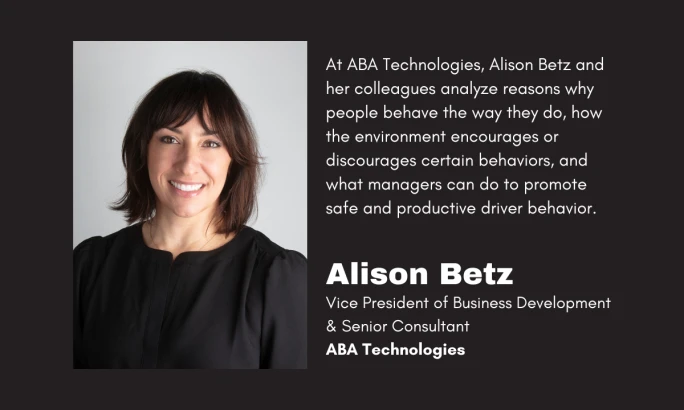
Dr. Alison Betz is a behavioral scientist who conducts research on driver safety and presents at the NETS, NAFA, and AFLA conferences and on webinars.
Photo: A. Betz / Automotive Fleet
2. Training Without Follow-up Coaching
Most drivers need some level of training to learn their job, but it doesn’t stop there: coaching, feedback conversations, and performance observations are essential to maintain positive change. Managers and supervisors are largely responsible for conducting regular coaching sessions, but many supervisors don’t learn effective coaching strategies.
Instead, they learn methods for correcting unsafe behavior, rather than taking preventive action.
Training sometimes sends employees a different message about what is expected on the job than the reality.
For instance, during training, a pharmaceutical sales rep may learn safe driving practices they can’t comply with once on the job. For instance, their managers ask them to visit an unreasonable number of doctors’ offices per day and meet sales goals that promote unsafe behavior.
In other words, the message is, “If you plan to meet that goal, you’ll have to cut corners.”
Strategies That Get Results
Now that we’ve identified potential mistakes that are keeping you from getting through to your drivers, here are some strategies to drive behavioral change.
Rather than taking a one size fits all approach, thoroughly assessing telematics data to pinpoint any concerning behaviors per department, region, area, etc.
Don’t assume each employee is the same and needs the same support. Tailor coaching sessions for field supervisors, empowering them to effectively address these behaviors and align driver actions with company safety objectives.
Replace your quarterly or annual safety review with an active and continual evaluation. The company's safety culture, messaging, and actions enable us to craft messaging that fosters meaningful behavior change among employees.
Conduct audits of training materials to identify necessary adjustments that resonate with drivers, sparking a genuine desire to adopt safer practices.
Don’t forget that change is needed at every level, not just with the drivers. Assist in aligning executive communication with the overarching goal of driver behavior improvement.
Finally, work with experts to implement and continuously refine the solution, driving enhanced driver performance, improved safety outcomes, and a positive company culture.
Subscribe to Our Newsletter
More Safety
IIHS Crash Avoidance Tests Reveal Safety Gaps in Cargo Vans and Work Trucks
New crash-avoidance ratings from the Insurance Institute for Highway Safety reveal inconsistent performance among commercial vehicles, with several popular cargo vans and heavy-duty pickups struggling to avoid collisions with other vehicles and pedestrians.
Read More →
What’s Next for Fleet? Safety, AI & Industry Recognition | AF News Recap
Could your company's culture be encouraging distracted driving? This week, we're exploring how workplace expectations affect driver safety, what AI, EVs, and autonomous vehicles could mean for the future of fleet management, and how fleet professionals can strengthen their award nominations.
Read More →
Does Your Fleet's Culture Encourage Distracted Driving?
What happens when the people responsible for enforcing safety rules are the ones setting the wrong example? The answer may reveal why some of the biggest risks to fleet drivers have little to do with what's written in the employee handbook.
Read More →
Sponsored•October 1, 2026
Fleet Manager’s Ultimate Playbook: Navigating the New Standard in OEM Connectivity
Rising operating costs, driver safety concerns, and unplanned downtime are putting unprecedented pressure on modern fleets. Discover how fleet managers use embedded OEM connectivity and real-time vehicle data to cut TCO, prevent downtime, and protect drivers without aftermarket telematics hardware.
Read More →
From Driver Well-Being to EV Charging | AF News Recap
Mental health belongs in the fleet safety conversation. This week, we’re looking at five ways fleets can support employee well-being before a crisis, plus Holman’s expansion in Mexico, new one-day Fleet Forward passes, and why EV charging demand is outpacing infrastructure growth.
Read More →
Nexar-Nauto Merger Aims to Give Fleets Better Safety Intelligence Through Larger Driving Dataset
Stefan Heck tells Automotive Fleet that combining more than 10 billion miles of driving history with Nexar's AI models will give fleets deeper insights into driver risk and roadway conditions than either company could provide independently.
Read More →
Don't Wait for a Crisis: 5 Ways to Build Mental Health Into Your Fleet Safety Program
For Suicide Prevention Month, fleet and safety leaders have an opportunity to put mental health where it belongs: at the center of workplace safety.
Read More →
How Camera Data Can Strengthen a Fleet’s Insurance Renewal
Insights from a commercial insurance carrier and a broker show how fleets can turn video telematic data, driver coaching, and improved claims results into a stronger case at insurance renewal.
Read More →
The Safest Fleets Aren’t the Ones with the Most Technology
You’ve made the telematics investment. Here’s how to capture the other half of its value and build the safest fleet on the road.
Read More →
Sponsored•August 7, 2026
Hidden in Plain Sight: Fleet Compliance Risks
Fleet compliance isn't just about having policies — it's about consistently enforcing them. This practical guide reveals six hidden compliance risks common in public sector and shared fleet operations and outlines proven strategies to improve visibility, accountability, and audit readiness
Read More →