




NSC Discusses New Fleet Safety Training Program, Future Plans
The National Safety Council is working to keep drivers safe on the road with the launch of its new training program.

The NSC Fleet Essentials training program begins with a module that focuses on safe backing, vehicle dynamics, and more.
Photo: Automotive Fleet
The National Safety Council (NSC) recently announced it is launching the Fleet Essentials training program, a series of online courses employers can use to educate their drivers.
Driving is the leading cause of work-related deaths every year, according to the NSC, and Mark Chung, executive vice president of roadway practice, said the organization is working to eliminate the leading causes of preventable death and injury, focusing its efforts on the workplace and roadway.
“Fleet safety is the crossover between workplace and roadway, and we are thrilled to launch this training program to help employers educate all employees whose jobs require them to be behind the wheel to best ensure everyone makes it home safely every time,” Chung said.
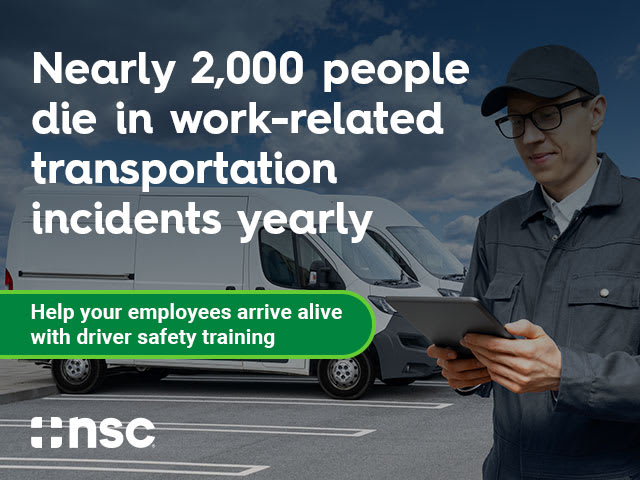
The goal of NSC's program is to decrease that number of people who died as a result of occupational transportation incidents.
Photo: NSC
Goals of the NSC Fleet Essentials Training Program
According to the U.S. Bureau of Labor Statistics, more than 2,000 people died as a result of occupational transportation incidents in 2022, making up 37.7% of the total occupational fatalities that year.
Chung shared that the goal of the program from the NSC’s perspective is to decrease that number, ultimately to zero, and save lives.
Drivers who do not have their Commercial Driver’s License but are required to drive any vehicle for work may not be considered fleet or professional drivers by their employers and could therefore lack formal training, according to the NSC. That’s as many as 15.5 million drivers in the U.S. who may not be properly trained to operate a vehicle on the job.
Delivery truck drivers and sales employees have the highest rates of injuries and fatalities among all occupations, both of whom are non-CDL drivers.
The “alarming gap in training” is the biggest challenge in the industry, according to Chung.
“A fleet driver is any employee who drives while on the job, such as truck and delivery drivers but also salespeople, tradespeople, the news media, all of which drive to a destination to perform their job function. This makes getting all of these people trained on things such as vehicle dynamics, driving professionally, and distraction awareness unique to driving for work quite literally essential to their safety,” he said.
The NSC Fleet Essentials training program includes courses for passenger vehicles, delivery vans, and medium-duty trucks. The training program also addresses topics such as vehicle dynamics, driving professionally, and distraction awareness unique to driving for work.
Training Program Courses
Driving Professionally: A 20-minute online course that helps fleet drivers understand key characteristics of driving professionally and recognize the importance of organization representation and liability while driving. The course explores the difference between driving for personal benefit versus driving in the course of your work.
Vehicle Dynamics: A 45-minute online course that helps drivers understand their vehicle’s capabilities and limitations and how the physical forces of inertia, gravity, and velocity affect it. Participants also learn why it is important to avoid risky maneuvers and how to avoid them.
Distracted Fleet Driver: A 20-minute online course that reminds fleet drivers that they cannot drive safely unless they’re attentive, alert, and engaged. Participants learn why it’s important to remain distraction-free and how to minimize distractions while driving. This course reviews the science of distracted driving, reveals myths about multitasking, and covers the dangerous effects of distracted driving for the fleet driver.
The NSC plans to roll out more modules in the coming months and years to best address the challenges employers face in keeping employees safe on every job site, including the roadways.
More Safety

Fleet Manager’s Ultimate Playbook: Navigating the New Standard in OEM Connectivity
Rising operating costs, driver safety concerns, and unplanned downtime are putting unprecedented pressure on modern fleets. Discover how fleet managers use embedded OEM connectivity and real-time vehicle data to cut TCO, prevent downtime, and protect drivers without aftermarket telematics hardware.
Read More →
From Driver Well-Being to EV Charging | AF News Recap
Mental health belongs in the fleet safety conversation. This week, we’re looking at five ways fleets can support employee well-being before a crisis, plus Holman’s expansion in Mexico, new one-day Fleet Forward passes, and why EV charging demand is outpacing infrastructure growth.
Read More →
Nexar-Nauto Merger Aims to Give Fleets Better Safety Intelligence Through Larger Driving Dataset
Stefan Heck tells Automotive Fleet that combining more than 10 billion miles of driving history with Nexar's AI models will give fleets deeper insights into driver risk and roadway conditions than either company could provide independently.
Read More →
Don't Wait for a Crisis: 5 Ways to Build Mental Health Into Your Fleet Safety Program
For Suicide Prevention Month, fleet and safety leaders have an opportunity to put mental health where it belongs: at the center of workplace safety.
Read More →
How Camera Data Can Strengthen a Fleet’s Insurance Renewal
Insights from a commercial insurance carrier and a broker show how fleets can turn video telematic data, driver coaching, and improved claims results into a stronger case at insurance renewal.
Read More →
The Safest Fleets Aren’t the Ones with the Most Technology
You’ve made the telematics investment. Here’s how to capture the other half of its value and build the safest fleet on the road.
Read More →
Hidden in Plain Sight: Fleet Compliance Risks
Fleet compliance isn't just about having policies — it's about consistently enforcing them. This practical guide reveals six hidden compliance risks common in public sector and shared fleet operations and outlines proven strategies to improve visibility, accountability, and audit readiness
Read More →
NETS Sets 2026 Fleet Safety Benchmark Conference for Indianapolis
The Sept. 15–17 program will feature fleet benchmarking data, case studies, emerging technologies, and implementation strategies while running alongside the NSC Safety Congress & Expo.
Read More →
Off-the-Job Crashes Account for 43% of Employers’ $61.7 Billion Crash Burden
NETS quantifies costs dispersed across fleet, risk, HR, and other departments while providing new per-crash benchmarks for employers.
Read More →
Ram Recalls More Than 1.27 Million 1500 Pickups for Seat Belt Anchor Issue
The recall affects certain 2019-2026 Ram 1500 pickups that may have improperly attached second-row seat belt buckle anchors.
Read More →