




NTSB Issues New Safety Recommendations for Commercial Vehicles
After investigating a 2020 multi-vehicle crash that included a motorcoach, three trucks and a passenger vehicle, the National Transportation Safety Board found that highway speed limits, commercial vehicle collision avoidance systems, connected technology, and more need to be addressed.


The NTSB found that although the second truck was equipped with collision-mitigation technology, a misaligned sensor rendered it inoperative.
Screen capture of NTSB virtual meeting

Speeding was linked to nearly 9,500 roadway deaths in 2019 alone. A 2020 multi-vehicle collision has safety experts re-evaluating ways to reduce crashes and fatalities.
Photo via pexels.com/Quintin Gellar
After investigating a 2020 multi-vehicle crash near Mt. Pleasant Township, Pennsylvania, the National Transportation Safety Board issued three new safety recommendations impacting commercial vehicles.
The collision involved a motorcoach, three tractor-trailers, and a passenger vehicle. Five people were killed and 50 others were injured.
The NTSB determined that the motorcoach driver was at fault. The coach was traveling around a curve at night and in light snow. The board said the probable cause of the crash was the motorcoach driver’s loss of control due to traveling at an unsafe speed on the wet curve and the driver’s likely excessive steering inputs.
Ultimately, these factors caused the motorcoach to run off the road, strike an embankment, and roll over across the roadway, where two commercial trucks ran into it. The high initial and impact speed of the second truck also contributed to the severity of the crash, the NTSB found. In addition, a westbound car and another tractor-trailer drove off the road to avoid the wreckage and came to rest wedged side by side against each other. The motorcoach driver, two passengers, and the driver and co-driver of the second truck died in the crash. Forty-nine of the motorcoach passengers and the co-driver of the first truck were injured.
The NTSB found during its investigation the regulatory speed limit on the turnpike was 70 mph. An advisory speed sign of 55 mph, posted at the curve where the crash occurred, recommended that motorists reduce their speed before entering. The motorcoach driver entered the curve at 77 mph and struck the embankment at about 60 mph before overturning.
The first truck hit the motorcoach at a speed of about 21 mph, causing minor damage. The second truck crashed into the first truck and the motorcoach, causing catastrophic damage; its last recorded speed was 56 mph. All three trucks involved were equipped with forward collision avoidance systems. The system on the second truck was inoperative at the time of the crash because of a misalignment in the radar on which the system depended. A fault code for the misaligned system was identified in July 2019. The investigation did not find any evidence that this had been reported on the driver vehicle inspection report.
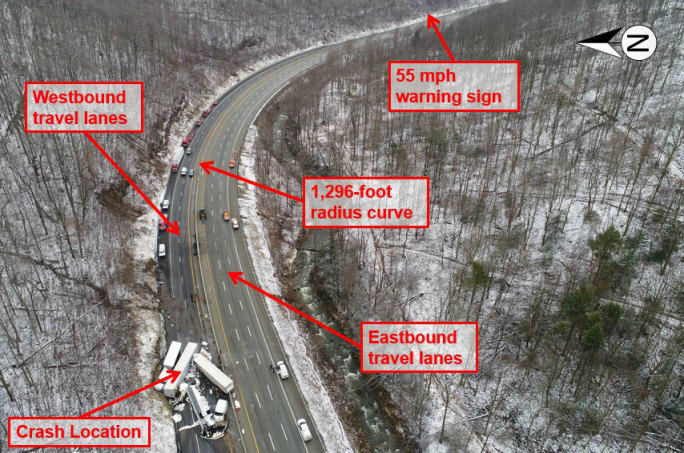
In this photo, the final rest positions of all vehicles involved in crash below the curve on westbound Pennsylvania Turnpike.
Photo: Pennsylvania State Police. Graphic overlay by NTSB
NTSB Calls for Speed Limiters, Collision Avoidance Standards
As a result of this investigation, the NTSB issued new safety recommendations related to three specific areas.
The first concerns excessive speed for wet pavement conditions.
Specifically, the NTSB recommended that the Federal Highway Administration evaluate the applicability and use of the 85th percentile speed input variable in its tools for setting appropriate speed limits. The NTSB also recommended the use of speed safety cameras on the turnpike outside of active work zones and that the Pennsylvania Turnpike Commission implement the use of variable speed limit signs to adjust speed limits based on real-time information on weather and road conditions.
The second area of recommendations concerns the lack of standards for commercial vehicle collision avoidance and mitigation systems to enhance safety, including forward collision avoidance systems and connected vehicle technology.
For starters, NTSB recommended that the Department of Transportation implement a plan for nationwide connected-vehicle technology deployment to address current limitations. In addition, they reiterated recommendations to the National Highway Traffic Safety Administration to develop minimum performance standards for connected-vehicle technology for all highway vehicles and to require this technology to be installed on all newly manufactured highway vehicles.
NTSB also urged NHTSA to develop performance standards for advanced speed-limiting technology for heavy vehicles and to require that all newly manufactured heavy vehicles be equipped with such devices. Similarly, NHTSA should complete the development and application of performance standards for forward collision avoidance systems in commercial vehicles.
Finally, NTSB recommended that all buses and trucks over 10,000 pounds gross vehicle weight rating be required to be equipped with onboard video event recorders. The Federal Motor Carrier Safety Administration, it said, should provide guidance to motor carriers to proactively use onboard video event recorder information to aid in driver training and ensure driver compliance with regulatory rules essential for safe operation.
The NTSB does not have rulemaking authority and can only make recommendations to other government agencies, as well as to industries, associations, motor carriers involved, etc.
More Safety

Does Your Fleet's Culture Encourage Distracted Driving?
What happens when the people responsible for enforcing safety rules are the ones setting the wrong example? The answer may reveal why some of the biggest risks to fleet drivers have little to do with what's written in the employee handbook.
Read More →
Fleet Manager’s Ultimate Playbook: Navigating the New Standard in OEM Connectivity
Rising operating costs, driver safety concerns, and unplanned downtime are putting unprecedented pressure on modern fleets. Discover how fleet managers use embedded OEM connectivity and real-time vehicle data to cut TCO, prevent downtime, and protect drivers without aftermarket telematics hardware.
Read More →
From Driver Well-Being to EV Charging | AF News Recap
Mental health belongs in the fleet safety conversation. This week, we’re looking at five ways fleets can support employee well-being before a crisis, plus Holman’s expansion in Mexico, new one-day Fleet Forward passes, and why EV charging demand is outpacing infrastructure growth.
Read More →
Nexar-Nauto Merger Aims to Give Fleets Better Safety Intelligence Through Larger Driving Dataset
Stefan Heck tells Automotive Fleet that combining more than 10 billion miles of driving history with Nexar's AI models will give fleets deeper insights into driver risk and roadway conditions than either company could provide independently.
Read More →
Don't Wait for a Crisis: 5 Ways to Build Mental Health Into Your Fleet Safety Program
For Suicide Prevention Month, fleet and safety leaders have an opportunity to put mental health where it belongs: at the center of workplace safety.
Read More →
How Camera Data Can Strengthen a Fleet’s Insurance Renewal
Insights from a commercial insurance carrier and a broker show how fleets can turn video telematic data, driver coaching, and improved claims results into a stronger case at insurance renewal.
Read More →
The Safest Fleets Aren’t the Ones with the Most Technology
You’ve made the telematics investment. Here’s how to capture the other half of its value and build the safest fleet on the road.
Read More →
Hidden in Plain Sight: Fleet Compliance Risks
Fleet compliance isn't just about having policies — it's about consistently enforcing them. This practical guide reveals six hidden compliance risks common in public sector and shared fleet operations and outlines proven strategies to improve visibility, accountability, and audit readiness
Read More →
NETS Sets 2026 Fleet Safety Benchmark Conference for Indianapolis
The Sept. 15–17 program will feature fleet benchmarking data, case studies, emerging technologies, and implementation strategies while running alongside the NSC Safety Congress & Expo.
Read More →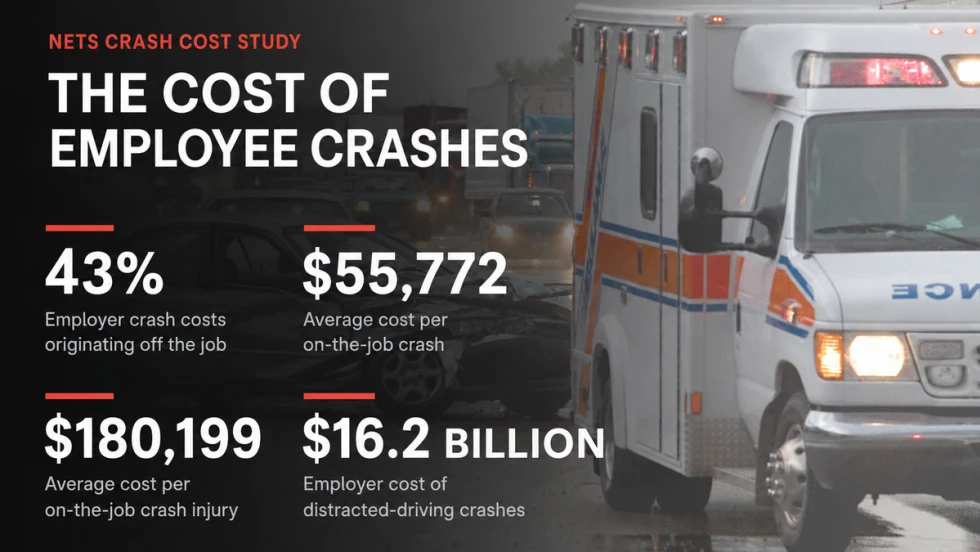
Off-the-Job Crashes Account for 43% of Employers’ $61.7 Billion Crash Burden
NETS quantifies costs dispersed across fleet, risk, HR, and other departments while providing new per-crash benchmarks for employers.
Read More →