




Dhaval Kikani spent 40 years as an engineer for Ford. Check out his perspective on the evolution of automotive tech!
Dream Cars Are Coming: Engineering Breakthroughs Pave the Way
Cars that run 100,000 miles without a major repair, are powered by several revolutionary types of automotive propulsion-from jet to chemical-and never need an oil change or grease job.
by Staff
February 1, 1962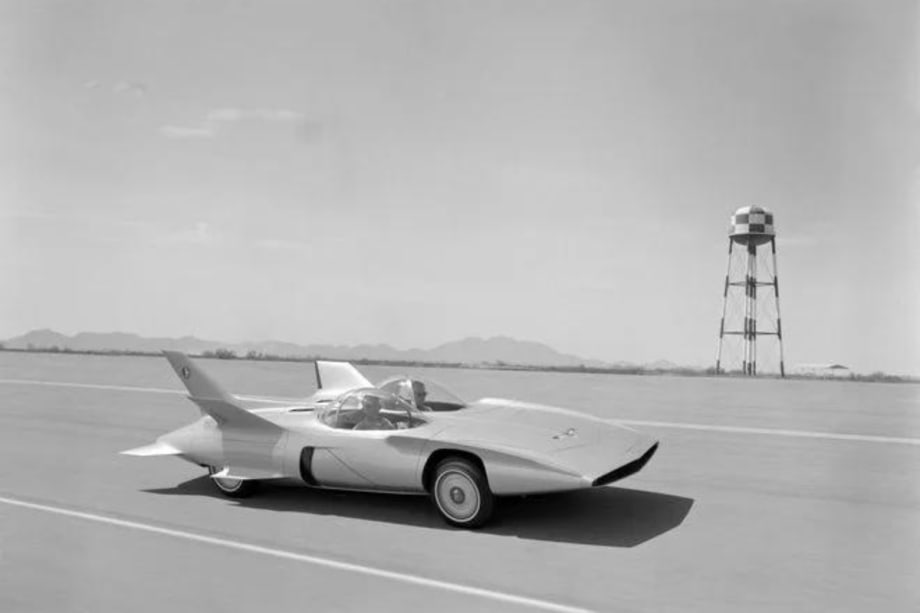
Built in 1958, the Firebird III was the only member of the Firebird trio to have anyt direct impact on the design of GM production features.
Photo: GM
6 min to read
From the Automotive Fleet Archives:
Cars that run 100,000 miles without a major repair, are powered by several revolutionary types of automotive propulsion-from jet to chemical-and never need an oil change or grease job.
Sound impossible? Twenty years ago it would have. Today, such cars are a near reality as the result of major engineering breakthroughs which are transforming the shape and motion of the modern auto.
In fact, there are such cars on the road. Unfortunately, they'll never be offered to the fleet operator. The cars, of course, are the auto industry's dream of experimental or idea cars.
These dream cars, costing millions of dollars, will never go into production. Yet, they provide the auto industry with an invaluable laboratory on wheels. Crammed into their inner workings are just about every automotive engineering advance now known.
The dream cars someday will provide the fleet operator with such things as gas turbine or fuel cell engines, new body styling techniques and even possibily an electronic audio warning signal to alert the driver when tire pressure is low, a door unlatched, a car following too closely and when there is a danger of engine trouble.
Far Fetched? Maybe Not
If this sounds far fetched, remember that the dream cars of a decade ago contained such now commonplace equipment as power brakes, power steering and tubeless tires.
One of the most exciting developments in the industry today is the gas turbine engine.
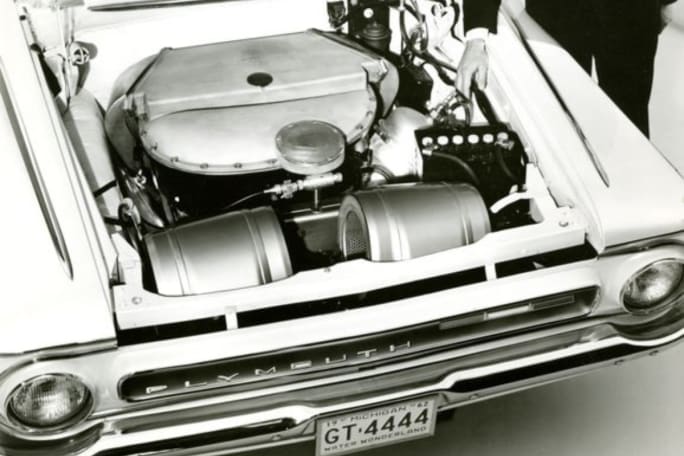
The 1962 Plymouth Turbo Fury had a turbine engine. The engine was said to have run efficiently on various low cost fuel including kerosene fuel and diesel oil.
Photo: Stellantis
While all automakers are working on the promising power plant, Chrysler Corp. appears to be the leading exponent of automotive gas turbines.
The company, which recently completed a 3,100-mile cross country test of a gas turbine powered Dodge Dart, announced that it will build 50 to 75 turbine powered cars within the next 18 to 24 months for sale to "selected customers." Since the cars will primarily be test vehicles, they probably will go to fleet users in order to be put through a thorough workout.
A gas turbine engine offers many advantages over the conventional internal combustion piston engine.
First, it is a lot simpler. There is only one moving part to every five in a conventional power plant. It requires no distributor or breaker points, only one spark plug, no anti-freeze and no oil change.
Second, there is no vibration in a turbine engine. Explosions are taking place constantly while a piston engine runs. Combustion is constant in a gas turbine. Also, there is no starting problem or warm-up problem, even in coldest weather.
Third, a gas turbine engine will run on almost any fuel. Chrysler says its engine will operate equally well on diesel fuel, peanut oil, gasoline, kerosene, alcohol, furnace oil, French perfume or virtually any liquid that will run through a pipe and will burn with oil.
While most fleet operators won't be using Napoleon brandy to power their cars, the versatility of the turbine offers many advantages.
One of the problems in the development of a turbine engine is that air and fuel are mixed and burned under pressure from gases which forced a turbine wheel to spin at terrific speed, something like an old windmill.
In early turbines the exhaust was so hot it was feared expelled heat would melt pavements or endanger pedestrians. Chrysler says this problem has been solved by recirculating the exhaust.
Another problem with early turbines was that such high temperatures were developed that scarce, critical and expensive metals were needed. Chrysler says it has found a new readily available alloy which solves this problem for mass production.
George J. Heubner, Jr., executive vice president for research at Chrysler Corp., believes that mass production of a turbine engine could be achieved within five years. Prices would be comparable to internal combustion engines if mass production is reached.
Ford Motor Co. and General Motors Corp. are working on the development of a gas turbine engine, but they have made no public pronouncements in recent months. The Firebird III, a GM experimental car, has had a gas turbine engine under its hood for the past several years.
Auto Industry Research Worthwhile
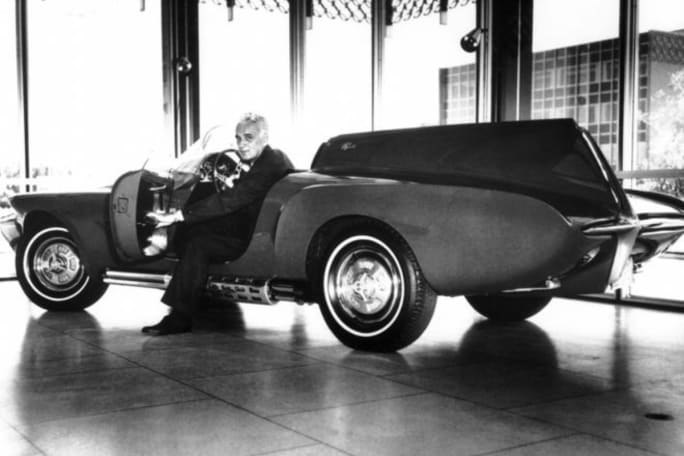
The Plymouth XNR was a concept vehicle designed by Virgil Exner at Chrysler.
Photo: Stellantis
Even if the gas turbine engine proves unfit for general use, the auto industry's research and development will have been worthwhile.
One of the major developments of turbine research is fuel injection systems, which have been used on modern passenger cars and may be used again when they are further developed. Ram manifold used by Chrysler Corp. to increase engine efficiency is another result of research on the gas turbine engine.
Improved automotive ventilating systems and supercharging systems were developed for cars with piston-type engines during research on the gas turbine.
Heating systems for homes and air conditioning systems for homes and cars benefited from research on the gas turbine. Also, because of the greater demands placed on some parts by a gas turbine engine, engineers working on gas turbine projects improved gears, bearings and lubricants which are being used today on piston-type engines.
Another development that may be an outgrowth of the turbine is thermoelectric or magneto hydrodynamic powerplants on cars. These engines of course, must wait the development of a successful turbine power plant.
Multi-Fuel Piston Engine
Still another power plant possibility is a piston engine that will burn kerosene, furnace oil or almost any fuel under a newly developed principle developed by Texaco Inc.
Ford has a production agreement with Texaco, which has developed such a multi-fuel engine and has been testing it for the past 10 years. Texaco engineers say the engine is ready for production and claim it will run a standard six cylinder car more than 40 miles on a gallon of kerosene or furnace fuel.
Under the Texaco principle, low grade fuel is shot directly at the spark plug in a swirling manner. This high concentration of the fuel around the ignition plug causes it to burn more completely than the high octane gasoline used in today's engines.
The result is high fuel economy, very little exhaust fume plus the advantage of being able to use almost any fuel and change from one fuel to another.
Engines aren't the only automotive components coming in for attention in the million dollar experimental cars.
Startling innovations in the car of the future may include space-frame body construction using a lattice of lightweight structural members placed where the loads require them and covered by stressed panels. Plastics and other lightweight metals would be incorporated into body design.
Transparent steel, already in the development stage, could replace glass in roofs. And color-filled metal used in the body would eliminate sprayed-on surface paint.
Specialized Vehicles On the Horizon
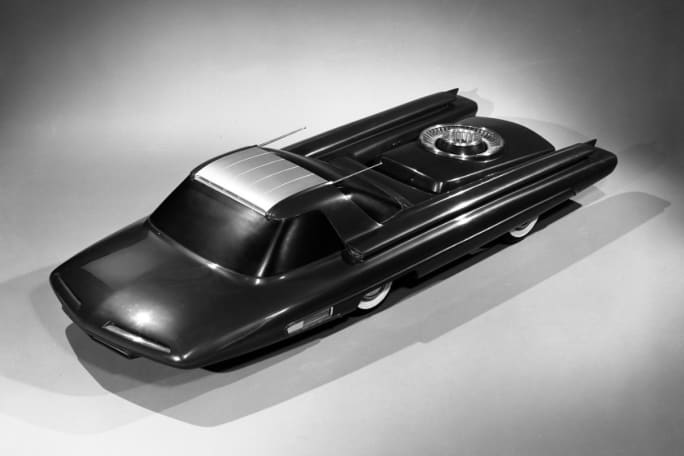
The Ford Nucleon concept car was developed in 1957 as a nuclear-powered car. The 1962 concept model is shown here.
Photo: Ford Heritage Vault
If this isn't enough, Andrew A. Kucher, Ford vice president of research and engineering for-sees anticipatory auto-control mechanisms to supplement slow human reactions behind the wheel.
One of the most interesting prospects, according to Kucher, is vehicle specialization.
"Distinct types of autos should be available for diverse purposes ranging from turnpike driving to localized commuting, each with its own advantages of performance, interior space, comfort and ease of handling," Kucher said.
One of latest idea cars is the Dodge Flitewing.
Built at a cost of $125,000 and resembling a present-day production model in both styling and interior features, the Flitewing has "flip-up" windows in place of conventional roll-down windows. When the door is opened, a window-roof canopy automatically cantilevers upward. When the door is closed, the canopy descends and fastens firmly in place.
A new speedometer, which utilizes a series of 13 elliptical windows to indicate speed at a glance in 10-mile-per-hour increments, replaces the traditional speed gauge. Dashboard knobs and dials are replaced with pushbuttons.
Radio and heater controls are located in a full-length console. Other non-driving controls such as the light switches and turn indicators are located on the driver's door panel.
All of the experimental or dream cars have one thing in common. They are designed to increase driving pleasure and cut down the amount of maintenance problems. This is good news for fleet users.
Subscribe to Our Newsletter
More Operations

How to Manage Conflict for Your Fleet Operations
Conflict management is becoming a core leadership skill. Here are five strategies fleet leaders should know.
Read More →
Sponsored•June 1, 2026
Turning Connected Vehicle Data Into Decisions That Matter
Fleet leaders have more data than ever, but turning that data into clear, actionable decisions remains a challenge. This white paper shows how leading organizations are using connected vehicle data to improve safety, reduce costs, and optimize fleet performance. Learn how to turn insight into action across your fleet.
Read More →
Sponsored•June 1, 2026
Cameras, Safety and Insurance: From Reactive Claims to Real-time Prevention
Commercial auto remains one of the most challenging and costly lines of coverage for fleet operators and insurers alike. Learn more about how to effectively address these issues from Onur Aksan, Enterprise Business Development Executive, Geotab.
Read More →

Sponsored•May 29, 2026
Are You Tracking Your Fleet's True Total Cost of Ownership?
Bobit Business Media surveyed 190 fleet professionals and found that while most fleets are tracking costs, fragmented systems and data gaps are keeping true TCO visibility out of reach. With rising pressure to control spend in an increasingly volatile environment, the gap between what fleets think they know and what the data actually shows is wider than you might expect. See how your peers are managing costs today and where the industry still has room to improve.
Read More →
Sponsored•May 28, 2026
Turn Fleet Data Into Smarter Decisions
Fleet leaders have access to more operational data than ever, but disconnected systems and unclear metrics often slow decision-making instead of improving it. This article outlines five practical steps fleets can take to transform fragmented data into actionable insights that improve planning, safety, utilization, and long-term performance.
Read More →
Sponsored•May 15, 2026
Hybrids: Electrification Without the Challenges
For fleet managers, fuel is one of the biggest line items in the budget — and it's one hybrids can shrink without changing how your people work. Download the eBook to see the numbers, understand the technology, and get a step-by-step guide to making the switch.
Read More →
How NOV Uses Telematics to Improve Fleet Safety Across 160 Locations
James Victory of NOV discusses how the company manages fleet safety, maintenance, and telematics across more than 150 locations supporting oilfield operations throughout the U.S.
Read More →
Fleet Meets: Steven Santostasi
This edition of the Fleet Meets series features Steven Santostasi, the current TSP channel manager for Ford Pro.
Read More →
Sponsored•May 13, 2026
Why Fleet Managers Are Replacing Departmental Vehicles with Shared Motor Pools
Departmentally assigned vehicles often create hidden costs through underutilization, poor visibility, and increased administrative burden. This white paper explores how shared motor pool strategies help fleets reduce costs, improve accountability, and optimize vehicle utilization.
Read More →
Soap Box Derby Challenge: Assembling the Crew
Meet Gabriel, Matthew, and Angel — the team helping bring this soap box derby build to life.
Read More →