




New Study Shows Automatic Emergency Braking Improves Crash Avoidance in 2024 Vehicles
AAA’s new study shows 2024 vehicles equipped with AEB significantly outperform older models in collision prevention, offering key insights for fleet safety and the future of braking technology.

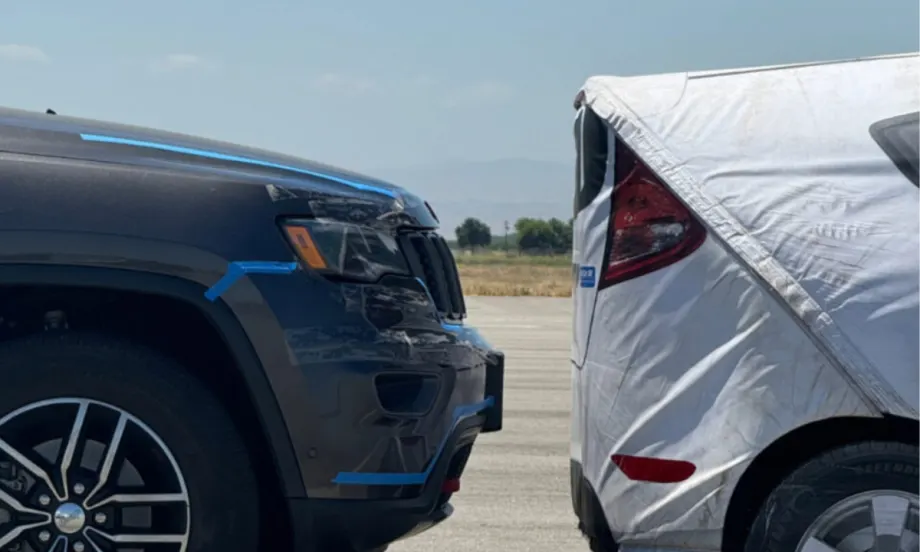
Over the last decade, AAA has evaluated various advanced driver assistance systems, including AEB, to determine if the technology performs as expected.
Photo: AAA
AAA’s latest research found that new (2024) model vehicles with automatic emergency braking (AEB) avoided 100% of forward collisions when tested at speeds up to 35 mph, in comparison to old (2017 – 2018) model vehicles, which only avoided collisions 51% of the time.
AEB uses forward-facing cameras and other sensors to automatically tell the car to apply the brakes when a crash is imminent. Most new vehicles are equipped with AEB, but earlier this year, the National Highway Traffic Safety Administration (NHTSA) issued a new Federal Motor Vehicle Safety Standard (FMVSS) requiring automakers to include AEB in their vehicles by 2029.
“Since we began testing AEB in 2014, the advancements by automakers are commendable and promising in improving driver safety,” Greg Brannon, director of automotive engineering research, said. “There is still significant work ahead to ensure the systems work at higher speeds.”
A Decade of Evaluating AEB and Other Advanced Driver Assistance Systems
Over the last decade, AAA has evaluated various advanced driver assistance systems, including AEB, to determine if the technology performs as expected.
While these systems continue to be refined with upgraded software and sensors, AAA wanted to see if AEB functionality has improved compared to older versions.
How AAA Evaluated AEB in New vs. Older Models
In partnership with the Automobile Club of Southern California’s Automotive Research Center, AAA conducted research in a closed-course, simulated environment to evaluate the performance progression of AEB systems on older model vehicles (2017 – 2018) compared to new (2024).
Old and new test vehicles of the same make and model were evaluated at three common speeds (12 mph, 25 mph, and 35 mph) to see how well they performed in a forward collision. Learn more from the full report.
Improved Crash Avoidance Rates in 2024 Vehicles
New model vehicles (2024) were nearly twice as likely to avoid a collision as older model vehicles (2017 – 2018) when tested at speeds up to 35 mph, which aligns with current safety standards requiring AEB to work up to this same speed.
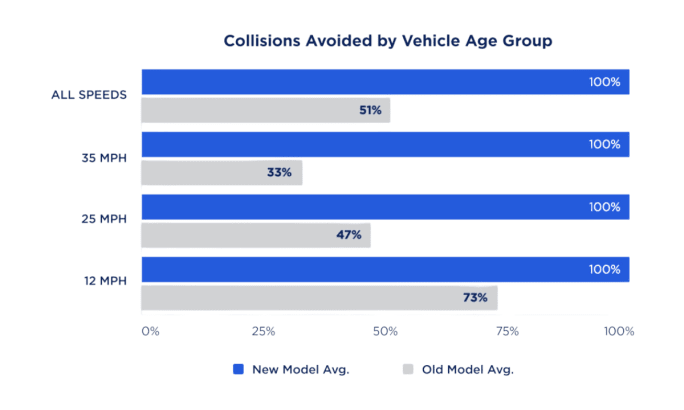
New model vehicles (2024) were nearly twice as likely to avoid a collision as older model vehicles (2017 – 2018) when tested at speeds up to 35 mph.
Source: AAA
Based on these results, the progression of AEB systems in vehicles demonstrates substantial improvement over time. The newest models were capable of avoiding potential collisions altogether at slower speeds.
This improvement in AEB technology is a promising development that significantly reduces the risk of collisions on the road. As car manufacturers continue to enhance these systems, can the public expect even higher levels of safety and reliability? AAA will continue to monitor these developments and other changes to regulations.
What Happens at Higher Speeds?
According to data collected by the Federal Highway Administration (FHWA), most total miles driven in the U.S. occur at higher speeds (above 35 mph).
AAA engineers added test scenarios to assess the limits of current AEB systems at higher speeds. Three out of four vehicles evaluated avoided a 45 mph collision. For those vehicles that avoided a collision at 45 mph, the test speed was increased to 55 mph. None of the remaining test vehicles avoided a collision at 55 mph.
AAA Urges Continued AEB Development for Higher-Speed Safety
These findings highlight the importance of continued AEB improvements. A NHTSA rule released earlier this year requires new vehicles to avoid a forward collision at speeds up to 62 mph by 2029.
Encouraged by the new NHTSA ruling, AAA offers the following advice to industry:
Continued Development of Advanced AEB Systems: Automakers should prioritize developing AEB systems for high-speed scenarios like those in the new FMVSS 127. These systems have already displayed significant efficacy in preventing collisions up to 35 mph.
Enhance Forward Collision Warning (FCW) Alerts: If FCW systems offer earlier alerts, they can provide drivers with additional reaction time, decreasing the sole reliance on AEB systems. This approach can establish a more cooperative safety mechanism where the driver and the vehicle collaborate to prevent collisions.
Research and Development for High-Speed Scenarios: Ongoing investment in research and development is crucial for improving the effectiveness of AEB systems at higher speeds, which involves advancing sensor technologies, optimizing braking algorithms to minimize false positives, and undertaking comprehensive real-world testing to meet updated regulatory requirements and guarantee safety at higher speeds.
Driver Safety Tips: Using Automatic Emergency Braking Responsibly
The progression of these braking systems is improving and performing as intended. Having these systems in your vehicle can help prevent collisions, but keep in mind the following advice:
Never rely solely on technology to apply the brakes. AEB systems are not a replacement for an attentive driver.
Be aware of the limitations of an AEB system and stay engaged while driving. Maintain focus, even when driving vehicles equipped with advanced safety features.
Engaging in risky driving behaviors such as speeding, texting, driving while drowsy or distracted, or driving under the influence of cannabis or alcohol significantly increases the risk of a collision. Stay alert by following speed limits, keeping your smartphone out of reach, and only driving when sober.
How AAA Conducted AEB Testing in a Closed-Course Environment
In partnership with the Automobile Club of Southern California’s Automotive Research Center, AAA tested early and late model vehicles from the same automaker evaluated back-to-back on the same day to eliminate any testing bias.
Vehicles were driven on a closed-course roadway with a DRI Soft Car 360 positioned at the end of the course, with the rear facing the subject vehicle.
Refer to the full report for details on the methodology, including specific testing equipment and test track characteristics.
More Safety
IIHS Crash Avoidance Tests Reveal Safety Gaps in Cargo Vans and Work Trucks
New crash-avoidance ratings from the Insurance Institute for Highway Safety reveal inconsistent performance among commercial vehicles, with several popular cargo vans and heavy-duty pickups struggling to avoid collisions with other vehicles and pedestrians.
Read More →
What’s Next for Fleet? Safety, AI & Industry Recognition | AF News Recap
Could your company's culture be encouraging distracted driving? This week, we're exploring how workplace expectations affect driver safety, what AI, EVs, and autonomous vehicles could mean for the future of fleet management, and how fleet professionals can strengthen their award nominations.
Read More →
Does Your Fleet's Culture Encourage Distracted Driving?
What happens when the people responsible for enforcing safety rules are the ones setting the wrong example? The answer may reveal why some of the biggest risks to fleet drivers have little to do with what's written in the employee handbook.
Read More →
Fleet Manager’s Ultimate Playbook: Navigating the New Standard in OEM Connectivity
Rising operating costs, driver safety concerns, and unplanned downtime are putting unprecedented pressure on modern fleets. Discover how fleet managers use embedded OEM connectivity and real-time vehicle data to cut TCO, prevent downtime, and protect drivers without aftermarket telematics hardware.
Read More →
From Driver Well-Being to EV Charging | AF News Recap
Mental health belongs in the fleet safety conversation. This week, we’re looking at five ways fleets can support employee well-being before a crisis, plus Holman’s expansion in Mexico, new one-day Fleet Forward passes, and why EV charging demand is outpacing infrastructure growth.
Read More →
Nexar-Nauto Merger Aims to Give Fleets Better Safety Intelligence Through Larger Driving Dataset
Stefan Heck tells Automotive Fleet that combining more than 10 billion miles of driving history with Nexar's AI models will give fleets deeper insights into driver risk and roadway conditions than either company could provide independently.
Read More →
Don't Wait for a Crisis: 5 Ways to Build Mental Health Into Your Fleet Safety Program
For Suicide Prevention Month, fleet and safety leaders have an opportunity to put mental health where it belongs: at the center of workplace safety.
Read More →
How Camera Data Can Strengthen a Fleet’s Insurance Renewal
Insights from a commercial insurance carrier and a broker show how fleets can turn video telematic data, driver coaching, and improved claims results into a stronger case at insurance renewal.
Read More →
The Safest Fleets Aren’t the Ones with the Most Technology
You’ve made the telematics investment. Here’s how to capture the other half of its value and build the safest fleet on the road.
Read More →
Hidden in Plain Sight: Fleet Compliance Risks
Fleet compliance isn't just about having policies — it's about consistently enforcing them. This practical guide reveals six hidden compliance risks common in public sector and shared fleet operations and outlines proven strategies to improve visibility, accountability, and audit readiness
Read More →