





Automated Driving Systems Get Poor Marks in New Ratings System
Why Is NHTSA’s New Braking Rule Under Fire?
Automatic emergency braking technology has a history of controversies. An automakers’ trade group is opposing NHTSA’s newly released rule.
July 3, 2024
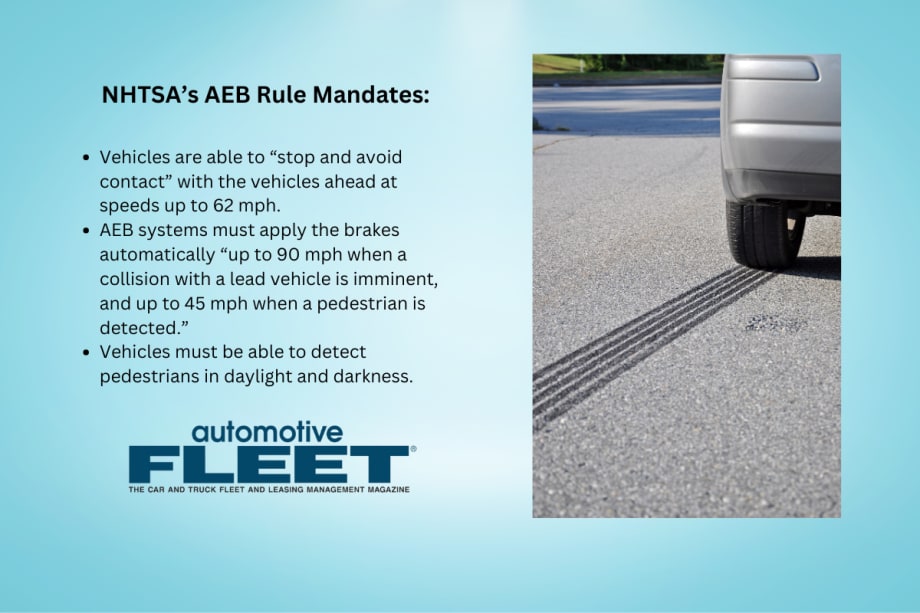
The Alliance for Automotive Innovation contends that fulfilling the rule’s requirements is “practically impossible with available technology."
Photo: Canva
5 min to read
In 2016, the top 20 automakers committed to making automatic emergency braking (AEB) standard equipment on nearly all their vehicles by the end of 2023. The commitment was made in conjunction with the Insurance Institute for Highway Safety (IIHS) and NHTSA.
As a refresher on the technology, AEB uses vehicle sensors to identify potential front-end collisions with other vehicles, warn drivers, and automatically apply the brakes to help avoid or reduce a collision's severity.
After incremental progress, those automakers reached that target by the end of 2023.
Fulfilling the pledge was supposed to prevent 42,000 crashes and 20,000 injuries by 2025. The estimate is based on IIHS research, which found that front crash prevention systems with forward collision warning and automatic emergency braking cut rear-end crashes by half.
In April 2024, the Department of Transportation finalized the rule requiring all vehicle manufacturers to include AEB in all light-duty vehicles by 2029.
But a trade group representing most of the major automakers is now asking the Biden Administration to reconsider.
New AEB Rule Practically Impossible
On June 24, the Alliance for Automotive Innovation (AAI) sent a letter to NHTSA and one to members of Congress, arguing that fulfilling the rule’s requirements is “practically impossible with available technology.”
AAI contends that automakers developed AEB in conjunction with NHTSA and IIHS, yet the new standard deviates from the original agreement on what the technology should achieve.
The new rule requires that:
All vehicles are able to “stop and avoid contact” with the vehicles ahead at speeds up to 62 mph;
AEB systems must apply the brakes automatically “up to 90 mph when a collision with a lead vehicle is imminent, and up to 45 mph when a pedestrian is detected;”
Vehicles must be able to detect pedestrians in daylight and darkness.
AAI’s President and CEO, John Bozzella, writes: “Driving AEB-equipped vehicles in the U.S. under NHTSA’s new standard will become unpredictable, erratic and will frustrate or flummox drivers.”
While AAI is not against the technology, calling it “lifesaving,” the letters note that NHTSA’s own data shows only one tested vehicle met the stopping distance requirements in the final rule.
“NHTSA’s action will require more costly systems that won’t improve driver or pedestrian safety, which is why we are asking the agency to reopen the proceeding and make these necessary corrections.”
Further, AAI argues that the new systems would actually result in more rear-end collisions.
Phantom Braking & AEB Controversy
As AEB technology evolved, it has not been without controversy.
NHTSA investigated complaints regarding 400,000 Tesla vehicles' Autopilot system, which has AEB. The complaints contend that the AEB system falsely detects an object in the road and brakes unexpectedly with no actual collision threat.
The phenomenon, known as “phantom braking,” was specific to Tesla Model 3 and Model Y vehicles in 2021-2022 model years.
Other complaints of unexpected braking have arisen in 2017 to 2019 MY Honda Accords and CR-Vs, in 2019 to 2020 MY Mazda3 models, and in 2017 to 2018 MY Nissan Rogue models, resulting in recalls and investigations.
This year, NHTSA upgraded and expanded its probe into Honda models, now covering almost 3 million vehicles and including 2020 to 2022 MY Accord and CR-V models.
AAI Recommendations on AEB
The letter ends with AAI’s requests and recommendations.
AAI requests that NHTSA reduce the maximum test speed for the vehicle and pedestrian requirements, adjust the headway requirements to align with the results of NHTSA’s research, and better define when a crash is “imminent.”
AAI also recommends that NHTSA adopt a European system that detects a potential forward collision, provides a driver warning, and automatically engages the braking system to avoid or mitigate a collision. This standard would use existing crashworthiness systems designed to better protect road users.
A Realistic View of AEB's Future
Readers have likely experienced an AEB system in action, if not exactly phantom braking.
The car stops suddenly to avoid another car that isn’t in danger of a collision and that the driver is already aware of. Or the car stops for no apparent reason, and the driver chalks it up to some object in the system sensors’ periphery that will never be known.
Perhaps some readers have experienced a situation where AEB did it's intended job and clearly avoided a collision or mitigated a more serious one.
These instances are jarring, and to Bozzella’s point, would frustrate and flummox drivers. But are they true safety hazards?
AEB is now intrinsic to vehicle engineering; automakers will not remove the technology. Therefore, they are tasked with improving it. The technology will improve, and automakers have until 2029 to satisfy the new rule.
Like many regulations, the rule may end up being relaxed or rewritten based on the realities of the market closer to the 2029 mandate date.
There are two narratives here. The first, posited by AAI, concerns whether the industry should be forced to engineer even more advanced AEB tech, at night and at higher speeds, after working with regulators in good faith to achieve our current state.
The other narrative concerns the growth of technology around semiautonomous driving, embodied in Tesla’s full self-driving (FSD) system.
FSD has led to 17 fatal accidents, including one involving phantom braking, according to a Washington Post report that analyzed NHTSA data. How consumers, fleet managers, drivers, and regulators approach this growing gray area of safety will have much greater implications.
Two Tesla owners filed a class-action lawsuit against the EV maker earlier this year, claiming their Teslas braked suddenly on several occasions. Pretrial discovery and depositions in this case would be immensely instructive to the industry. Yet the public would not have access to these findings or anything related to a settlement with Tesla.
We'll have to wait for NHTSA's findings into phantom braking. Certainly, much more research is essential.
More Safety

Sponsored•October 1, 2026
Fleet Manager’s Ultimate Playbook: Navigating the New Standard in OEM Connectivity
Rising operating costs, driver safety concerns, and unplanned downtime are putting unprecedented pressure on modern fleets. Discover how fleet managers use embedded OEM connectivity and real-time vehicle data to cut TCO, prevent downtime, and protect drivers without aftermarket telematics hardware.
Read More →
From Driver Well-Being to EV Charging | AF News Recap
Mental health belongs in the fleet safety conversation. This week, we’re looking at five ways fleets can support employee well-being before a crisis, plus Holman’s expansion in Mexico, new one-day Fleet Forward passes, and why EV charging demand is outpacing infrastructure growth.
Read More →
Nexar-Nauto Merger Aims to Give Fleets Better Safety Intelligence Through Larger Driving Dataset
Stefan Heck tells Automotive Fleet that combining more than 10 billion miles of driving history with Nexar's AI models will give fleets deeper insights into driver risk and roadway conditions than either company could provide independently.
Read More →
Don't Wait for a Crisis: 5 Ways to Build Mental Health Into Your Fleet Safety Program
For Suicide Prevention Month, fleet and safety leaders have an opportunity to put mental health where it belongs: at the center of workplace safety.
Read More →
How Camera Data Can Strengthen a Fleet’s Insurance Renewal
Insights from a commercial insurance carrier and a broker show how fleets can turn video telematic data, driver coaching, and improved claims results into a stronger case at insurance renewal.
Read More →
The Safest Fleets Aren’t the Ones with the Most Technology
You’ve made the telematics investment. Here’s how to capture the other half of its value and build the safest fleet on the road.
Read More →
Sponsored•August 7, 2026
Hidden in Plain Sight: Fleet Compliance Risks
Fleet compliance isn't just about having policies — it's about consistently enforcing them. This practical guide reveals six hidden compliance risks common in public sector and shared fleet operations and outlines proven strategies to improve visibility, accountability, and audit readiness
Read More →
NETS Sets 2026 Fleet Safety Benchmark Conference for Indianapolis
The Sept. 15–17 program will feature fleet benchmarking data, case studies, emerging technologies, and implementation strategies while running alongside the NSC Safety Congress & Expo.
Read More →
Off-the-Job Crashes Account for 43% of Employers’ $61.7 Billion Crash Burden
NETS quantifies costs dispersed across fleet, risk, HR, and other departments while providing new per-crash benchmarks for employers.
Read More →
Ram Recalls More Than 1.27 Million 1500 Pickups for Seat Belt Anchor Issue
The recall affects certain 2019-2026 Ram 1500 pickups that may have improperly attached second-row seat belt buckle anchors.
Read More →