





Read More: NHTSA Aims to Reduce Pedestrian Crashes with AEB Mandate
New IIHS Research Shows These Vehicles Pose Greater Risk to Pedestrians
Pickups, SUVs, and vans with a hood height greater than 40 inches are about 45% more likely to cause fatalities in pedestrian crashes, according to the IIHS.
November 15, 2023
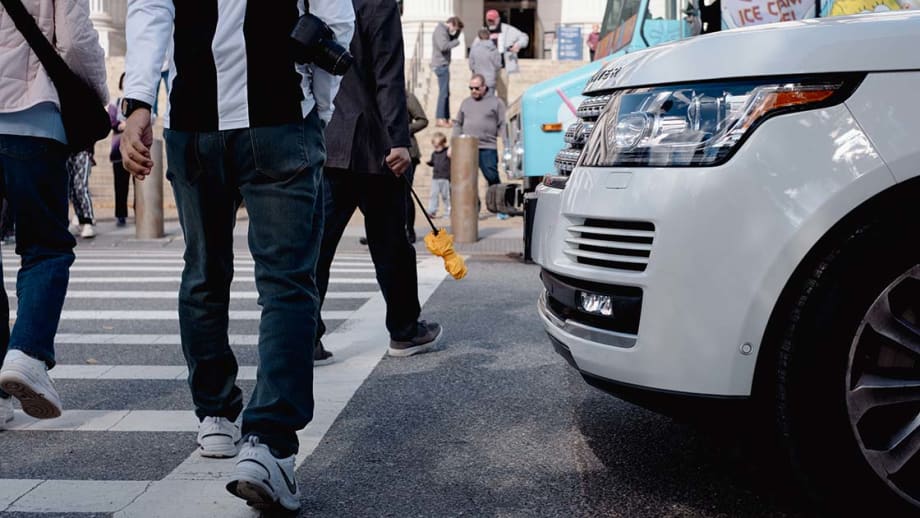
While speeding and poorly designed infrastructure have helped fuel the increase, many safety advocates have also drawn a connection to the growing portion of the U.S. vehicle fleet made up of pickups and SUVs.
Photo: IIHS
5 min to read
New research from the Insurance Institute for Highway Safety shows vehicles with especially tall front ends are most dangerous to pedestrians, but a blunt profile makes medium-height vehicles deadly, too.
Whatever their nose shape, pickups, SUVs, and vans with a hood height greater than 40 inches are about 45% more likely to cause fatalities in pedestrian crashes than cars and other vehicles with a hood height of 30 inches or less and a sloping profile, an IIHS study of nearly 18,000 pedestrian crashes found.
However, among vehicles with hood heights between 30 and 40 inches, a blunt, or more vertical, front end increases the risk to pedestrians.
“Some of today’s vehicles are pretty intimidating when you’re passing in front of them in a crosswalk,” IIHS President David Harkey said. “These results tell us our instincts are correct: More aggressive-looking vehicles can indeed do more harm.”
Revealing Stats from IIHS
Pedestrian crash deaths have risen 80% since hitting their low in 2009. Nearly 7,400 walkers — more than 20 people a day — lost their lives in 2021 after being struck by a vehicle.
While speeding and poorly designed infrastructure have helped fuel the increase, many safety advocates have also drawn a connection to the growing portion of the U.S. vehicle fleet made up of pickups and SUVs.
Over the past 30 years, the average U.S. passenger vehicle has gotten about four inches wider, 10 inches longer, eight inches taller, and 1,000 pounds heavier. Many vehicles are more than 40 inches tall at the leading edge of the hood. On some large pickups, the hoods are almost at eye level for many adults.
To examine the connection between fatality risk and vehicle size and shape, IIHS researchers analyzed 17,897 crashes involving a single passenger vehicle and a single pedestrian.
Using Vehicle Identification Numbers to identify the crash-involved vehicles, they calculated key front-end measurements corresponding to 2,958 unique car, minivan, large van, SUV, and pickup models from photographs.
They excluded vehicles with pedestrian automatic emergency braking systems and controlled for other factors that could affect the likelihood of a fatality, such as the speed limit and age and sex of the struck pedestrian.
Vehicles with hoods more than 40 inches off the ground at the leading edge and a grille sloped at an angle of 65 degrees or less were 45% more likely to cause pedestrian fatalities than those with a similar slope and hood heights of 30 inches or less.
Vehicles with hood heights of more than 40 inches and blunt front ends angled at greater than 65 degrees were 44% more likely to cause fatalities.
“Manufacturers can make vehicles less dangerous to pedestrians by lowering the front end of the hood and angling the grille and hood to create a sloped profile,” said IIHS Senior Research Transportation Engineer Wen Hu. “There’s no functional benefit to these massive, blocky fronts.”
While sloping front ends did not reduce the risk posed by vehicles with the tallest hoods, they did make a difference for vehicles with hood heights of 30-40 inches.
Compared with low and sloped vehicles, medium-height vehicles with blunt fronts were 26% more likely to cause pedestrian fatalities.
In contrast, the risk of a fatality was about the same for medium-height vehicles with sloped fronts as for low vehicles with either blunt or sloped fronts.
The researchers looked at several other vehicle characteristics, including the angle of the windshield, length of the hood, and angle of the hood. Among these, the slope of the hood had the biggest effect.
There was a 25% increase in the risk of a fatality for vehicles with flat hoods — those with angles of 15 degrees or less — compared with vehicles with more sloping hoods. That was true regardless of height and front-end shape.
IIHS Examined Crash Records
To better understand how vehicles of different geometries injure pedestrians, IIHS examined detailed records from 121 crashes collected by the International Center for Automotive Medicine Pedestrian Consortium.
In each crash, the front end of a car, pickup, or SUV struck a teenager or adult.
The data included detailed crash reconstructions, including information about the motion of the pedestrian’s body during the crash and the nature and severity of their injuries.
The reports also included the year, make, and model of the striking vehicle and the height of the pedestrian.
The researchers used the same measurements as those used in the larger study to define vehicles with blunt and sloped front ends and tall and short ones.
For this study, however, they divided the involved vehicles into only two height groups because of the smaller sample size. Taller vehicles were defined as those with a hood leading edge more than 35 inches off the ground. Shorter ones were those with a hood leading edge 35 inches or less from the ground.
In general, vehicles taller than 35 inches were more dangerous to pedestrians than the shorter ones, mainly because they tended to cause more severe head injuries.
Among vehicles taller than 35 inches, those with vertical front ends were more dangerous than those with sloped front ends. Torso and hip injuries from these vehicles were more frequent and severe.
Unlike all other vehicle types, tall and blunt vehicles primarily inflicted torso injuries with their front ends rather than with the tops of their hoods. They were more likely to injure pedestrians by throwing them forward, while tall and sloped vehicles usually rolled them onto the hood of the vehicle first.
Pedestrians who were shorter relative to the height of the striking vehicle also suffered more severe injuries.
“It’s clear that the increasing size of the vehicles in the U.S. fleet is costing pedestrians their lives,” Harkey said. “We encourage automakers to consider these findings and take a hard look at the height and shape of their SUVs and pickups.”
More Safety
IIHS Crash Avoidance Tests Reveal Safety Gaps in Cargo Vans and Work Trucks
New crash-avoidance ratings from the Insurance Institute for Highway Safety reveal inconsistent performance among commercial vehicles, with several popular cargo vans and heavy-duty pickups struggling to avoid collisions with other vehicles and pedestrians.
Read More →
What’s Next for Fleet? Safety, AI & Industry Recognition | AF News Recap
Could your company's culture be encouraging distracted driving? This week, we're exploring how workplace expectations affect driver safety, what AI, EVs, and autonomous vehicles could mean for the future of fleet management, and how fleet professionals can strengthen their award nominations.
Read More →
Does Your Fleet's Culture Encourage Distracted Driving?
What happens when the people responsible for enforcing safety rules are the ones setting the wrong example? The answer may reveal why some of the biggest risks to fleet drivers have little to do with what's written in the employee handbook.
Read More →
Sponsored•October 1, 2026
Fleet Manager’s Ultimate Playbook: Navigating the New Standard in OEM Connectivity
Rising operating costs, driver safety concerns, and unplanned downtime are putting unprecedented pressure on modern fleets. Discover how fleet managers use embedded OEM connectivity and real-time vehicle data to cut TCO, prevent downtime, and protect drivers without aftermarket telematics hardware.
Read More →
From Driver Well-Being to EV Charging | AF News Recap
Mental health belongs in the fleet safety conversation. This week, we’re looking at five ways fleets can support employee well-being before a crisis, plus Holman’s expansion in Mexico, new one-day Fleet Forward passes, and why EV charging demand is outpacing infrastructure growth.
Read More →
Nexar-Nauto Merger Aims to Give Fleets Better Safety Intelligence Through Larger Driving Dataset
Stefan Heck tells Automotive Fleet that combining more than 10 billion miles of driving history with Nexar's AI models will give fleets deeper insights into driver risk and roadway conditions than either company could provide independently.
Read More →
Don't Wait for a Crisis: 5 Ways to Build Mental Health Into Your Fleet Safety Program
For Suicide Prevention Month, fleet and safety leaders have an opportunity to put mental health where it belongs: at the center of workplace safety.
Read More →
How Camera Data Can Strengthen a Fleet’s Insurance Renewal
Insights from a commercial insurance carrier and a broker show how fleets can turn video telematic data, driver coaching, and improved claims results into a stronger case at insurance renewal.
Read More →
The Safest Fleets Aren’t the Ones with the Most Technology
You’ve made the telematics investment. Here’s how to capture the other half of its value and build the safest fleet on the road.
Read More →
Sponsored•August 7, 2026
Hidden in Plain Sight: Fleet Compliance Risks
Fleet compliance isn't just about having policies — it's about consistently enforcing them. This practical guide reveals six hidden compliance risks common in public sector and shared fleet operations and outlines proven strategies to improve visibility, accountability, and audit readiness
Read More →