




Insurance Institute Decries Higher Speed Limits
The president of the Insurance Institute for Highway Safety lamented a trend of states raising highway speed limits and cited institute data showing higher road fatality and injury rates as a result during a recent speech.
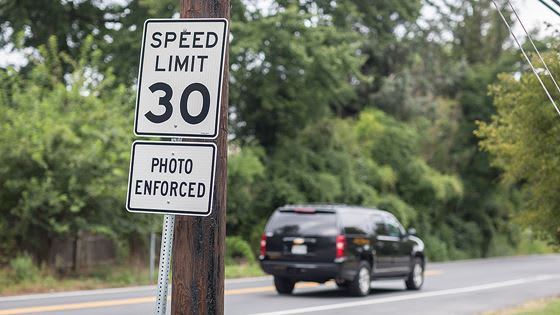
Photo courtesy of IIHS.
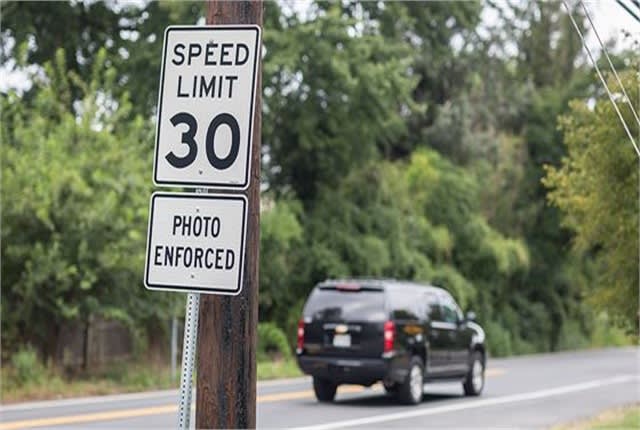
Photo courtesy of IIHS.
The president of the Insurance Institute for Highway Safety lamented a trend of states raising highway speed limits and cited institute data showing higher road fatality and injury rates as a result during a recent speech.
Adrian Lund, the institute's president, said this trend costs lives, during a presentation to the Governors Highway Safety Association. Lund's speech also placed a spotlight on driver assistance technology and the life-saving impact of state laws requiring safety belt use, alcohol ignition interlocks for DUI offenders, and helmets for motorcyclists.
"Research shows that when speed limits are raised, speeds go up and so do fatal crashes," Lund said. "Crashes are more likely because it takes longer for a vehicle to stop or slow down. Collisions at high speeds are more deadly because crash energy increases exponentially as speeds go up."
Lund, president of both the Insurance Institute for Highway Safety and the Highway Loss Data Institute, made his presentation at GHSA’s annual meeting on Sept. 1. This year’s conference, held Aug. 29-Sept. 2 in Nashville, was titled, “Drunk, Drugged & Distracted – Reaching High-Risk Drivers.” The GHSA is a nonprofit group representing state and territorial highway safety offices. Some of its members, in other words, are the people tasked with implementing those higher speed limits.
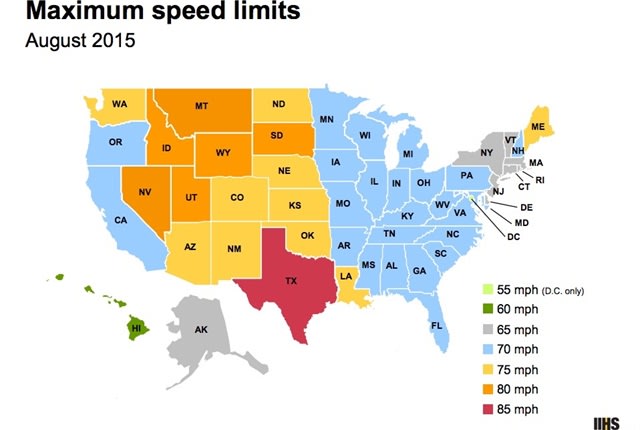
Graphic courtesy of IIHS.
Lund also urged widespread deployment of speed-camera programs to improve enforcement of existing speed limits. Only 138 jurisdictions in the U.S. now have automated speed enforcement. But a newly released IIHS study reached a surprising conclusion: If all U.S. communities had speed-camera programs like the one that IIHS studied in Maryland’s Montgomery County, more than 21,000 fatal or incapacitating injuries would have been prevented in 2013.
Of the nearly 10,000 crash fatalities in 2013, 29 percent involved exceeding the speed limit. “Speeding makes crashes more likely and more likely to be deadly,” Lund said.
But the study demonstrates how effective a speed-camera program can be in changing driver behavior when the driving public is made aware of its presence, Lund said. (To view a video about the study's findings, click on the photo or link below the headline.)
Speed cameras were introduced in Montgomery County in 2007. By 2014, the county had 56 fixed cameras, 30 portable cameras, and six mobile speed vans. The cameras were positioned on residential streets with speed limits of 35 mph or less and in school zones.
Success came quickly. Just six months after the program’s launch, the proportion of drivers traveling at least 10 miles over the speed limit had fallen on streets with the cameras.
Seven years later, the program is still working. Cameras have reduced by 59 percent the likelihood of a driver exceeding the speed limit by more than 10 mph, compared with similar roads in two nearby Virginia counties that don't have speed cameras, the new study found.
The researchers also examined crashes on camera-eligible roads in Montgomery County, relative to comparison roads in Virginia. They found that the camera program resulted in a 19-percent reduction in the likelihood that a crash would involve a fatality or an incapacitating injury, as reported by a police officer on the scene.
The study connects the dots to show that speed cameras save lives, Lund said.
Although cameras alone are effective, Montgomery County also found a way to deploy them so that they have an even bigger impact. In 2012, the county introduced speed-camera corridors. Enforcement is focused on long segments of roads instead of specific locations. County workers regularly move the cameras to different spots on those roads, so drivers don’t become familiar with their exact locations.
The corridor approach led to further safety gains, reducing the likelihood of a crash involving fatal or incapacitating injury an additional 30 percent beyond the use of cameras alone, the researchers found.
Overall, the county’s camera program in its current form – including the use of corridors and a minor enforcement change that took effect in 2009 – reduces fatal or incapacitating injuries by 39 percent on residential roads with speed limits of 25-35 mph, the researchers said. The estimate of 21,000 fatal or incapacitating injuries that cameras could prevent nationwide is based on that reduction.
Lund acknowledged that speed-camera programs in general are controversial, sometimes triggering accusations of Big Brother-like surveillance. This resistance can pose political hurdles for safety advocates who support automated speed-limit enforcement.
A total of 62 percent of drivers surveyed in Montgomery County said they favored speed cameras on residential streets, according to IIHS research. Supporters even include some drivers who have been issued speeding tickets as a result of the program.
Also controversial is whether raising speed limits is ever a good idea. In June, for example, the speed limit was raised from 65 to 70 mph on about 810 miles of interstates and highways in Wisconsin. Similarly, in July the speed limit also increased to 70 mph on some highways in north Texas.
In contrast to IIHS research, proponents of such changes argue that they aren’t compromising traffic safety.
In fact, during a July interview with NBCDFW 5 News, Texas Department of Transportation-Fort Worth District spokesperson Val Lopez said the Texas speed-limit increase improves safety because it's more in line with the actual pace of traffic.
“If you have big variability in speeds between the slowest and the fastest driver, you actually have a less safe environment,” Lopez said. “So the more consistent the speed of the travelers is, the better off you are.”
More Safety

Nexar-Nauto Merger Aims to Give Fleets Better Safety Intelligence Through Larger Driving Dataset
Stefan Heck tells Automotive Fleet that combining more than 10 billion miles of driving history with Nexar's AI models will give fleets deeper insights into driver risk and roadway conditions than either company could provide independently.
Read More →
Don't Wait for a Crisis: 5 Ways to Build Mental Health Into Your Fleet Safety Program
For Suicide Prevention Month, fleet and safety leaders have an opportunity to put mental health where it belongs: at the center of workplace safety.
Read More →
How Camera Data Can Strengthen a Fleet’s Insurance Renewal
Insights from a commercial insurance carrier and a broker show how fleets can turn video telematic data, driver coaching, and improved claims results into a stronger case at insurance renewal.
Read More →
The Safest Fleets Aren’t the Ones with the Most Technology
You’ve made the telematics investment. Here’s how to capture the other half of its value and build the safest fleet on the road.
Read More →
Hidden in Plain Sight: Fleet Compliance Risks
Fleet compliance isn't just about having policies — it's about consistently enforcing them. This practical guide reveals six hidden compliance risks common in public sector and shared fleet operations and outlines proven strategies to improve visibility, accountability, and audit readiness
Read More →
NETS Sets 2026 Fleet Safety Benchmark Conference for Indianapolis
The Sept. 15–17 program will feature fleet benchmarking data, case studies, emerging technologies, and implementation strategies while running alongside the NSC Safety Congress & Expo.
Read More →
Off-the-Job Crashes Account for 43% of Employers’ $61.7 Billion Crash Burden
NETS quantifies costs dispersed across fleet, risk, HR, and other departments while providing new per-crash benchmarks for employers.
Read More →
Ram Recalls More Than 1.27 Million 1500 Pickups for Seat Belt Anchor Issue
The recall affects certain 2019-2026 Ram 1500 pickups that may have improperly attached second-row seat belt buckle anchors.
Read More →
How Better Visibility Cut Speeding Violations by 48%
Fleet leaders don't need more data, they need clearer visibility into what the data is saying. This case study explores how one utility replaced speeding-event counts with a single metric — miles driven in violation — to strengthen safety and significantly reduce speeding violations.
Read More →
Operation Safe Driver Week: Why the Industry's Oldest Safety Campaign Still Matters to Fleets
A look at how a 2007 enforcement initiative became one of the most consequential weeks on the fleet safety calendar, and what it means for your drivers in 2026.
Read More →