




Related: NHTSA Revamping Crash Tests
IIHS Considers Passenger-Side Crash Testing
The Insurance Institute for Highway Safety (IIHS) may institute passenger-side frontal crash testing as part of its Top Safety Pick criteria after results from tests on smaller SUVs showed that passengers were at greater risk.
by Staff
June 23, 2016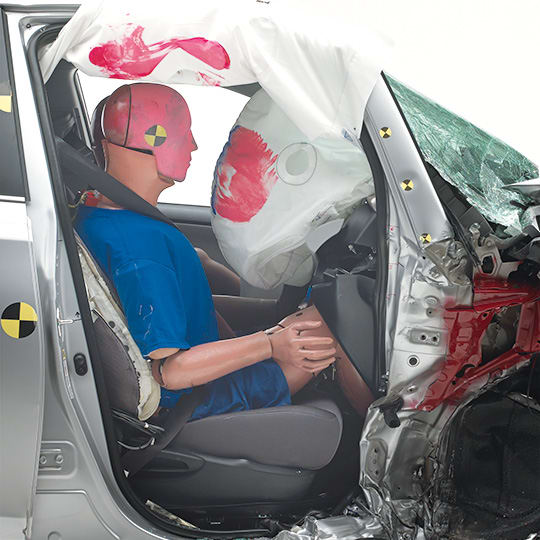
Photo courtesy of IIHS.
1 min to read
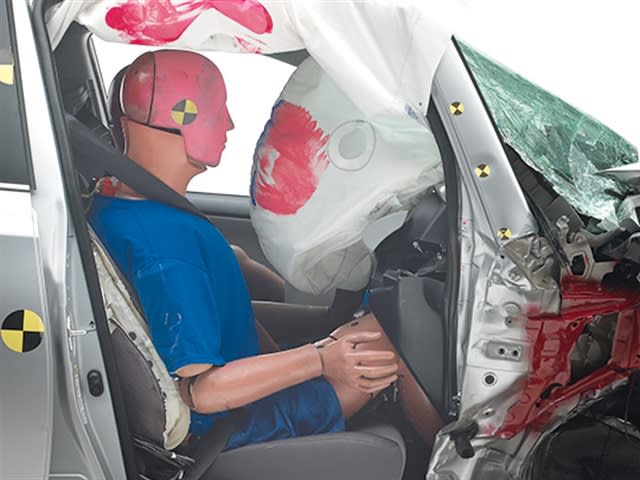
Photo courtesy of IIHS.
The Insurance Institute for Highway Safety (IIHS) may institute passenger-side frontal crash testing as part of its Top Safety Pick criteria after results from tests on smaller SUVs showed that passengers were at greater risk.
The institute performed 40-mph passenger-side small overlap tests on seven smaller SUVs with good driver-side small overlap ratings. Only one of the vehicles, the 2016 Hyundai Tucson, performed at a level that would merit a good rating, while the others were poor to acceptable.
Other vehicles tested included the 2015 Buick Encore, 2015 Honda CR-V, 2015 Mazda CX-5, 2014 Nissan Rogue, 2015 Subaru Forester, and 2015 Toyota RAV-4.
Small overlap crashes pose a challenge because they bypass a typical vehicle's main front structure. Since the test was introduced, 13 manufacturers have made structural changes to 97 vehicles. Of these, nearly three-quarters earned a good rating after the changes.
During the small overlap frontal test, a vehicle travels at 40 mph toward a 5-foot-tall rigid barrier. Twenty-five percent of the total width of the vehicle strikes the barrier on the driver side.
More Safety
Ram Recalls More Than 1.27 Million 1500 Pickups for Seat Belt Anchor Issue
The recall affects certain 2019-2026 Ram 1500 pickups that may have improperly attached second-row seat belt buckle anchors.
Read More →
Sponsored•August 1, 2026
Top 50 Executive Fleets
It is that time of year again! Time for the 2026 list of the Top 50 Executive Fleets, presented by Automotive Fleet and Volvo as part of its annual Fleet 500. Download now to see this year's list of companies!
Read More →
Sponsored•July 17, 2026
How Better Visibility Cut Speeding Violations by 48%
Fleet leaders don't need more data, they need clearer visibility into what the data is saying. This case study explores how one utility replaced speeding-event counts with a single metric — miles driven in violation — to strengthen safety and significantly reduce speeding violations.
Read More →
Operation Safe Driver Week: Why the Industry's Oldest Safety Campaign Still Matters to Fleets
A look at how a 2007 enforcement initiative became one of the most consequential weeks on the fleet safety calendar, and what it means for your drivers in 2026.
Read More →
Nexar-Nauto Merger Aims to Give Fleets Better Safety Intelligence Through Larger Driving Dataset
Stefan Heck tells Automotive Fleet that combining more than 10 billion miles of driving history with Nexar's AI models will give fleets deeper insights into driver risk and roadway conditions than either company could provide independently.
Read More →
Sponsored•July 2, 2026
From Silos to Solutions: Relationship Management for Safer Fleets
From telematics adoption and driver accountability to policy consistency and risk mitigation, this episode breaks down what it really takes to build a safer fleet culture without slowing business down.
Read More →
IIHS Launches First Commercial Vehicle Safety Evaluations
The Insurance Institute for Highway Safety has begun evaluating heavy-duty pickups and cargo vans for driver protection. Which models earned top marks?
Read More →
Reducing Risk by Eliminating Phone Use Behind the Wheel
Hosted with the cofounder of Lifesaver Mobile, this episode addresses phone use behind the wheel and how to design a driving environment that actually helps prevents accidents.
Read More →
Cameras, Safety and Insurance: From Reactive Claims to Real-Time Prevention (Part 2 of 2)
Part Two: Commercial auto remains one of the most challenging and costly lines of coverage for fleet operators and insurers alike. Continue learning more about how to effectively address these issues from Onur Aksan, Enterprise Business Development Executive, Geotab
Read More →
How 5-Second Telematics Data Is Changing Fleet Safety
This episode connects with Steve Santostasi of Ford Pro and covers how a few seconds of data can make a difference in fleet safety.
Read More →