





Miss This? Watch: Inside Ford Pro’s AI Tool for Faster Fleet Data Analysis
Pedestrian Deaths Drop in First Half of 2025, Marking Largest Decline in Years
An 11% drop in pedestrian fatalities in early 2025 signals progress in U.S. road safety, but elevated death rates and ongoing risks underscore the need for continued action from fleets and policymakers.
March 26, 2026
The Governors Highway Safety Association (GHSA) has released preliminary data on 2025 pedestrian fatalities.
Credit: Automotive Fleet
2 min to read
U.S. pedestrian fatalities declined by 11% in the first half of 2025, according to new research from the Governors Highway Safety Association (GHSA).
Though this is a significant improvement, pedestrian deaths remain significantly higher than pre-pandemic levels.
Room for Improvement
An estimated 3,024 pedestrians were killed in traffic crashes between January and June, down from the same period in 2024. The reduction represents the largest midyear decline since GHSA began tracking pedestrian fatality data 15 years ago.
In a recent Facebook post, the GHSA noted that “positive momentum is welcome news, but drivers are still striking and killing 16 people walking every day. The only acceptable number of deaths on American roads is zero.”
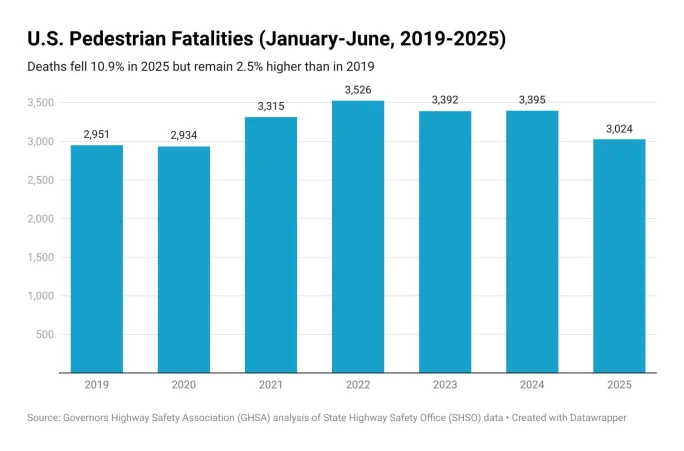
U.S. pedestrian fatalities by year.
Credit: Governors Highway Safety Association
The GHSA credits increased traffic enforcement, expanded use of vehicle safety technologies, and growing public awareness around dangerous driving behaviors for the improvement.
For fleet operators, the report underscores the importance of continued investment in safety strategies. Advanced driver assistance systems (ADAS), including pedestrian detection and automatic emergency braking, are playing an increasingly important role in mitigating crashes.
Telematics and driver monitoring systems are also helping build safer fleets by identifying risky behaviors and implementing corrective training.
Safety is Still First
Many cities and states have prioritized measures such as improved crosswalk visibility, better lighting, and traffic-calming initiatives to reduce vehicle speeds in high-risk areas.
Despite these gains, GHSA emphasizes that sustained effort is needed to maintain momentum. Pedestrians still account for a growing share of total traffic fatalities, and disparities persist across regions, with some states continuing to see increases.
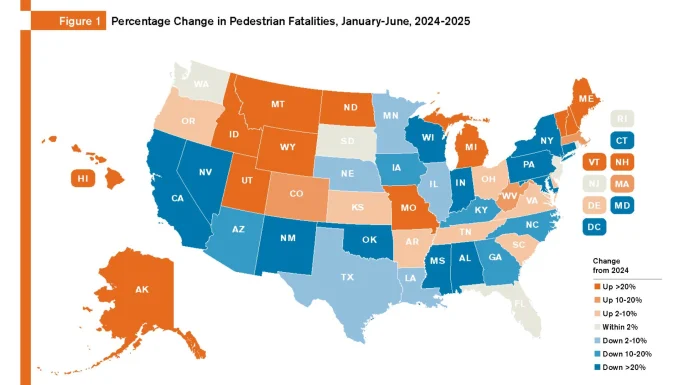
A map of pedestrian death incidents in the country.
Credit: Governors Highway Safety Association
For fleet professionals, safety remains a critical operational priority.
Proactive driver training, adoption of new technologies, and collaboration with local and national safety initiatives will be key to further reducing pedestrian-related incidents.
More Safety
Tips for Driving Safely on Halloween Night
This video features a reminder from the Connecticut Department of Transportation (DOT) and the Connecticut Police Chiefs Association, urging drivers to prioritize safety this Halloween.
Read More →
IIHS Crash Avoidance Tests Reveal Safety Gaps in Cargo Vans and Work Trucks
New crash-avoidance ratings from the Insurance Institute for Highway Safety reveal inconsistent performance among commercial vehicles, with several popular cargo vans and heavy-duty pickups struggling to avoid collisions with other vehicles and pedestrians.
Read More →
What’s Next for Fleet? Safety, AI & Industry Recognition | AF News Recap
Could your company's culture be encouraging distracted driving? This week, we're exploring how workplace expectations affect driver safety, what AI, EVs, and autonomous vehicles could mean for the future of fleet management, and how fleet professionals can strengthen their award nominations.
Read More →
Does Your Fleet's Culture Encourage Distracted Driving?
What happens when the people responsible for enforcing safety rules are the ones setting the wrong example? The answer may reveal why some of the biggest risks to fleet drivers have little to do with what's written in the employee handbook.
Read More →
Sponsored•October 1, 2026
Fleet Manager’s Ultimate Playbook: Navigating the New Standard in OEM Connectivity
Rising operating costs, driver safety concerns, and unplanned downtime are putting unprecedented pressure on modern fleets. Discover how fleet managers use embedded OEM connectivity and real-time vehicle data to cut TCO, prevent downtime, and protect drivers without aftermarket telematics hardware.
Read More →
From Driver Well-Being to EV Charging | AF News Recap
Mental health belongs in the fleet safety conversation. This week, we’re looking at five ways fleets can support employee well-being before a crisis, plus Holman’s expansion in Mexico, new one-day Fleet Forward passes, and why EV charging demand is outpacing infrastructure growth.
Read More →
Nexar-Nauto Merger Aims to Give Fleets Better Safety Intelligence Through Larger Driving Dataset
Stefan Heck tells Automotive Fleet that combining more than 10 billion miles of driving history with Nexar's AI models will give fleets deeper insights into driver risk and roadway conditions than either company could provide independently.
Read More →
Don't Wait for a Crisis: 5 Ways to Build Mental Health Into Your Fleet Safety Program
For Suicide Prevention Month, fleet and safety leaders have an opportunity to put mental health where it belongs: at the center of workplace safety.
Read More →
How Camera Data Can Strengthen a Fleet’s Insurance Renewal
Insights from a commercial insurance carrier and a broker show how fleets can turn video telematic data, driver coaching, and improved claims results into a stronger case at insurance renewal.
Read More →
The Safest Fleets Aren’t the Ones with the Most Technology
You’ve made the telematics investment. Here’s how to capture the other half of its value and build the safest fleet on the road.
Read More →