




Highway Bill Patch Could Derail Over Train Safety Measure
The latest proposed extension of federal highway funding includes a provision to delay a mandate for automatic-braking equipment on trains that could turn passing the measure into a game of political football.

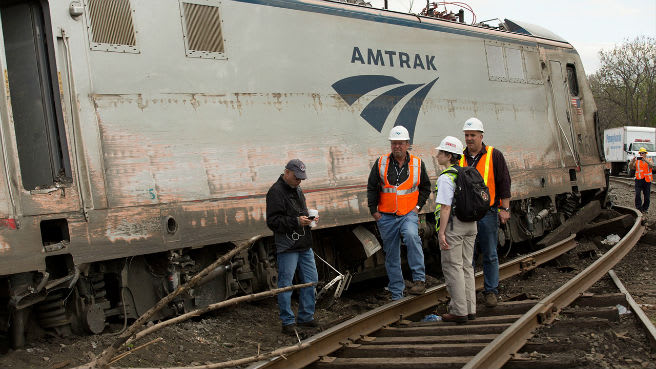
NTSB investigators at scene of Amtrak derailment in Philadelphia on May 12 that killed eight passengers and injured another 200. Photo: NTSB
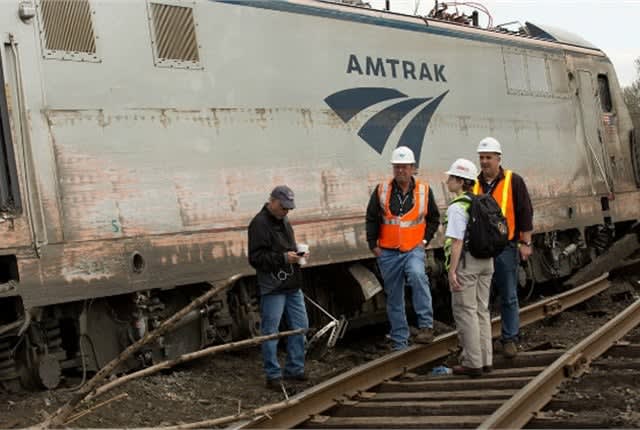
NTSB investigators at scene of Amtrak derailment in Philadelphia on May 12 that killed eight passengers and injured another 200. Photo: NTSB
The latest extension of federal highway funding will last all of 22 days. Just introduced in the House, the Surface Transportation Extension Act of 2015 (H.R. 3819) would fund and extend the authorization for federal highway and transit programs through November 20.
The good news is this latest funding patch can be voted on by Congress with no need for additional funds to be approved, as the Highway Trust Fund will remain solvent through the period it seeks to cover.
The bad news is this patch includes a provision to delay a mandate calling for automatic-braking equipment on trains that could turn passing the measure into a game of political football.
H.R. 3819 was introduced by Transportation and Infrastructure Committee Chairman Rep. Bill Shuster (R-PA), T&I Ranking Member Peter DeFazio (D-OR) and Ways and Means Committee Chairman Paul Ryan (R-WI).
“This extension will allow the highway bill process to continue moving forward without shutting down transportation programs and projects across the country,” Shuster said in an Oct. 26 statement.
“Last week, the Transportation Committee unanimously approved the bipartisan, multi-year Surface Transportation Reauthorization and Reform Act of 2015,” Shuster noted. “We look forward to voting on that bill in the House soon and then going to conference with the Senate on their highway bill. I am confident that we can resolve the differences between the House and Senate measures and producing a final product that’s good for our nation’s infrastructure.”
But there's more. “This legislation also includes a necessary, bipartisan extension of the deadline for implementation of Positive Train Control technology,” Shuster stated. “We need to extend the Positive Train Control deadline as soon as possible to prevent significant disruptions of both passenger and freight rail service across the country.”
Intense lobbying by the railroad industry is credited with getting the T&I Committee to approve extending the deadline to install PTC automatic braking on roughly 70,000 miles of track from the end of this year until 2018.
That effort succeeded despite the push by safety advocates for PTC to be implemented on time that picked up speed back on May 12, when the crash of an Amtrak train that derailed in Philadelphia killed eight passengers and injured another 200.
Shuster contended in his statement that “freight railroads have indicated they will suspend shipments of certain chemicals, such as chlorine used to purify drinking water and anhydrous ammonia used in fertilizer, well before the end of the year” if the PTC deadline is not extended.
He added that “some freight railroads may suspend all shipments of commodities. Passenger rail service will also be impacted: commuter railroads will have to suspend operations, and Amtrak service outside of the corridor between Washington and New York will stop.”
The problem is not everyone in Congress has bought the railroads’ argument. As reported by Politico transportation reporter Heather Caygle, “congressional infighting over PTC has threatened to derail the plan” especially because a key player, Sen. Barbara Boxer (D-CA), is committed to blocking any highway bill that kicks the PTC can as far down the tracks as this latest patch would.
Boxer is the Ranking Member of the Senate Environment & Public Works Committee, which must approve any highway bill passed by the House before sending it to the full Senate for consideration.
PTC uses electronic technology to prevent train-to-train collisions, over-speed derailments, incursions into work zones and the movement of a train through a main line switch that is improperly set. The Rail Safety Improvement Act of 2008 (RSIA) mandates that PTC be implemented across a significant portion of the nation's tracks by December 31, 2015.
Per the Federal Railroad Administration, PTC will be required on “essentially Class I railroad main lines (i.e., over which 5 million or more gross tons are transported annually) that handle any poisonous-inhalation-hazardous (PIH) materials; and, any railroad main lines over which regularly scheduled intercity passenger or commuter rail services are provided.”
More Operations
Here's When You Should Make an Exception to Fleet Policy
Fleet policies are designed to create consistency, but not every driver or situation fits neatly within standard rules.
Read More →
AI-Native or AI-Acquired: What Should Fleet Managers Look for in an AI Platform?
Six questions can help fleet managers look beyond AI marketing claims to evaluate integration, data access, and real-world operational performance.
Read More →
A buyer's guide to fleet management software in 2027
Buying fleet management software in 2027 means looking beyond features and price. As fleet operations, technology and expectations evolve, this guide explores what today’s fleet professionals should consider when choosing a system that can deliver value now and adapt to what comes next.
Read More →

What Will Shape the Next Era of Fleet Management?
EVs, AI, and autonomous vehicles are reshaping fleet management. Discover what’s ahead—and how fleet leaders can prepare for the next era.
Read More →
How Fleets Can Recruit and Train Veterans for Technician Roles
Here's how the technician shortage has affected uptime for fleets, and what to do about it.
Read More →
Avis Budget Group Deploys Neology Toll Management Technology Across Major Brands
Neology’s neoFleet platform will manage toll transactions and toll-authority operations for vehicles across Avis, Budget, Payless, Budget Truck and Zipcar.
Read More →
Fleet Personal-Use Charges Edge Higher in 2026
Nearly eight in 10 surveyed fleets allow personal use of company vehicles, while just over half of respondents report charging employees for the privilege.
Read More →
The Future of Fleet + What’s Changing Right Now | AF News Recap
Could developments overseas offer a preview of what’s coming for U.S. fleets? This week, we’re looking at the future of AI, autonomy, and electrification, plus Ford Pro’s new certified pre-owned program, smarter vehicle offboarding, and a new way for fleets to manage toll expenses.
Read More →
How to Handle Vehicle Offboarding
What do fleet managers need to do when a driver leaves?
Read More →
Fleet Manager’s Ultimate Playbook: Navigating the New Standard in OEM Connectivity
Rising operating costs, driver safety concerns, and unplanned downtime are putting unprecedented pressure on modern fleets. Discover how fleet managers use embedded OEM connectivity and real-time vehicle data to cut TCO, prevent downtime, and protect drivers without aftermarket telematics hardware.
Read More →